









.png)




.svg)
.svg)
.svg)







.png)
.png)






.jpg)

%20F%20(1).jpeg)







.webp)






 Login
Login
This page is the entry point to a structured body of guidance on operating a modern investor relations function under the European disclosure regime. It is written for IROs, CFOs, company secretaries and IR managers at European listed issuers; both newly listed mid-caps building the discipline for the first time and established constituents refining what is already in place.
The guide is organised around the three operational pillars that define the contemporary IR function: the Investor Relations portal and software stack that supports the team's day-to-day execution, the communication discipline that shapes the equity narrative across every external touchpoint, and the events programme that converts mandatory disclosure into measurable investor engagement.
The perspective informing this guide is grounded in the operational visibility Euronext Corporate Solutions accumulates through its day-to-day engagement with more than 4,000 listed and pre-IPO companies across European markets. The patterns described - what works consistently, what fails predictably, what differentiates the top quartile from the median - derive from that direct operational evidence rather than from generic best-practice frameworks. Where the guide adopts a position, it does so deliberately: the IR function is too consequential to the equity story to be treated as a downstream reporting workflow, and the technology infrastructure that supports it is too strategically material to be treated as a routine procurement decision.
For readers operating under time constraints, the most efficient path is to read this overview end-to-end, or proceed directly to the sub-page most relevant to current priorities:
- IR Portal & Software for teams reassessing their technology stack
- IR Communication Best Practices for teams refining the equity story
- Organising IR Events that Drive Engagement for teams preparing a capital markets day or hybrid AGM
What investor relations actually is
Investor relations is the corporate function responsible for managing the dialogue between a listed company and its current and prospective investors. Its remit covers shareholder identification, regulatory disclosure, financial communication, investor targeting and engagement around earnings cycles, capital markets days, and AGMs. Done well, it builds the conditions for a fair valuation, a stable shareholder base and a credible voice in the equity story.
For listed issuers in Europe, the IR function sits at the intersection of three pressures that have intensified over the past decade: tighter regulation under the Market Abuse Regulation (MAR) and the Shareholder Rights Directive II (SRD II), the rise of passive and ESG-mandated capital, and the structural shift to digital-first investor engagement. The IRO no longer simply distributes the press release and books the roadshow. They orchestrate a year-round programme that has to satisfy regulators, analysts, long-only institutions, hedge funds and an increasingly material retail base. Often doing so across multiple jurisdictions and reporting languages.
This guide, structured around the three pillars of IR delivery, sets out what a modern IR function needs to operate effectively.
The three pillars of a modern IR function
The portal, the communication discipline and the events programme are not parallel workstreams. They are three sides of the same operating system, and the leverage in a modern IR function comes from the way they reinforce each other.
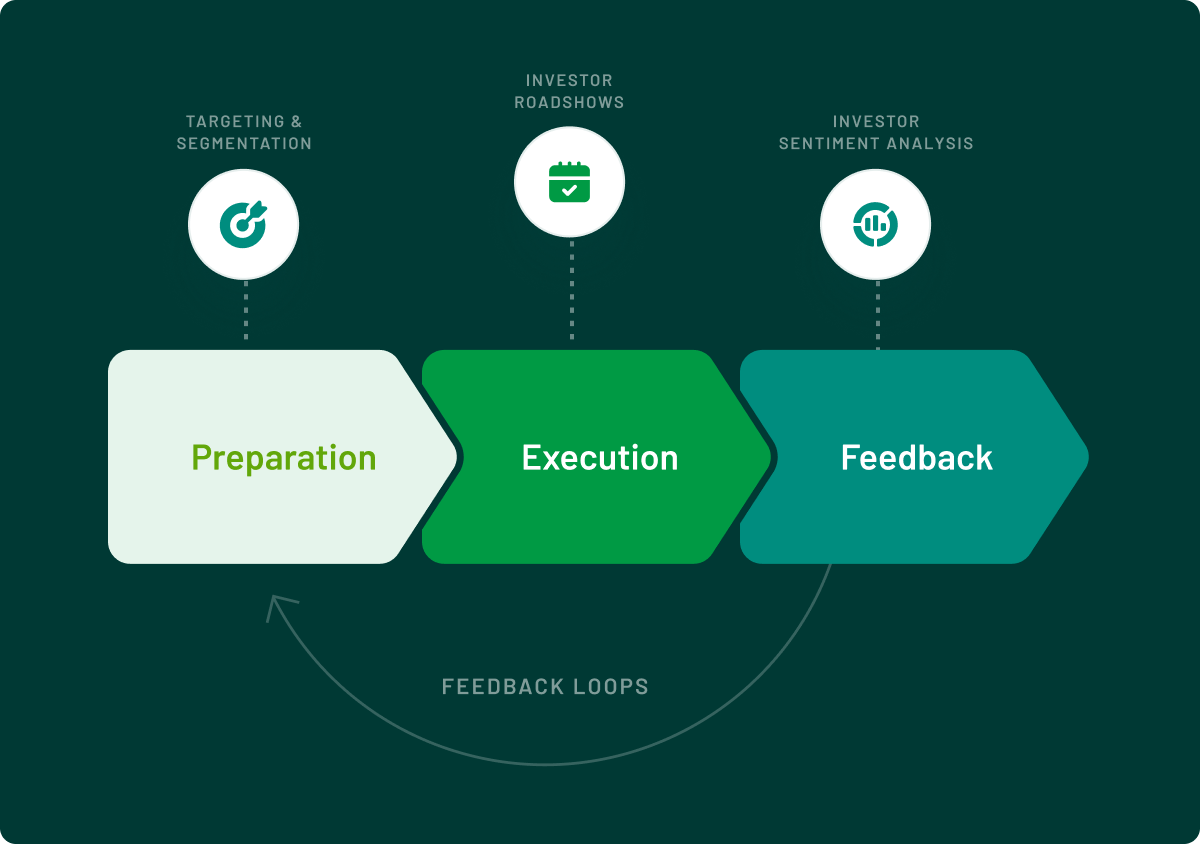
An IR portal or software supplies the data and the audit trail. Shareholder analysis tells the team which holders matter; the CRM holds the history of every interaction with each of them; the real-time market data layer gives the executive a defensible read on how disclosure is being received. The communication discipline turns that data into messages and viceversa, and the events programme delivers those messages in the formats investors actually consume: the AGM, the capital markets day, the results call, the conference call webinar. When virtual, and with the right webcasting platform, engagement data captured during the event flows back into the portal, refines the targeting workflow, and informs the next round of communication. The loop closes; each cycle produces a sharper picture than the one before.
This compounding is what separates the IR functions that influence the multiple from the ones that simply meet the disclosure calendar:
- Skip the portal and the communication runs on intuition
- Skip the communication discipline and the events become broadcast exercises with no narrative spine
- Skip the events and the equity story stays on paper
The three sub-sections that follow describe each pillar in turn, with links to the deeper sub-pillar pages for practitioner-level detail.
1. IR portal and software
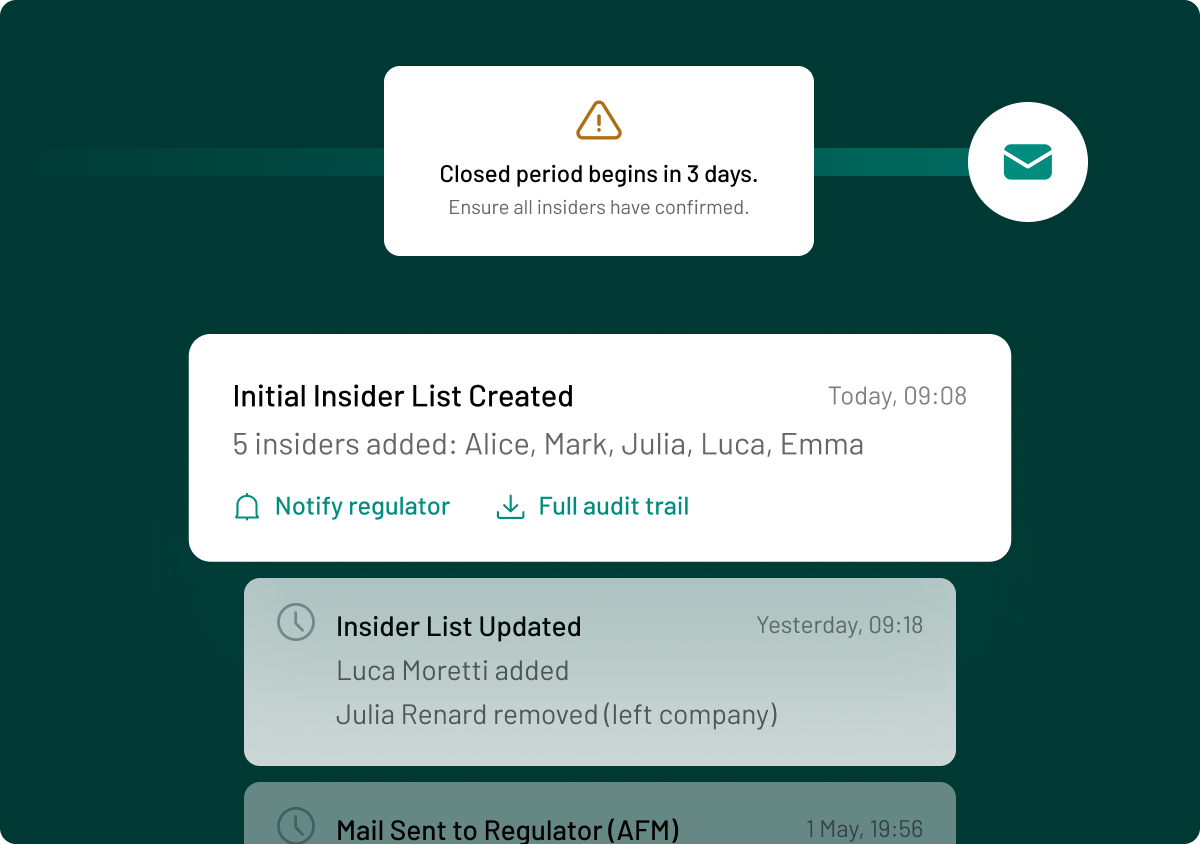
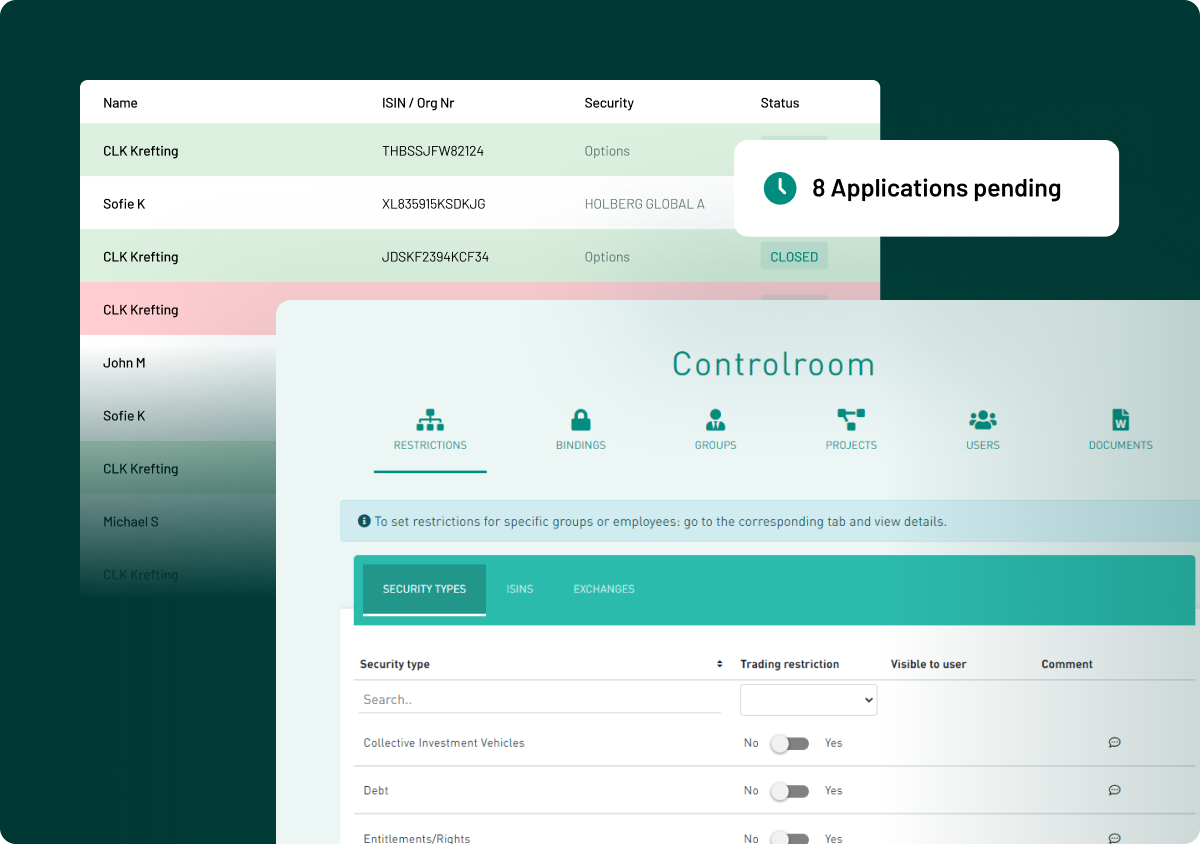
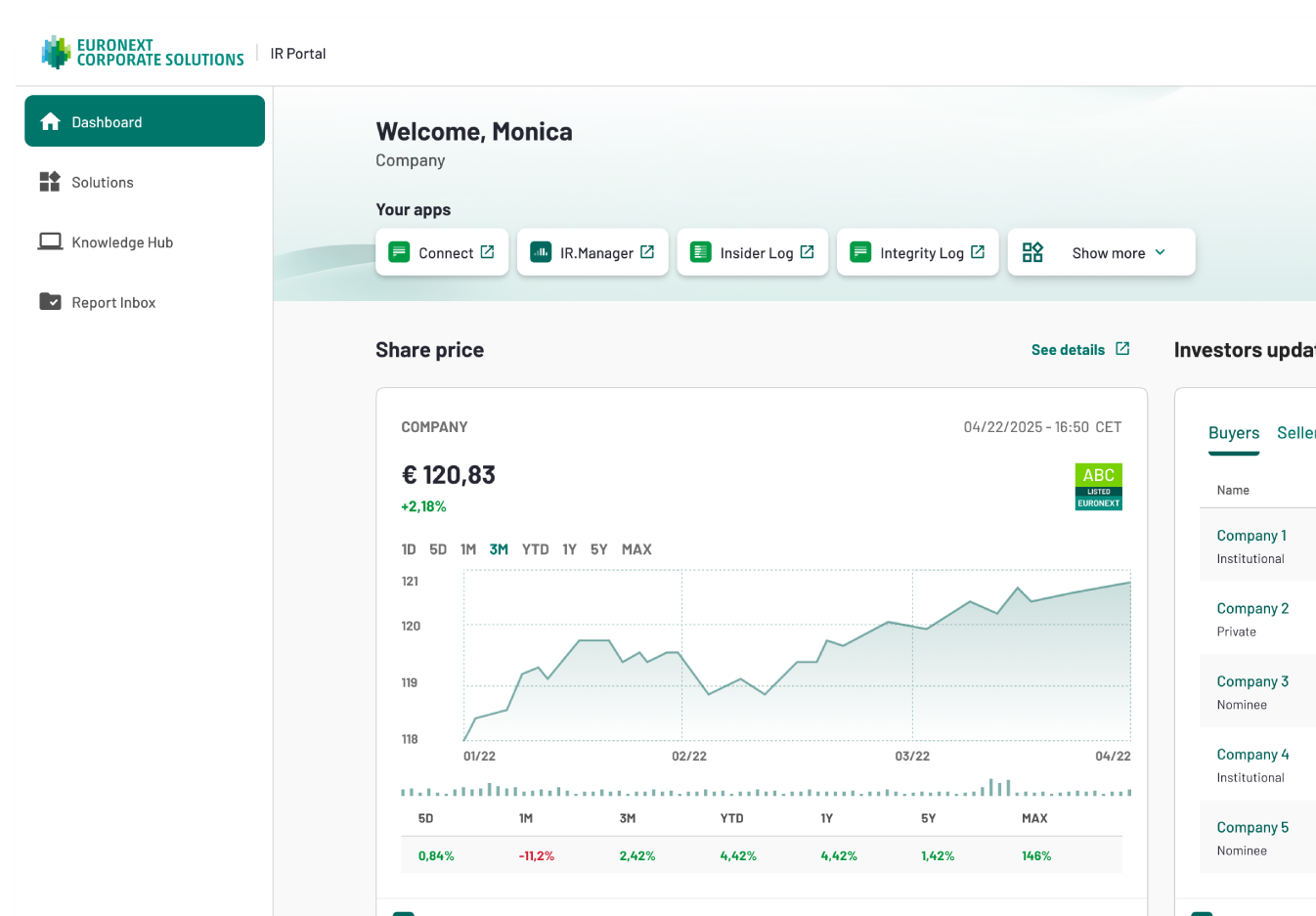
A modern IR portal and/or software is the operational backbone of every IR team. It consolidates shareholder analysis, CRM, real-time share-price data, and post-listing advisory deliverables into a single secure environment. Without this layer, IR teams default to spreadsheets, scattered email threads and manually refreshed contact lists, workflows that scale badly and create regulatory exposure when ownership changes accelerate around earnings or activist campaigns.
The reality is: the market has matured. Listed companies now expect IR software to integrate shareholder identification under SRD II, deliver investor targeting based on holdings data rather than guesswork, and produce the audit trail required when disclosure timing is challenged. Selecting the right platform is no longer a procurement decision. It is a strategic one.
→ Read more about the IR Portal & Software
2. IR communication
Communication is where the IR function earns its credibility. The discipline covers the equity story, scheduled disclosure (results, trading updates, regulatory announcements), targeted outreach to existing and prospective holders, perception studies, crisis communication, and the executive coaching needed to keep the C-suite on message. The bar has risen sharply: investors now compare disclosure quality across peers in real time, and a poorly framed earnings call can compress the multiple for several quarters.
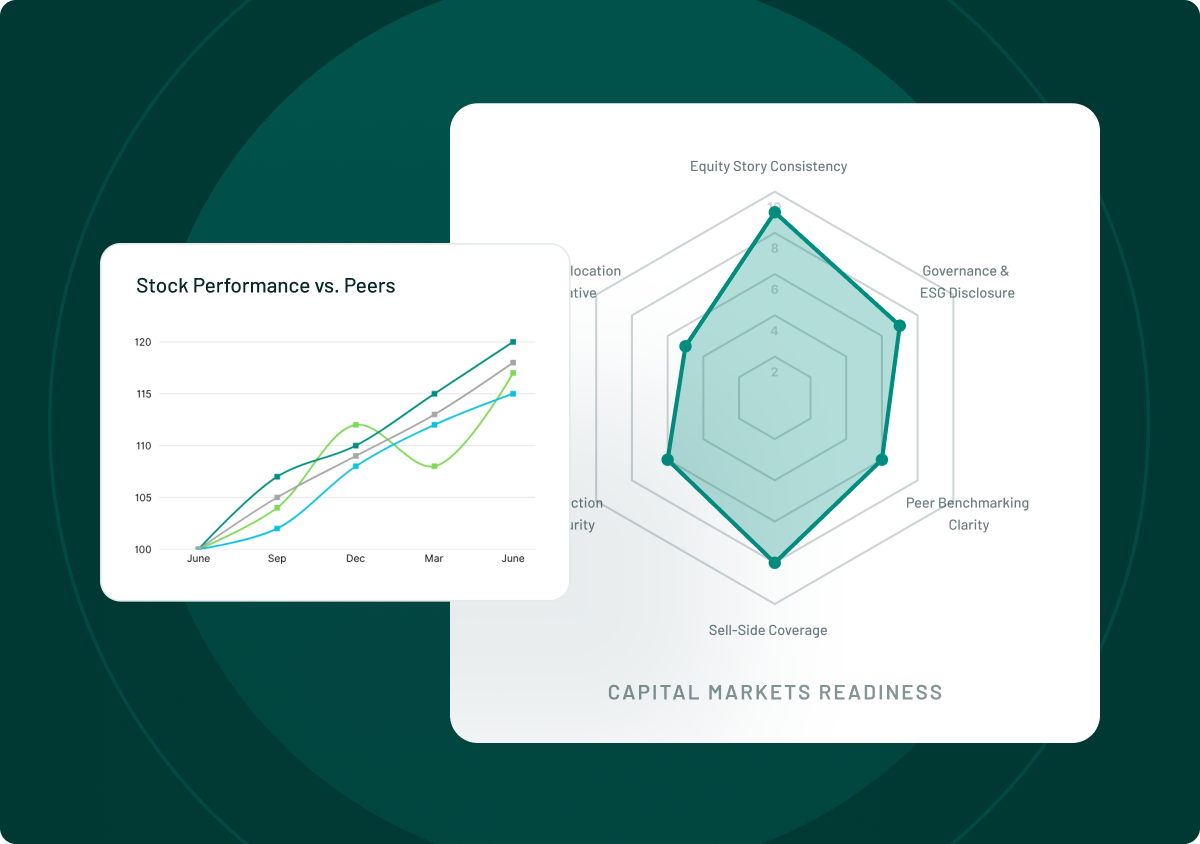
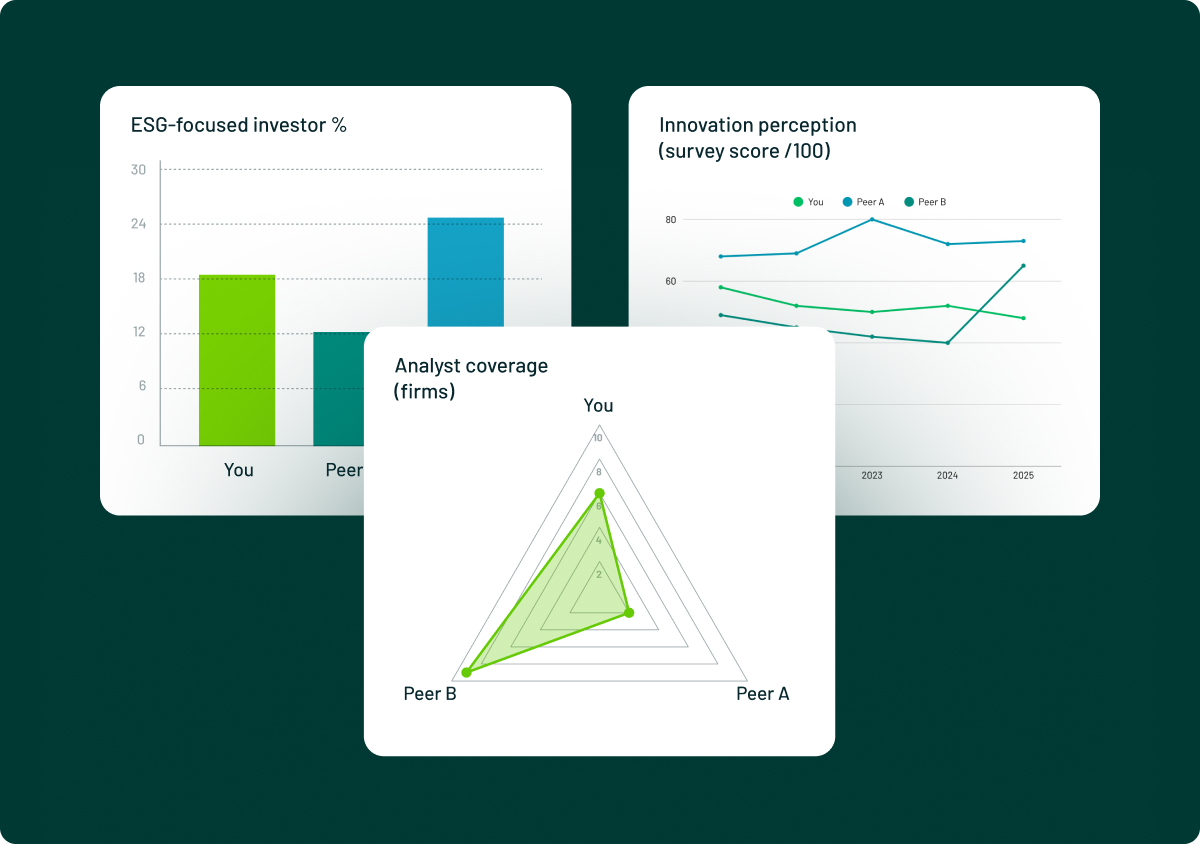
Effective IR communication is consistent, granular and forward-looking. It anticipates the questions before they are asked, treats every interaction as an input to the next quarterly cycle, and uses data from perception studies, sentiment tracking, and peer benchmarking to refine the message rather than relying on intuition.
→ Read the full guide: IR Communication Best Practices
3. IR events
Investor events are where strategy becomes tangible. The annual calendar typically includes the AGM, half-year and full-year results presentations, at least one Investor Day (or capital market day), sector conferences, roadshows, and increasingly a programme of smaller virtual meetings with retail platforms and ESG-mandated funds. Each format has a different purpose, audience and production discipline, and that’s exactly what separates the events that move the share price from the ones that do not.
The shift to hybrid and virtual delivery, accelerated by the pandemic and now embedded in investor expectations, has changed the economics. Reach is higher, cost per touch is lower, and the data captured during the event (attendance, engagement, Q&A patterns) feeds back into targeting and outreach.
→ Read the full guide: Organising IR Events that Drive Engagement
The technology stack behind a modern IR function
A credible IR programme in 2026 sits on four technology layers:
Shareholder intelligence. Identification of beneficial owners under SRD II, monitoring of position changes, peer ownership analysis and activist detection.
CRM and outreach. A purpose-built investor relations CRM that holds the entire history of every interaction with every fund: meetings, calls, attendance at events, sentiment notes, ESG questions raised, and supports targeted outreach around earnings and roadshow planning.
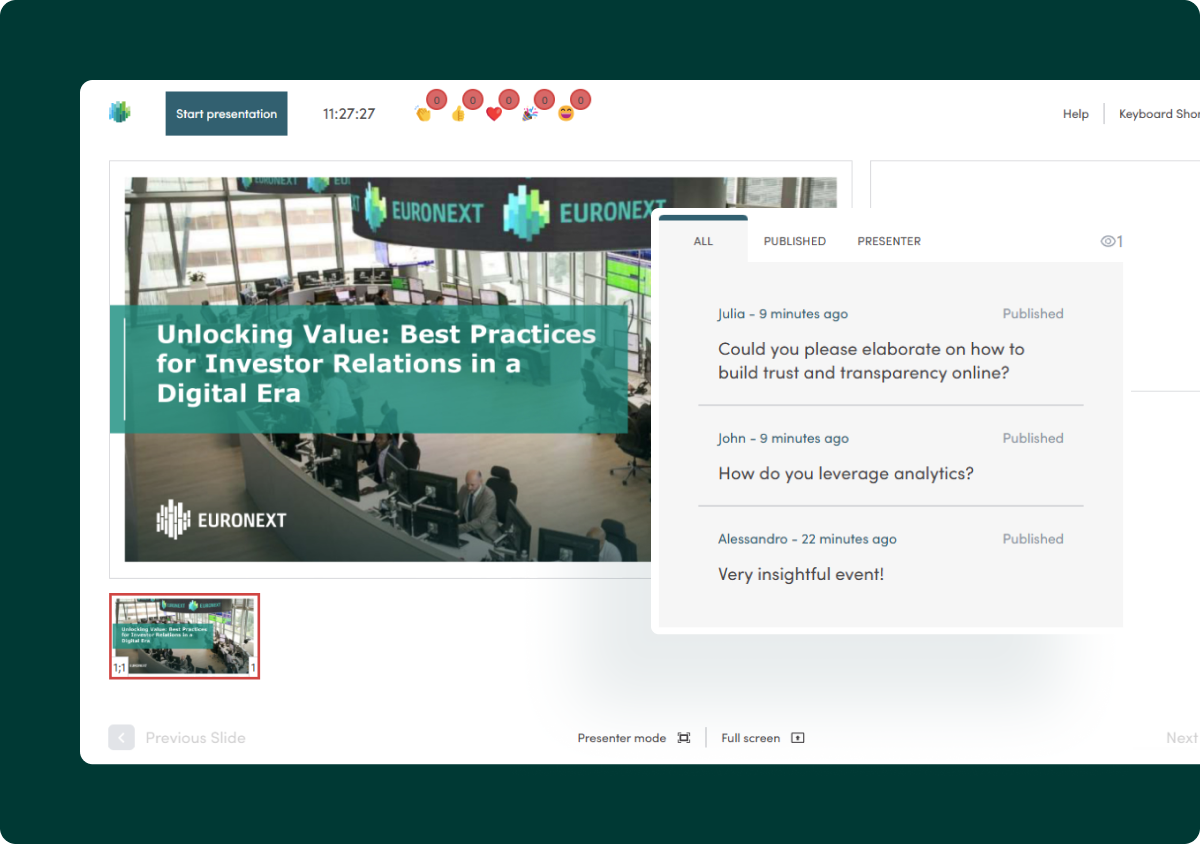
Disclosure and event delivery. A secure webcasting and event solution that handles results presentations, capital markets days and AGMs at the production quality investors now expect, with full regulatory traceability.
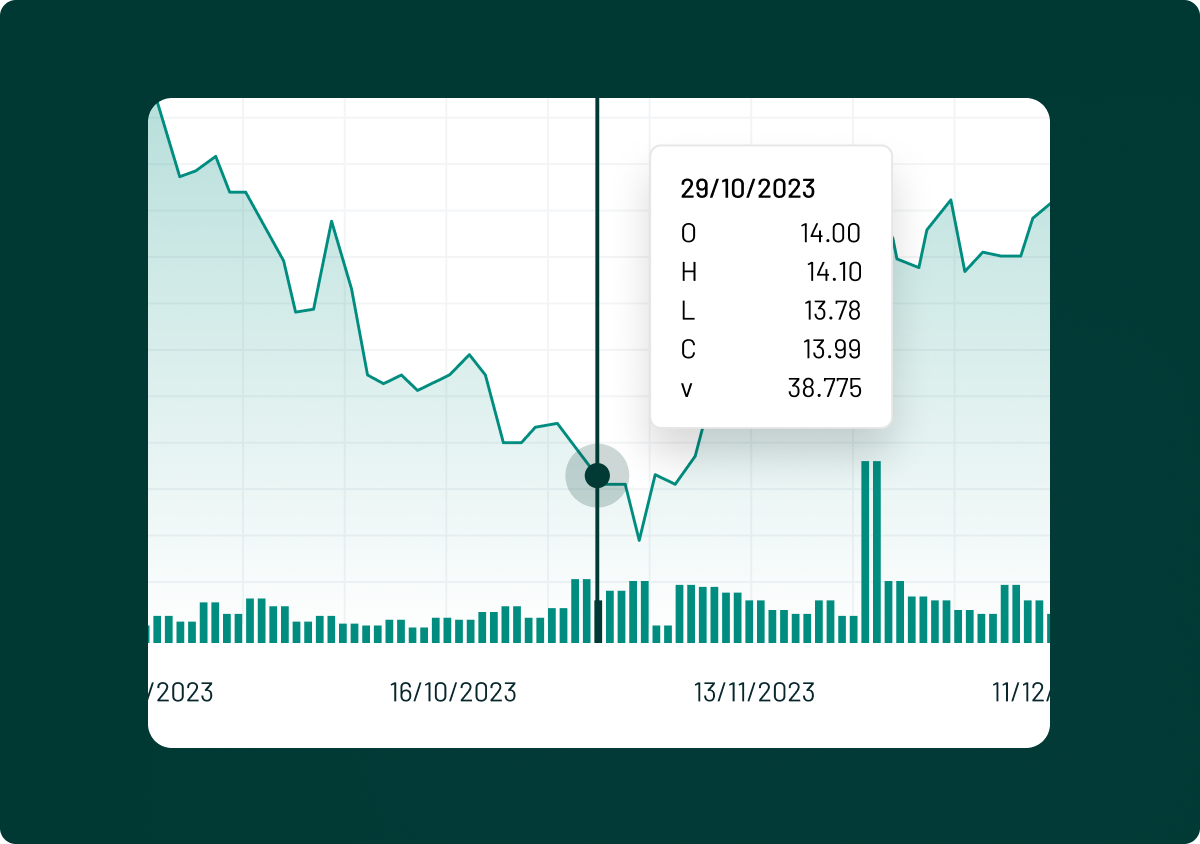
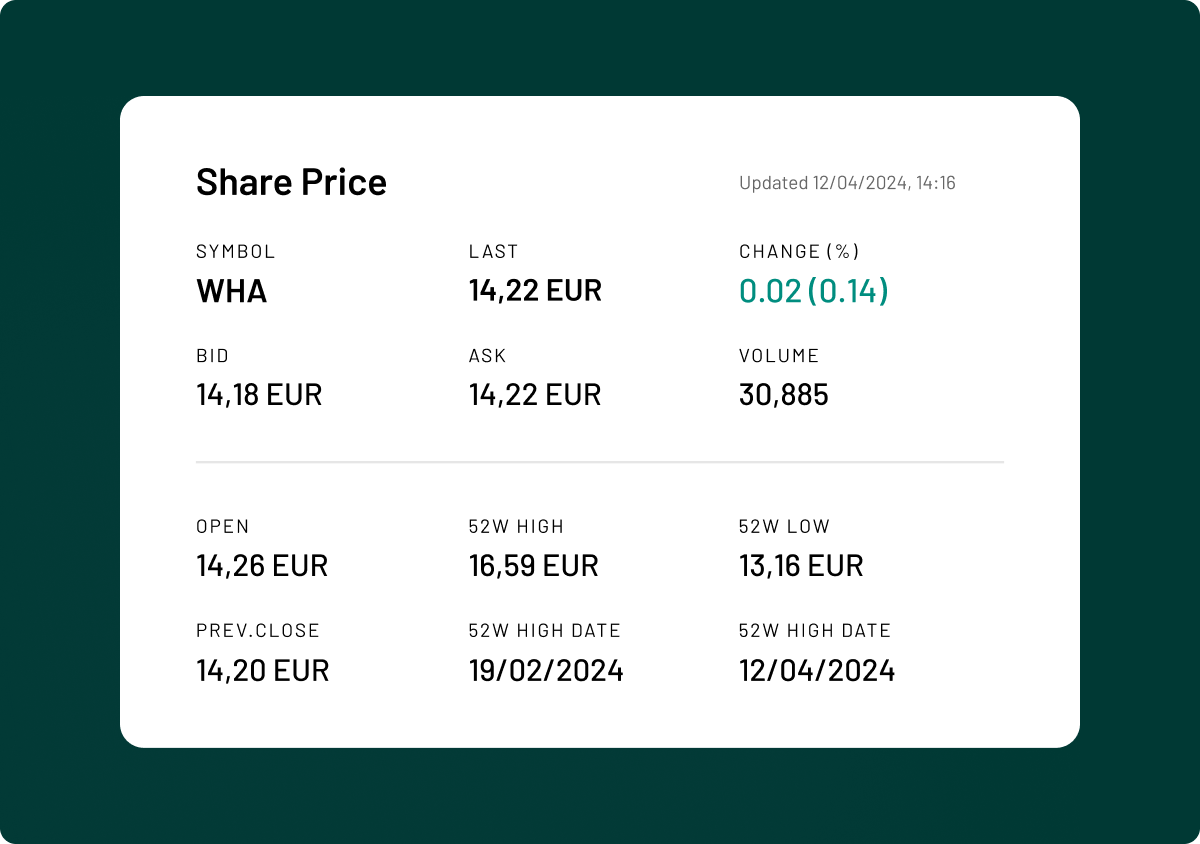
Real-time market data. Live share price feeds and trading indicators displayed on the IR website, on internal dashboards, and increasingly in chat-based briefing tools used by the executive team.
Selecting these layers as a coherent stack - rather than four separate procurements - is what allows the IR team to spend its time on judgment-led work (positioning, messaging, executive preparation) rather than data reconciliation.
What good looks like: the IR maturity model
Not every IR function needs the same setup. The right configuration depends on listing venue, free float, shareholder mix and the strategic moment of the issuer (newly listed, mature index constituent, M&A-active, under activist pressure).
- Foundational. The team meets disclosure obligations on time, runs a credible AGM, holds quarterly results calls and maintains a basic IR website. Suitable for newly listed issuers in their first two years on market.
- Established. The team operates a year-round investor engagement programme, runs at least one capital markets day, conducts annual perception studies, and uses an IR CRM to manage the contact base. Most mid-cap European issuers operate at this level.
- Advanced. The team integrates shareholder analysis with targeting, runs structured ESG engagement separately from financial IR, deploys hybrid event formats with measurable engagement data, maintains a retail investor outreach stream, and feeds investor sentiment into board-level strategy discussions. This is where leading large-caps now operate.
- Best-in-class. The IR function is treated as a strategic business unit. It influences capital allocation decisions, has a direct line to the board, runs continuous perception monitoring, and is recognised in investor surveys (Extel, IR Magazine) as a sector benchmark.
The technology stack and process discipline scale with the maturity level. A foundational programme can be run by a one-person team with a competent CRM. A best-in-class programme needs an integrated portal, dedicated specialists for shareholder analysis and ESG, and a partnership with experienced external advisors.
Who runs investor relations
The IR function reports differently depending on the company. The most common reporting line is to the CFO; the next most common, particularly in larger groups and in certain European markets, is direct to the CEO. A small number of issuers report IR through the company secretary or general counsel function. None of these structures is intrinsically right or wrong. What matters is that the IRO has the access, authority and resources to influence the messaging that reaches the market.
The composition of the IR team itself has broadened. A typical mid-cap setup now includes the head of IR, an IR manager handling day-to-day investor contact, and shared resources for ESG reporting and corporate communications. Larger groups add dedicated specialists for shareholder analysis, retail investor relations, and capital markets transactions. The skills profile has shifted with it: alongside the traditional financial-analyst background, IR teams now recruit from communications, sustainability and data analytics.
Frequently asked questions
What does an investor relations function do?
The IR function manages the dialogue between a listed company and the investment community. Its responsibilities include regulatory disclosure, shareholder identification, investor targeting, the equity story, financial communication around earnings cycles, capital markets days, AGMs and crisis communication when material events occur.
What is an IR portal or software?
An IR portal or software is a secure environment that consolidates the operational tools an IR team needs to function: shareholder analysis, an IR CRM, real-time share-price widgets, advisory reports and corporate event management. It replaces the patchwork of spreadsheets, separate vendor logins and manual data refreshes that characterised IR workflows a decade ago.
What is the best CRM for investor relations?
A purpose-built IR CRM differs from a general-purpose sales CRM in three ways: it includes a database of investment-world contacts and their fund mandates, it tracks holdings and position changes alongside meeting history, and it supports targeting workflows specific to investor outreach. The right choice depends on company size, listing venue and the depth of integration required with shareholder analysis.
How often should listed companies engage with investors?
The disclosure calendar (results, AGMs, mandatory announcements) sets the floor. Above it, leading IR functions run a continuous engagement programme: post-results roadshows, sector conferences, smaller targeted meetings with prospective holders, perception studies, and a dedicated retail investor stream. The cadence should be deliberate and not driven by inbound requests alone.
How are AI tools changing investor relations?
AI is being adopted across IR for three things: meeting preparation (automated briefing notes from CRM history), sentiment analysis on earnings call transcripts and analyst notes, and drafting support for routine communications. The constraint is regulatory: any AI-generated content that touches market-sensitive information must be reviewed under the same controls that apply to human-generated disclosure.
What is the most secure investor relations software?
Security in IR software covers three dimensions: data residency (where shareholder data is held), access control (who in the IR team and the broader organisation can see what), and audit trail (the ability to demonstrate to regulators when disclosure decisions were made and by whom). EU-hosted, ISO-certified, GDPR-compliant platforms are now table stakes for European listed issuers.
The Euronext Corporate Solutions IR offering
Investor relations technology is most useful when it is built by people who understand what is happening on the other side of the trade. Euronext Corporate Solutions sits inside the Euronext group: the leading pan-European market infrastructure operator, running the regulated markets in Amsterdam, Brussels, Dublin, Lisbon, Milan, Oslo and Paris, and connecting more than 1,800 listed companies to over 25% of European cash equity trading. That proximity to the primary and secondary markets shapes the way the IR products are designed: shareholder analysis built on the data flows that move through the central securities depositories, real-time share-price feeds sourced directly from the Euronext Data Centre, regulatory disclosure tooling that anticipates rule changes because the people building it work alongside the people writing the market notices.
For a listed issuer, the practical effect is a shorter distance between the IR workflow and the underlying market. When the disclosure regime changes, the product does not need to be retrofitted. When investor identification rules evolve under SRD II, the data pipeline is already built into the platform. When a capital markets day needs the production quality investors expect, the supporting team has run the equivalent for hundreds of issuers across European venues. This is not a feature of the software, it is a structural advantage of being part of a market operator rather than a third-party vendor adjacent to one.
Euronext Corporate Solutions supports more than 4,000 listed and pre-IPO companies across Europe with an integrated suite of IR products and advisory services. The portfolio covers the full IR stack: IR.Manager (the investor relations CRM), Shareholder Analysis (identification and ownership intelligence under SRD II), LiveEquity (real-time share-price widgets for IR websites), Post-Listing Advisory (strategic IR planning and investor targeting), and EngageStream (the secure event and webcasting platform used for results presentations, capital markets days and AGMs).
These products are delivered through a single secure portal, with single sign-on across the stack and integrated reporting. The same teams that build the software also deliver the advisory work, which means the technology and the strategic input stay aligned — and both stay close to the market activity that defines the IR mandate in the first place.
Continue reading
→ IR Portal & Software — what to look for, how to choose, and a comparison of the leading platforms.