









.png)




.svg)
.svg)
.svg)







.png)
.png)






.jpg)

%20F%20(1).jpeg)







.webp)






 Login
Login
Compliance failures do not stay contained
CFOs do not lose sleep over the insider list. That is not the job. But they do lose sleep over investor relations incidents, board-level governance questions, management teams distracted by internal investigations during a critical trading period and reputational events that started as process gaps.
That is what insider control failures actually cost. Not a fine, necessarily — though that is possible. More often, it is the time, attention and credibility that get spent on something that should never have become a problem at all.
The uncomfortable reality is that most of these situations do not stem from bad judgement or poor intent. They come from fragmented execution: one team handling lists, another managing approvals by email, threshold tracking living in a spreadsheet that may or may not be current. Each piece, in isolation, looks fine. Together, they leave gaps.
Results season is when weak controls become expensive
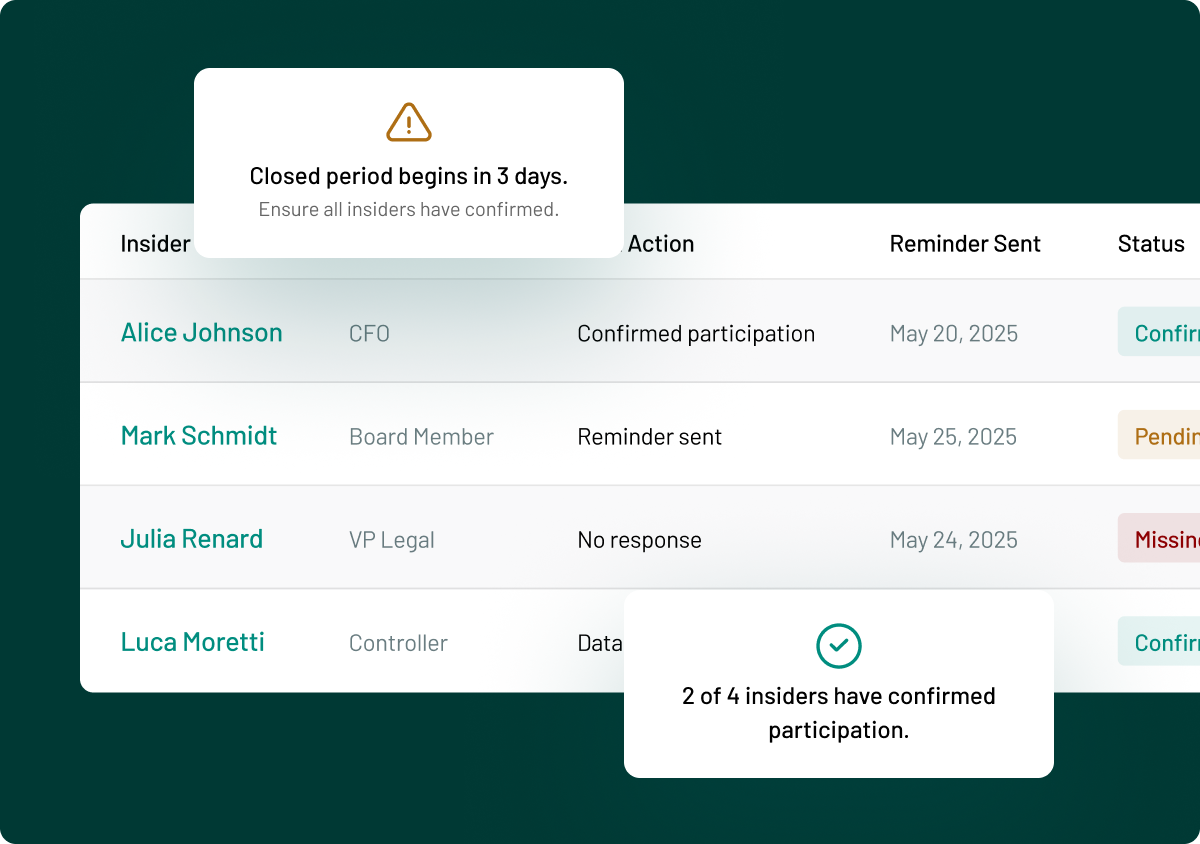
There is a defined window — 30 calendar days before the announcement of interim or year-end results — during which trading restrictions apply. Most senior people know this. The operational challenge is not awareness; it is consistent execution when everything else is also happening.
In a fragmented process, the risk surfaces in the details: the wrong person receives a notification late, or does not receive it at all. A pre-clearance request sits unanswered in an inbox. An exception is granted informally and never formally recorded. None of these things are deliberate. But an accidental trade in a closed period creates a chain reaction — internal investigation, external questions, leadership distraction — right when the organisation needs to be focused on performance and communications.
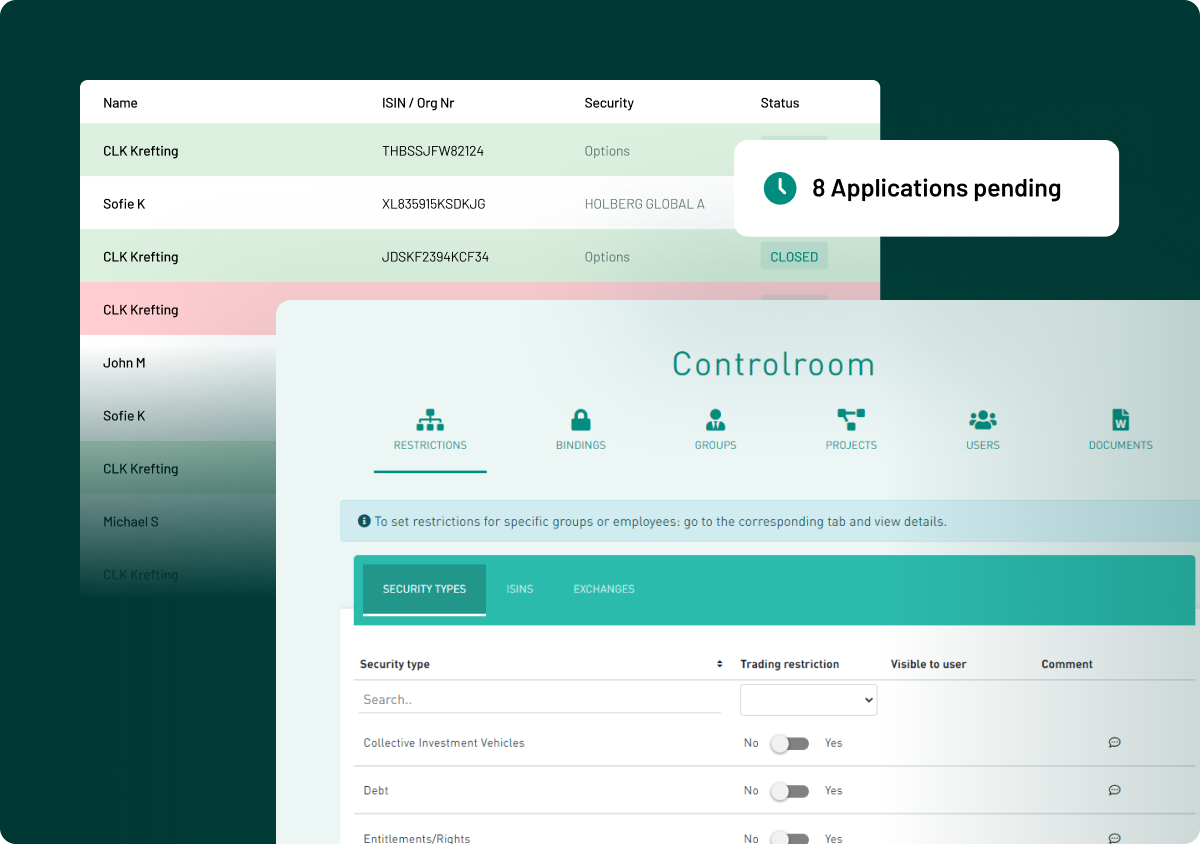
PDMR transaction management adds a separate layer of exposure. When approvals live in email, there is no live view of what is pending versus cleared, no systematic threshold tracking and no clean record to produce quickly if it is needed. The annual notification threshold under Article 19(8) of the Market Abuse Regulation (MAR) sits at €20,000, with national regulators able to raise it to €50,000 or lower it to €10,000 — which means manual tracking of something that varies by jurisdiction and changes over time. That is a fragile basis for a control.
Finance ends up paying the coordination cost
There is a secondary cost that is easy to underestimate. In organisations where MAR compliance is fragmented across tools and teams, finance tends to become an information hub by default: compliance needs reporting dates, legal needs 'what was known when,' IR needs disclosure timing support. All legitimate requests — but together, they pull senior finance time into backward-looking evidence assembly rather than forward-looking work.
The more disconnected the underlying tools, the more time people spend stitching together answers that a proper system would surface in seconds.
Protecting the things that actually matter to a CFO
An integrated MAR compliance platform addresses something more fundamental than process efficiency. It addresses the underlying question of whether the organisation can evidence, clearly and quickly, that it ran its insider controls properly.
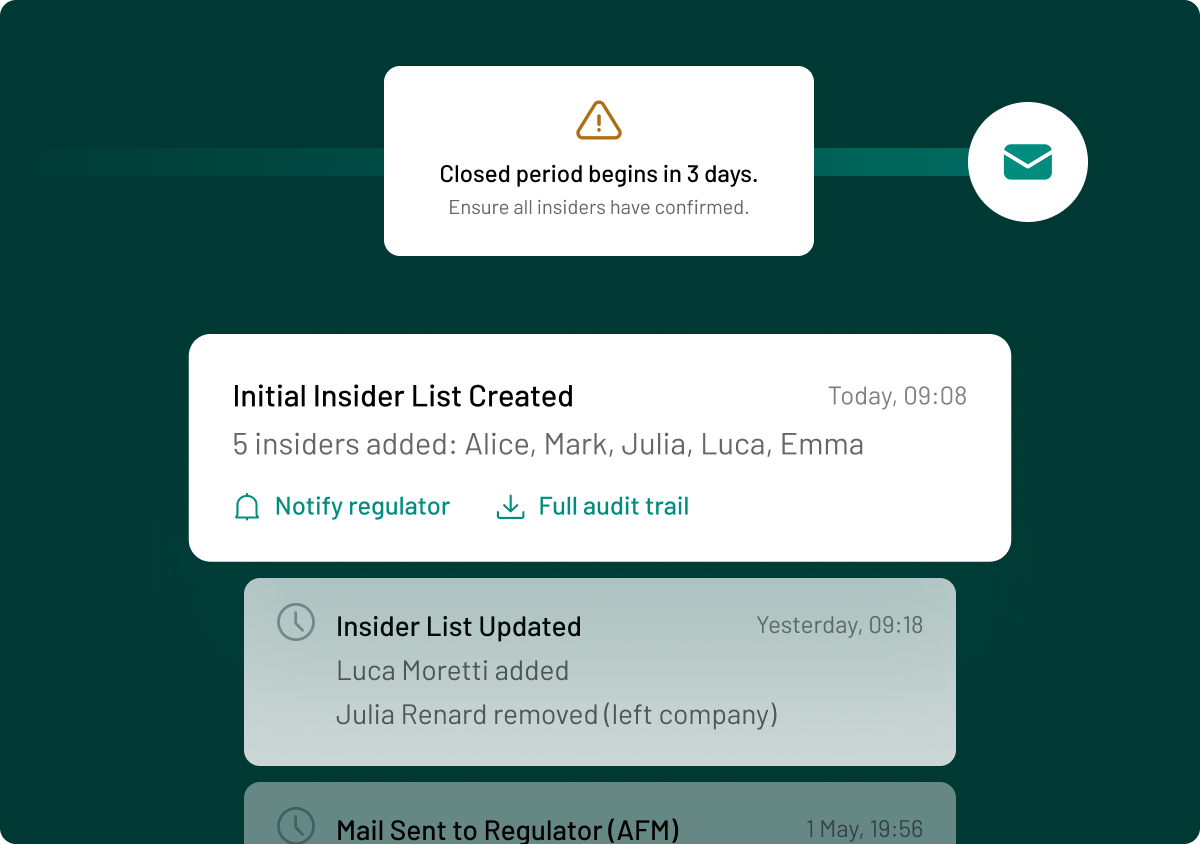
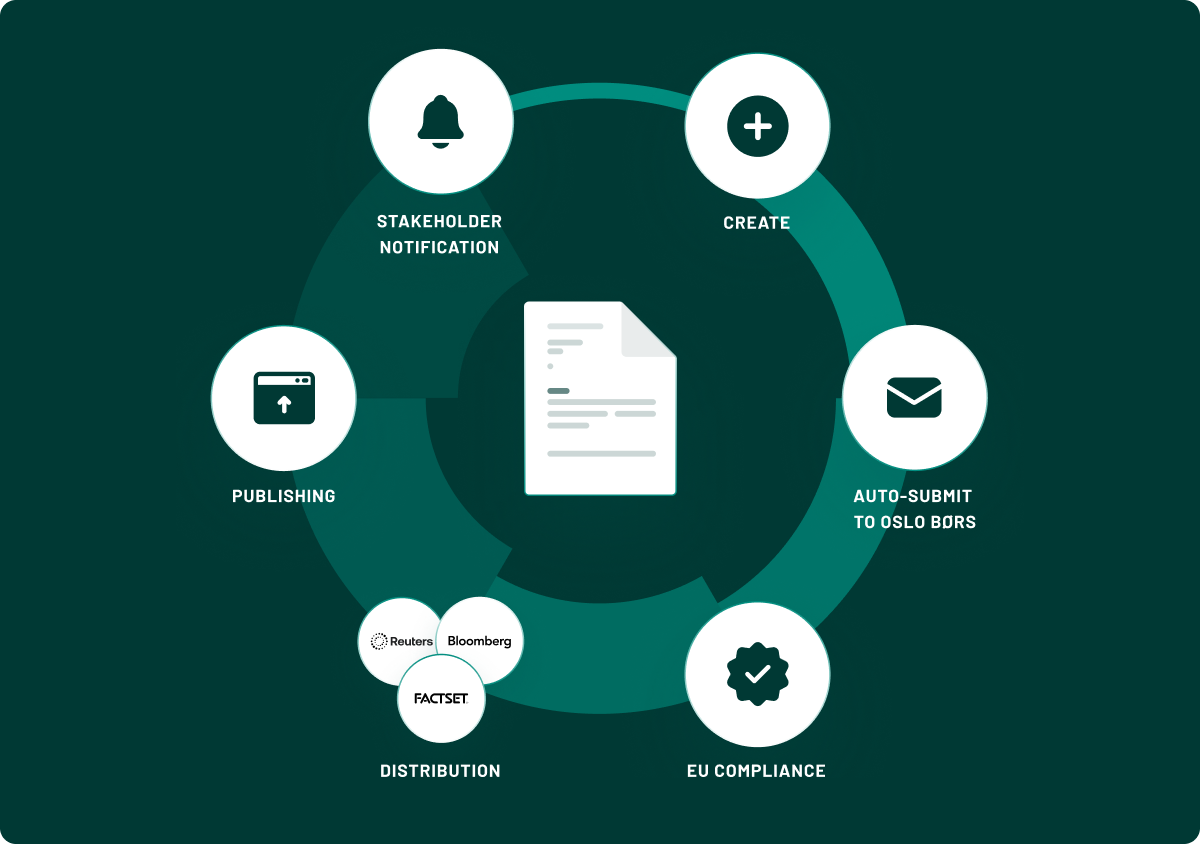
InsiderLog brings insider list management, closed period controls, PDMR transaction oversight and delayed disclosure documentation into a single workflow with a complete audit trail. Threshold tracking is continuous. Notifications are automated. Delayed disclosure decisions are documented in the required format and remain accessible. Every change is timestamped and archived. The result is a compliance record that holds together as a coherent narrative — the kind that allows a regulator or board conversation to stay factual rather than becoming reconstructive.
That is not a compliance outcome. That is a business outcome: protected trust, fewer avoidable incidents around results and management attention that stays on performance where it belongs.
Schedule a consultation with a compliance specialist to see how InsiderLog gives your organisation the control chain it needs.