

What Is Digital Communication? A Strategic Guide for Corporate and IR Teams
If your internal update lands in spam, your all-hands generates more questions than clarity, and your earnings call buffers midway through the Q&A, that is not a technology problem. That is a communication strategy problem.
Digital communication is how organizations shape what stakeholders know, believe, and do through every electronic touchpoint: from an earnings webcast to a LinkedIn post to an internal town hall. For corporate and investor relations teams, getting it right is not optional: it is a reputational, regulatory, and competitive imperative.
This guide covers the channels, strategy, measurement, and tools you need to build a digital communication approach that performs.

Table of content
What Is Digital Communication?
Why Digital Communication Matters for Business
The Main Channels of Digital Communication
Internal vs. External Digital Communication
How to Build a Digital Communication Strategy
Measuring the Impact of Digital Communication
Trends Shaping Digital Communication in 2025–2026
Your Next Communication Moment Is a Trust Moment
Frequently Asked Questions
What Is Digital Communication?
Digital communication is a broad umbrella term that covers all of your online two-way communication channels and platforms, It encompasses every touchpoint: press releases, social media, email, collaborative tools, investor webcasts and earnings calls, and internal all-hands meetings (or town-halls).
Unlike traditional communication, digital communication is:
• Scalable: one message reaches thousands of stakeholders simultaneously, across geographies
• Measurable: reach, engagement, and audience behavior are traceable in real time
• Bidirectional: audiences can respond, react, ask questions, and participate
• On-demand: content can be recorded, replayed, and accessed long after the live moment passes
For listed companies and large enterprises, this last point carries particular weight. An earnings presentation that lives only in a single live call reaches a fraction of the audience it could. A webcast with replay functionality, transcripts, and on-demand access extends that message's lifespan - and its lifetime - indefinitely.

Why Digital Communication Matters for Business
The way organizations communicate has shifted permanently. B2B buyers and institutional investors conduct the majority of their research independently, before ever engaging with a company representative. Digital touchpoints are therefore the primary environment for building the trust that precedes every transaction, investment decision, or strategic partnership.
Four forces make digital communication a boardroom priority:
• Stakeholder expectations have risen. Investors, customers, and employees expect consistent, professional, and accessible communication across all channels. This is especially true for customers who expect all the above, at every stage of the relationship.
• Geographic barriers have disappeared. A company in Amsterdam can brief institutional investors in London, New York, and Singapore in a single live event, reaching those who couldn't attend live through on-demand replay.
• Speed is a reputational variable. In a world of real-time markets and social media, organizations that communicate slowly or poorly in moments of change such as earnings releases, leadership transitions, or crises, pay a credibility cost that is difficult to recover.
• Data enables continuous improvement. Every digital communication event generates analytics: who attended, for how long, what they engaged with, what they asked. That data makes every future communication smarter.

The Main Channels of Digital Communication
When it comes to communicating, whether externally or internally, no single channel is able to do everything. Effective communication strategy means deploying the right tool for the right audience and at the right time. Not defaulting to whatever is most familiar. Here are the primary channels every corporate communications team should understand, own and use.
Email remains the backbone of B2B digital communication. It offers direct, one-to-one reach at scale. Unlike social media platforms, you own your audience list. For IR teams, email is the primary delivery mechanism for earnings releases, shareholder updates, and event invitations. For internal communications, it anchors formal announcements and policy updates.
Best for: Investor relations updates, lead nurturing, customer retention, regulatory notifications, internal announcements
Key principle: Segmentation determines relevance. A generic blast to your entire investor and customer database signals that you don't know your audience. Separate lists for institutional investors, retail shareholders, customers, and employees allow you to tailor message and tone precisely.
Social platforms give organizations a public voice and a direct line to professional audiences. LinkedIn dominates B2B communication, making it the primary platform for thought leadership, executive visibility, and event promotion. It is also a distribution channel for content spanning from gated content, conference presentations, CMD highlights, and strategic updates can all reach a broader audience via LinkedIn than through direct outreach alone.
Best for: Brand awareness, thought leadership, executive communications, event amplification, storytelling
Key principle: Consistency across platforms reinforces credibility. Stakeholders and investors move between your website, LinkedIn, and press releases. A fragmented or inconsistent voice across those surfaces creates doubt rather than confidence.
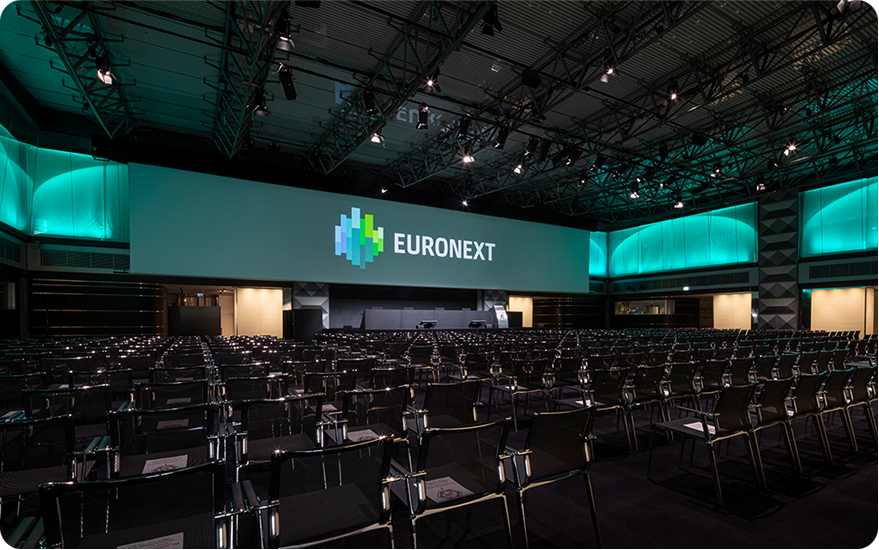
For listed companies and large enterprises, webcasting is the gold standard for high-stakes communication. An earnings call that drops mid-session, a Capital Markets Day with audio problems, or an AGM with no interaction capability - these are not technical inconveniences. They are credibility events that shake investor confidence and undermine months of relationship-building.
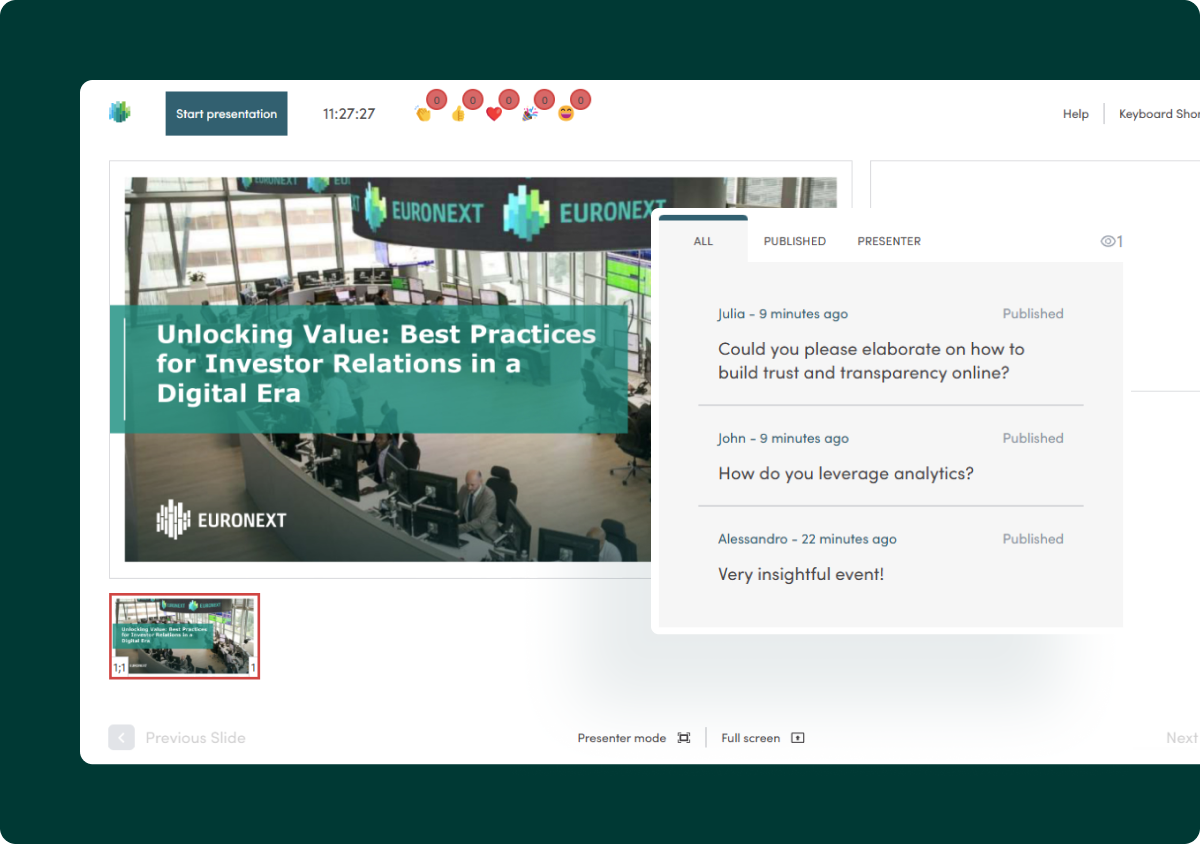
Professional webcasting gives you broadcast-quality reach with interactive depth: live Q&A, polling, audience analytics, on-demand replay, multilingual access, and branded environments that reinforce your organization's identity at every touchpoint.
The events that demand this level of infrastructure include:
- Earnings calls and half-year results: where institutional investors assess management credibility
- Capital Markets Days (CMDs): high-production strategic presentations to investor audiences
- Annual General Meetings (AGMs): fully virtual or hybrid formats that meet shareholder engagement obligations
- ESG and sustainability updates: where transparency and accessibility signal genuine commitment
- Internal all-hands and town halls: where leadership alignment across geographies requires more than a video call
Best for: Investor relations, financial results, AGMs, CMDs, leadership communications, large-scale internal events
Key principle: The quality of your webcast is a direct signal of how seriously you take the audience. Platform stability, production quality, and audience experience are not premium extras — they are the baseline expectation for any event that touches your investors or board.
Discover EngageStream - professional webcasting built for corporate and investor communications
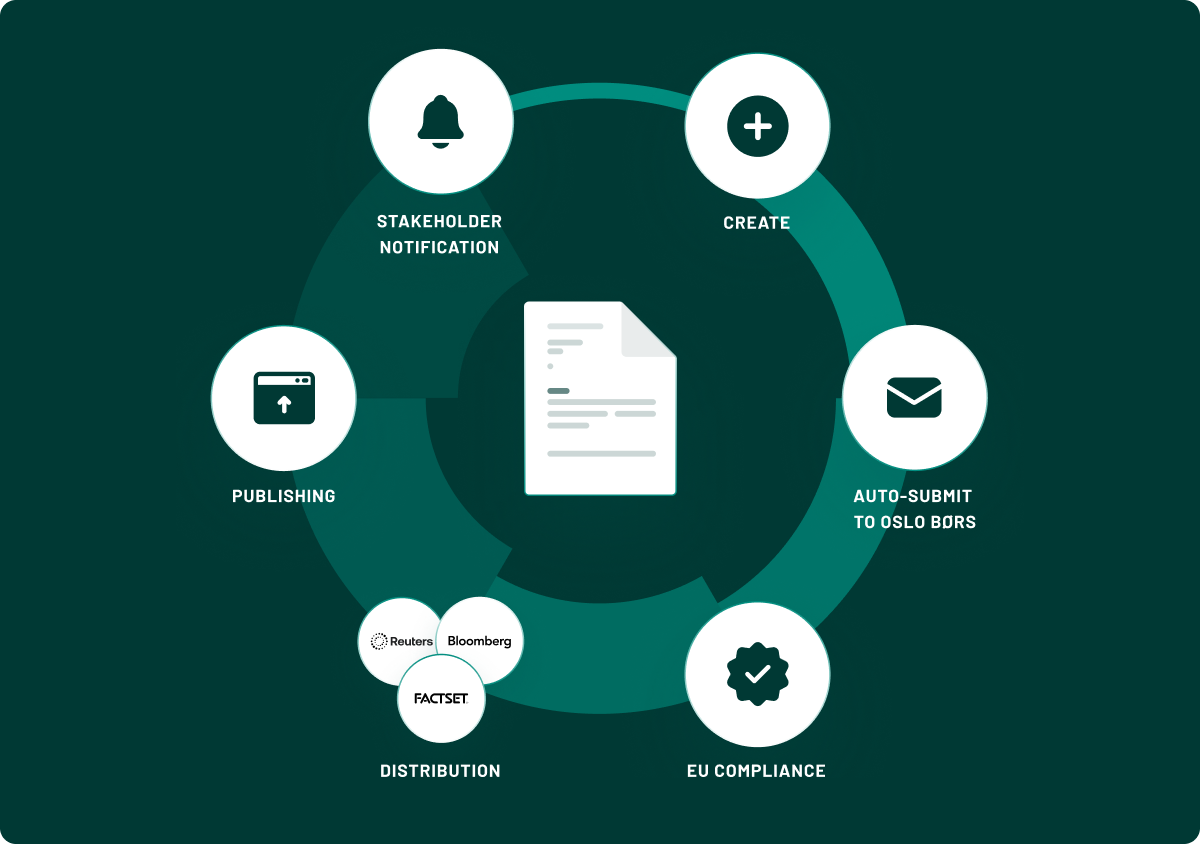
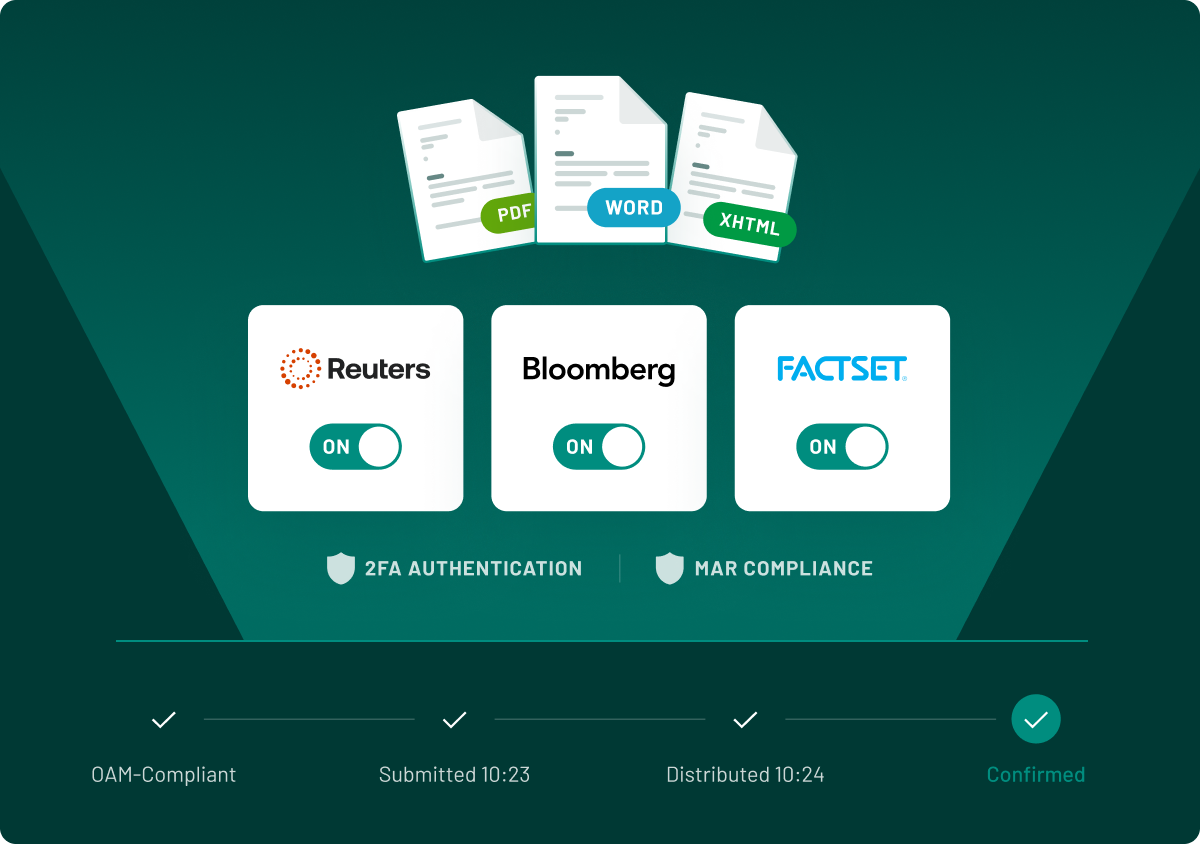
For listed companies, regulatory news distribution is a non-negotiable communication channel, not a supplementary one. Market Abuse Regulation (MAR) and national disclosure obligations require that price-sensitive information reaches the market simultaneously, through regulated channels, without delay. A press release on your corporate website or a tweet does not meet this standard.
Best for: Earnings announcements, material disclosures, leadership changes, transaction announcements, inside information releases
Key principle: Regulatory news is not marketing copy. Clarity, precision, timeliness, and distribution through an approved Regulatory Information Service (RIS) are the criteria that matter. Non-compliance carries legal and reputational risk.
EuroStockNews provides 24/7 regulatory news distribution across major European markets including Dublin and Oslo — integrated with the broader Euronext Corporate Solutions platform.
Your website and content library are your always-on communication infrastructure. Articles, guides, whitepapers, case studies, and pillar pages build authority and attract audiences at the research stage even before they engage your sales team. For corporate communications teams, content marketing also supports narrative management: a well-documented ESG position, a series of thought leadership pieces, or a library of leadership presentations all shape how the organization is perceived over time.
Best for: Organic lead generation, thought leadership, investor education, brand and narrative positioning
Key principle: Target the question your audience is actually asking, not just the keyword. An IR director searching for "how to run a virtual AGM" is farther along in their decision than one searching for "webcast platform." Content that matches intent converts.
Where webcasting is mainly built for one to many communication, video conferencing is built for dialogue: many to many. Tools like Zoom, Microsoft Teams, and Google Meet are the default infrastructure use mainly for internal collaboration and client calls. Read more about EngageStream.
Best for: Team meetings, client calls, workshops, small-group training
Key principle: Use the right tool for the right purpose. Running an earnings call on Zoom, or using a broadcast webcast platform for a small internal meeting, creates friction for participants and reflects poorly on the host. Match the tool to the audience size and interaction model.
Platforms like Slack and Microsoft Teams (chat) enable rapid, informal, context-rich internal communication. They have replaced much of the internal email thread for day-to-day coordination.
Best for: Internal team coordination, rapid decision-making, project collaboration
Key principle: Establish clear protocols. Define what belongs in a message thread vs. an email vs. a formal communication: without governance, collaboration tools generate noise rather than clarity, and critical information gets buried.
Explore our Webinar & Webcast Solutions
for earnings calls, AGMs, and stakeholder events
“If it goes well, no one notices – and that’s exactly the best compliment we can get. Analysts always comment on how professional and well-organised our events are.”
Michael Evans - Group Communications Director, Greencore Group plc
Internal vs. External Digital Communication
Digital communication serves fundamentally different purposes depending on its direction. Organizations that conflate the two tend to use the wrong channels, strike the wrong tone, and miss their audience entirely.
Resilient organizations treat internal and external communication as part of the same strategic framework because what you say inside your organization and what you say outside it must be coherent. Misalignment between internal messaging and external positioning is one of the fastest ways to lose credibility with both audiences.
|
Dimension |
Internal Communication | External Communication |
|
Primary audiences |
Employees, leadership, HR | Investors, customers, partners, media, regulators |
|
Key goals |
Alignment, culture, productivity, trust |
Awareness, credibility, conversion, compliance |
|
Typical channels |
Intranet, email, messaging tools, town hall webcasts |
Website, social media, earnings webcasts, regulatory news, AGMs |
|
Tone |
Direct, inclusive, transparent | Authoritative, consistent, brand-aligned |
|
Compliance sensitivity |
Data privacy, HR policy, insider trading protocols | MAR, MiFID II, fair disclosure, advertising standards |
How to Build a Digital Communication Strategy
A communication strategy is not a channel plan. It is the logic that connects your business objectives to your audience's needs, with channels acting as the delivery mechanisms. Organizations that start with "which platform should we use?" before answering "what does our audience need to know and believe?" consistently underperform.
Follow these steps to build a strategy that works:
Use data to tailor messaging to different audience segments without fragmenting your core narrative.
Define who owns each channel, who approves content, and how fast your team can respond, both in normal conditions and in a crisis. For listed companies, this includes a clear protocol for inside information and regulatory disclosure.
Define KPIs for each channel and review them regularly. The goal is outcome metrics, not activity metrics. Not "how many emails did we send?" but "how did investor confidence change after our last earnings communication?"
-
For listed companies: Your regulatory calendar is your communication calendar. Earnings releases, AGMs, Capital Markets Days, and inside information disclosures are fixed communication milestones, each with legal timing requirements, audience expectations, and reputational stakes. These events require infrastructure that scales, complies, and performs every time, without exception. Ad hoc tools are not an appropriate solution for this category of communication.
Measuring the Impact of Digital Communication
What gets measured gets improved. While digital communication is inherently measurable, most organizations track activity metrics (sends, views, posts published) rather than impact metrics (trust, understanding, decision influence). The former tells you what happened. The latter tells you whether it mattered.
A balanced measurement framework covers three levels:
Reach metrics:
Impressions, open rates, webcast registrations and live attendance, follower growth. These tell you how many people were exposed to your message.
Engagement metrics:
Click-through rates, Q&A participation, polling response rates, replay views, time watched. These answer the question: did they pay attention and engage?
Outcome metrics:
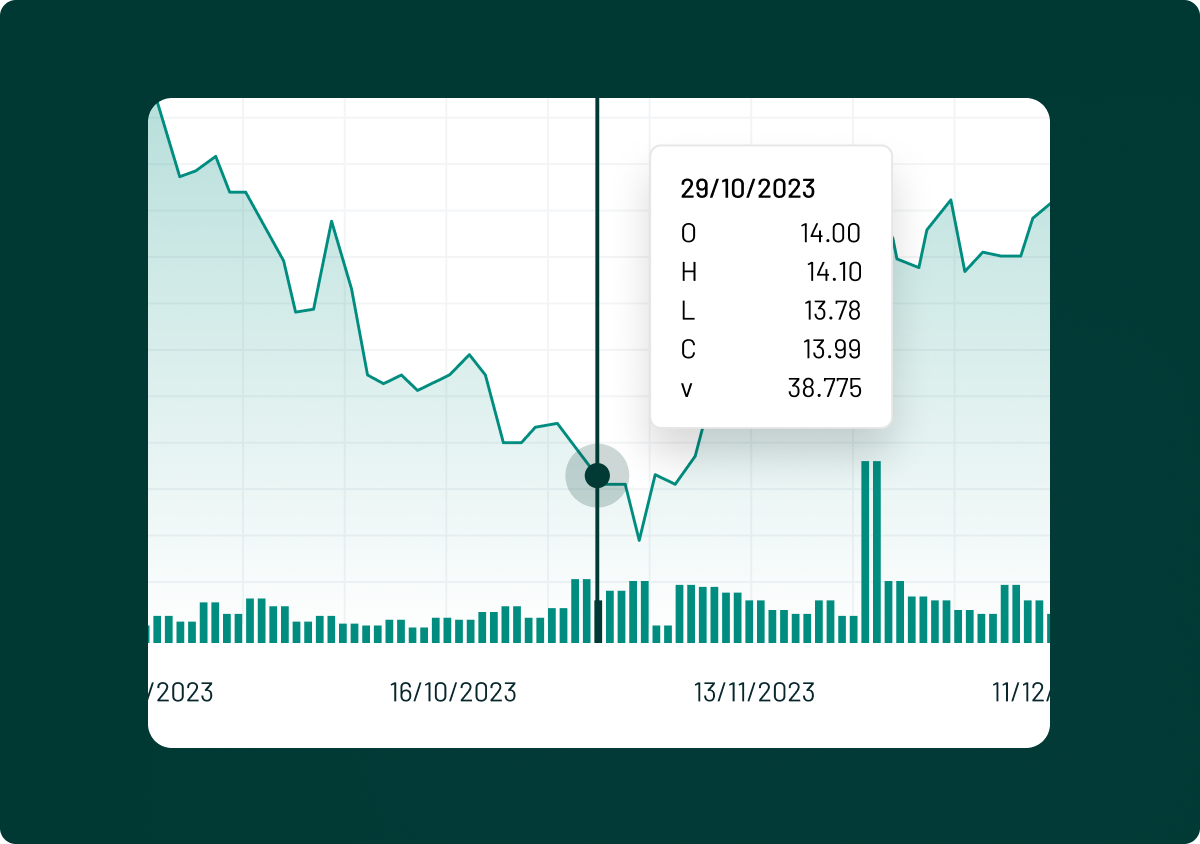
Lead conversion, investor meeting requests post-CMD, employee alignment survey scores, media sentiment, share price stability around disclosure events. Key metrics to track to understand if communication produced a business result.
-
The webcast advantage: For investor-facing events, analytics go deeper than most channels allow. EngageStream provides detailed reporting on live attendance, replay engagement, individual viewing time, Q&A volume, and geographic reach, enabling IR teams to directly demonstrate the value of their communication programs to management and show evidence of fair disclosure to regulators.
Video is the expected standard.
Executive communications, strategic updates, and investor briefings delivered in text-only formats are increasingly perceived as insufficient. Video-first communication is no longer a premium; it is the baseline expectation for credible organizations.
Omnichannel consistency is a trust signal.
Investors and stakeholders move fluidly between your investor portal, LinkedIn, earnings transcript, and press releases. Inconsistency across those surfaces creates doubt. Consistency builds the cumulative impression of a well-run, credible organization.
Your Next Communication Moment Is a Trust Moment
Every earnings call, AGM, Capital Markets Day, or company-wide announcement is an opportunity to strengthen stakeholder confidence or a chance to erode it. Organizations that consistently build trust are those that treat every communication milestone as a deliberate, well-prepared, professionally executed event.
EngageStream is built for exactly those moments: trusted by 850+ organizations to produce 15,000+ live events annually, across formats from virtual and hybrid to studio - and backed by ISO-certified security, GDPR compliance, and deep integration with the regulatory and IR tools listed companies depend on.

Explore our Webinar & Webcast Solutions
for earnings calls, AGMs, Capital Markets Days, and stakeholder events.
Start with your audience and objective — not the technology. For each communication moment, ask: who needs to receive this message, what do they need to understand or do, and what level of formality and compliance does this require? That logic will determine whether you need a regulatory newswire, a professional webcast, a LinkedIn post, or an internal all-hands.
References and further reading
Contact Sales
Have questions? We're here to help
Reach out for professional advice and discover how we can help you unlock the potential of your next events.
Contact us
Fill out the form to get in touch with our sales team.