









.png)







.svg)
.svg)
.svg)










.png)
.png)







.jpg)

%20F%20(1).jpeg)







.webp)






 Login
Login
Effective governance is the bedrock of any successful organisation. This is why it is essential to measure the performance of the board of directors and their effectiveness in areas relating to strategy and oversight.
A recent survey found that executives feel boards should be doing more to tackle critical risks, such as ESG (50%), talent management (38%) and artificial intelligence (35%). Another outcome of the report was that only 32% of C-suite professionals believe there is the right mix of expertise on their boards.
A board self-evaluation is a powerful tool to address these kinds of issues and inform positive changes to the functioning of the board. It transforms governance from a passive compliance exercise into an active, continuous improvement process.
This article explores the strategic benefits of board self-assessment, the principles of creating an impactful questionnaire and provides 30 key questions designed to provoke meaningful dialogue and drive tangible improvements in board performance and effectiveness.
- Board self-evaluation is most effective when it moves beyond compliance to drive measurable governance improvement.
- Well-designed questionnaires balance quantitative scoring with qualitative insight.
- Anonymity and psychological safety are critical for honest, actionable feedback.
- Digital tools and structured analysis significantly improve data quality and follow-through.
- Evaluation results must translate into clear actions, ownership and progress tracking.
The strategic benefits of board self-assessment
While many organisations conduct board evaluations to meet regulatory or investor expectations, but the benefits stretch far beyond simple box-ticking. It is a strategic exercise that can strengthen the entire organisation from the top down, if you get it right. Here are the key reasons to carry out a regular assessment.
Create a culture of continuous improvement and accountability
A regular, robust board self-evaluation process signals that the board holds itself to the same high standards it expects from management and other company stakeholders.
This commitment to self-reflection builds a culture that values feedback, addresses challenges openly and shares accountability. It moves the board from a static body to a dynamic team dedicated to evolving its capabilities and corporate governance practices.
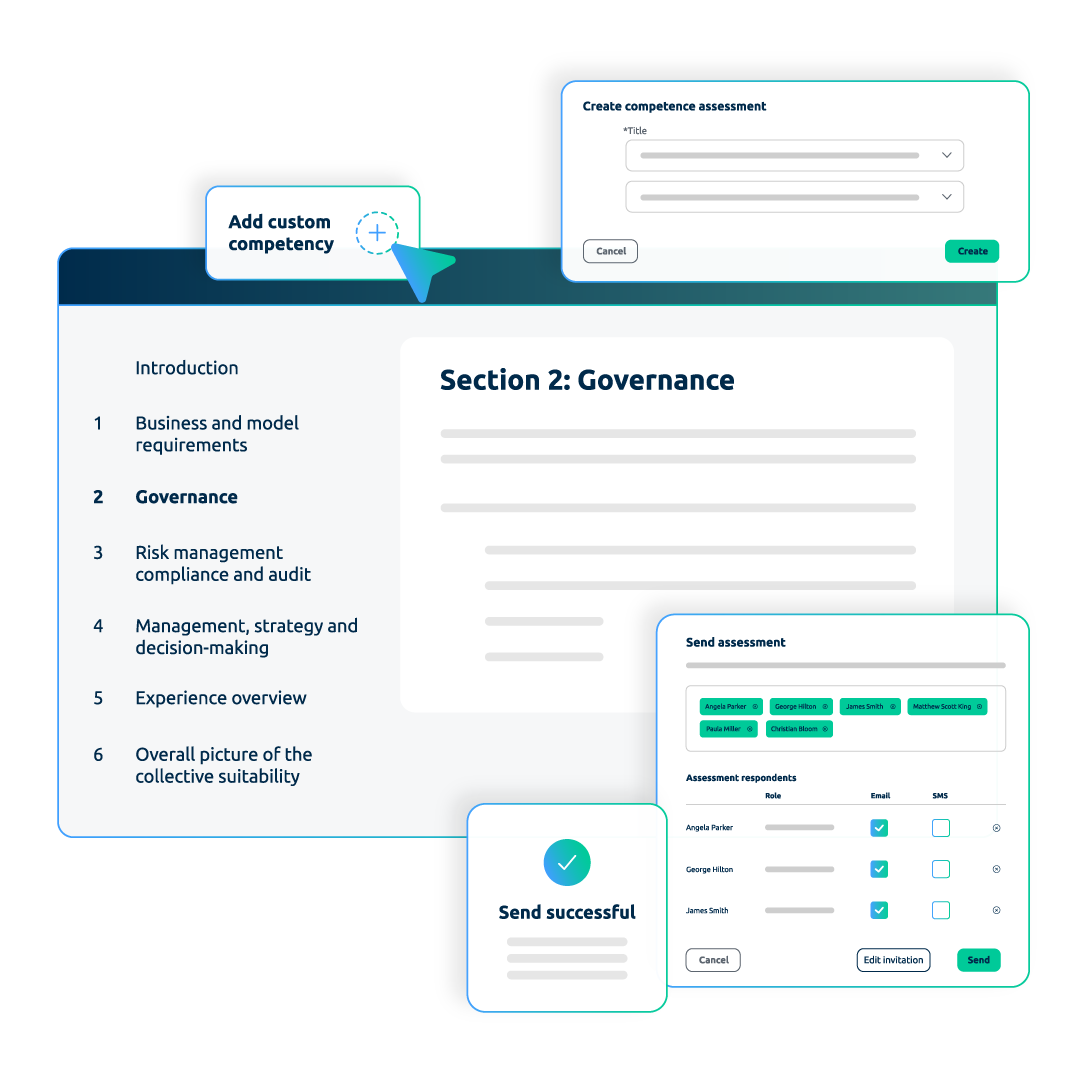
| Turn board evaluation into action Use Admincontrol to perform structured, anonymous board evaluations and surface real insights that drive measurable improvement. Learn more |
|---|
Identify strengths and address gaps in corporate governance practices
No board is perfect. A well-designed board self-assessment acts as a diagnostic tool, providing clear, data-driven insights into what the board does well and where it falls short.
It can uncover hidden issues, which allows you to take swift and effective action. For example:
| Evaluation outcome | Action plan |
|---|---|
| Misaligned skill sets in the board composition | Refresh the skills matrix against your strategy, set gap targets by role and quarter. Launch a focused recruitment and upskilling plan. |
| Inefficient meeting dynamics | Rebuild agendas around decisions with consent items moved out, strict time boxes and deadlines for delivering papers. Train the chair to use prompts that keep debate on track. |
| Unclear expectations around a committee’s role | Redraft the committee charter with purpose, remit and decision rights, agree a RACI with the board and management, then publish a simple annual workplan. |
| Vague understanding of risk appetite | Run a short board workshop to set measurable risk limits and tolerances. Approve a written risk appetite statement and add leading indicators with trigger actions to reports. |
| Board culture is too confrontational | Set meeting ground rules for respectful challenges, rotate the speaking order to bring in quieter voicesand schedule a brief facilitation session for the chair and committee chairs. |
Addressing these gaps proactively prevents minor issues from escalating into major governance failures.
Enhanced board performance and strategic leadership
The ultimate goal of any board evaluation is to enhance board performance. By identifying areas for improvement and understanding where to focus its development efforts, the board can refine its processes.
This leads to more effective strategic oversight, better risk management and a stronger partnership with the executive team, all of which feed into the company's long-term success.

Principles for crafting an impactful questionnaire
The quality of board self-evaluation depends entirely on the quality of its questions. A generic or poorly constructed questionnaire will yield superficial results.
What makes a question essential for board evaluation?
An essential question is one that probes a core function of the board. It should challenge assumptions and assess not just what the board does, but how it does it.
Key questions link directly to the fundamental responsibilities of a board of directors, including setting strategy, overseeing management, managing risk and ensuring the organisation has the resources it needs to thrive.
Quantitative vs qualitative insights
The most effective board assessments blend both quantitative and qualitative questions.
- Quantitative questions (using a 1-5 rating scale, for example) are excellent for identifying trends and areas of broad consensus or disagreement.
- Qualitative, open-ended questions are crucial for understanding the "why" behind the ratings, capturing nuanced opinions from board members and unearthing specific examples that can guide improvement efforts.
Clarity, objectivity and actionability
Use unambiguous questions that are free from leading language to ensure every board member interprets them the same way. Frame them objectively to encourage honest answers rather than just desired results.
Most importantly, each question should be actionable. The responses it generates should point toward a potential change in structure, process or behaviour that your board can make to improve its performance.
Honesty and candour in self-evaluation
Board members will only provide candid feedback if they trust that their responses are confidential and will be used constructively, not punitively.
Establishing a clear process, ensuring anonymity and framing board self-assessment as a collective tool for growth are paramount to encouraging the necessary introspection needed to get valuable insights from the evaluation.
The 36 key questions for board self-evaluation
This curated questionnaire is organised into nine critical categories of governance. Each section is designed to evaluate a different facet of the board's responsibilities and performance, providing a holistic view of board effectiveness.
Category 1: Board composition, structure and skills alignment
- Our current mix of skills and perspectives aligns with the strategy we oversee. [1–5]
- We have a live succession plan that is reviewed at least twice a year. [1–5]
- Estimate the % of priority skills covered by current directors. [%]
- Which single skills gap will matter most next year and why? [Text]
Category 2: Board culture, dynamics and engagement
- Directors feel safe to challenge and dissent without negative consequences. [1–5]
- At least 80% of directors read board packs on time and arrive prepared. [1–5]
- Estimate the % of meeting time spent in productive debate vs updates. [%]
- Describe one change that would improve engagement in the room. [Text]
Category 3: Strategic oversight and direction
- The board helped shape strategy rather than only review it in the last year. [1–5]
- Management execution against strategic KPIs is tracked with clear triggers. [1–5]
- Estimate how many meetings this year allocated 30% or more to strategy. [Number]
- Name one under-discussed trend that should be on the next agenda. [Text]
Category 4: Financial stewardship and resource oversight
- The board receives timely, decision-ready financial reports with clear variances. [1–5]
- Capital allocation choices are tested against alternatives and hurdle rates. [1–5]
- Estimate the % of board packs that include a simple ROI or value case. [%]
- Cite one recent board action that strengthened controls or reporting. [Text]
Category 5: Meeting effectiveness and efficiency
- Agendas for board meetings are decision-led and move routine items to consent or committee. [1–5]
- Pre-reading is concise and arrives at least seven days before meetings. [1–5]
- Estimate average overrun or underrun per meeting in minutes. [Number]
- What would you change first to make board meetings more effective. [Text]
Category 6: Committee performance and contribution
- Each committee has a clear charter, the right composition and a live workplan. [1–5]
- Committee outputs give the board the context and recommendation needed to decide. [1–5]
- Estimate the % of board items that should have gone to committee first. [%]
- Identify one remit overlap or gap that needs fixing. [Text]
Category 7: Risk management, compliance and ethical leadership
- The board has a clear risk appetite with limits and early warning indicators. [1–5]
- Top risks are monitored with forward-looking metrics and tested by scenarios. [1–5]
- Estimate time spent on risk across the last four meetings. [%]
- Share one recent example where tone at the top influenced behaviour. [Text]
Category 8: Stakeholder engagement and external relations
- The board understands expectations of key stakeholders and reviews them regularly. [1–5]
- External communications reflect balanced, timely and accurate disclosure. [1–5]
- Estimate the number of direct stakeholder touchpoints to the board each quarter. [Number]
- Which stakeholder group is under-heard and how should we engage them? [Text]
Category 9: Individual director performance and professional development
- I arrive prepared, contribute constructively and add distinct value. [1–5]
- I have a current learning plan linked to board priorities. [1–5]
- Estimate hours spent on pre-reading and development in a typical month. [Number]
- What support or training would help you increase your impact next quarter? [Text]
| Run effective board evaluations, without friction Design tailored questionnaires, ensure confidentiality and get clear reporting, all in one secure board evaluation solution. Learn more |
|---|
Best practices for board self-evaluation
The questionnaire is only a tool. The process of administering it is just as important for ensuring valuable results.
Anonymity and confidentiality
To elicit the most candid feedback, responses should be anonymous and confidential. This reassures board members that they can raise sensitive issues without fear of personal repercussions, creating a climate of trust that is essential for a meaningful board self-assessment.
Digital platforms vs traditional methods
Digital board evaluation platforms offer a secure and efficient way to administer questionnaires, automatically collate data and ensure anonymity. While traditional methods like paper surveys or phone interviews can work, digital platforms streamline the process and make data analysis far easier.
Clear expectations for participation and follow-up
Before launching the evaluation, the board chair or governance committee should clearly communicate its purpose, the process and the timeline. It's vital to set the expectation that the results will be discussed openly by the full board and that the process will lead to a concrete action plan.
Role of an independent consultant
For board members conducting their first evaluation or those dealing with sensitive dynamics, engaging an independent third-party consultant can be invaluable. A consultant can lend objectivity to the process, manage difficult conversations, benchmark results against peers and ensure the process stays on track. This can be costly and time-consuming, making an external evaluation every two to three years a more manageable ambition.
Using self-evaluation to improve governance
Analysis
The first step is a thorough analysis of the aggregated results. Look for patterns in the responses from board members, areas of strong agreement or wide divergence and recurring themes in the qualitative comments.
The goal is to distil the raw data into a clear summary of the board’s perceived strengths and, more importantly, its priority areas for development.
Actions
Board members should dedicate a full meeting to discussing the evaluation results. This discussion should culminate in the development of a concrete action plan with specific, measurable, achievable, relevant and time-bound (SMART) goals.
These might include initiatives like recruiting a director with specific expertise, restructuring a committee or revising the format of board meetings.
Monitoring
The action plan should not be filed away and forgotten. The governance committee or board chair should be tasked with monitoring progress against the plan and reporting back to the full board regularly.
This creates a closed-loop system of accountability and ensures that the self-evaluation process leads to lasting improvements in board effectiveness.
Frequently Asked Questions
It is generally recommended that boards conduct self-evaluations on an annual basis. In addition, interim reviews should be carried out whenever there are significant changes within the organisation or the board itself.
Typically, it's best practice to share the responses of board members in an aggregated form. This approach helps maintain a level of trust and candour, as individuals may be more honest in their assessments if they know their specific responses will not be publicly disclosed.
The key to preventing self-evaluations from becoming mere formalities is to ensure that the results are translated into actionable steps. This involves setting specific goals and regularly reviewing the progress made towards these goals, so that the self-evaluation process leads to meaningful improvements.
While engaging an external facilitator can be beneficial, especially to provide an objective perspective or deeper insights, it is not always essential. Boards may choose to involve an external professional when they require unbiased input or more specialised guidance.
Board self-evaluation is a foundational element of exceptional governance. By embracing a culture of self-reflection, boards can move beyond mere compliance to become true strategic leaders for their companies. The questions provided in this framework serve as a starting point for a deeper, more honest conversation about performance, culture and process.
Request a demo