









.png)
.png)













.png)
.png)














.webp)






 Login
Login
This complex anonymised case shows how parties can seek to capitalise on both good and bad news for a business when it is concealed from the public. It also demonstrates the threat to the integrity of the financial markets posed by those seeking to find an unfair advantage and the seriousness with which regulators investigate and punish offenders.
Find out what happened in the case of Company A and what issuers can learn from this story to maintain a compliant approach to managing inside information.
Background
Company A failed to disclose inside information on four separate occasions. Inside information is specific, non-public, likely to move the price of a financial instrument if made public and could be used by a reasonable investor to inform their decision-making. The company was found guilty for:
- A three-year delay to the execution of a contract at one location, estimated to cost Company A €110 million. It took six months to disclose this information.
- A probable delay and partial cancellation of the execution of another contract, worth €50 million and which was only partially made public six months after Company A became aware of it.
- The granting of a €15 million loan to improve Company A’s liquidity, which it did not disclose until two months later.
- Winning a €5.3 million contract, which it did not report to the markets for a month.
In addition, Company A failed to keep and update insider lists concerning two pieces of inside information. As a result of these failings, the company created an environment in which insider dealing was able to flourish. This involved the distribution of information between a number of individuals:
- Person B was the commercial manager of Company A and unlawfully disclosed two pieces of information to Person C. Person B also used one piece of inside information to inform the purchase of shares in Company A.
- Person C used two pieces of inside information to buy Company A shares for him and others. He also disclosed information to Person D, a director of an investment firm Company B.
- Person D recommended trades to five individuals through his company, based on two pieces of inside information.
- Person E, F, G and H used pieces of inside information provided by others to buy Company A shares.

What happened next?
The activity surrounding Company A aroused suspicion with the EU member state’s regulator, which investigated the matter. Five years later, it ruled that those involved had contravened a number of requirements under the Market Abuse Regulation (MAR). It fined Company A €500,000 and Person A €250,000 for failing to disclose inside information as soon as possible and for failing to create and maintain insider lists.
The other parties also received sanctions for their role in the case:
| Person | Fine |
|---|---|
| B | €25,000 |
| C | €300,000 |
| D | €400,000 |
| E | €15,000 |
| F | €40,000 |
| G | €30,000 |
| H | €30,000 |
Company B was found to have breached its professional obligations and insider dealing rules, leading to a sanction of €300,000. Both Company B and its director, Person D, were permanently prohibited from operating as financial advisors as a result.
How InsiderLog helps
Under MAR, you must disclose inside information as soon as possible. You can only delay the disclosure if you meet strict criteria and, if you do meet that threshold, you must keep an insider list to show who had access to inside information at any time. This also requires you to remind insiders of their obligation not to disclose the information or use it to commit insider dealing.
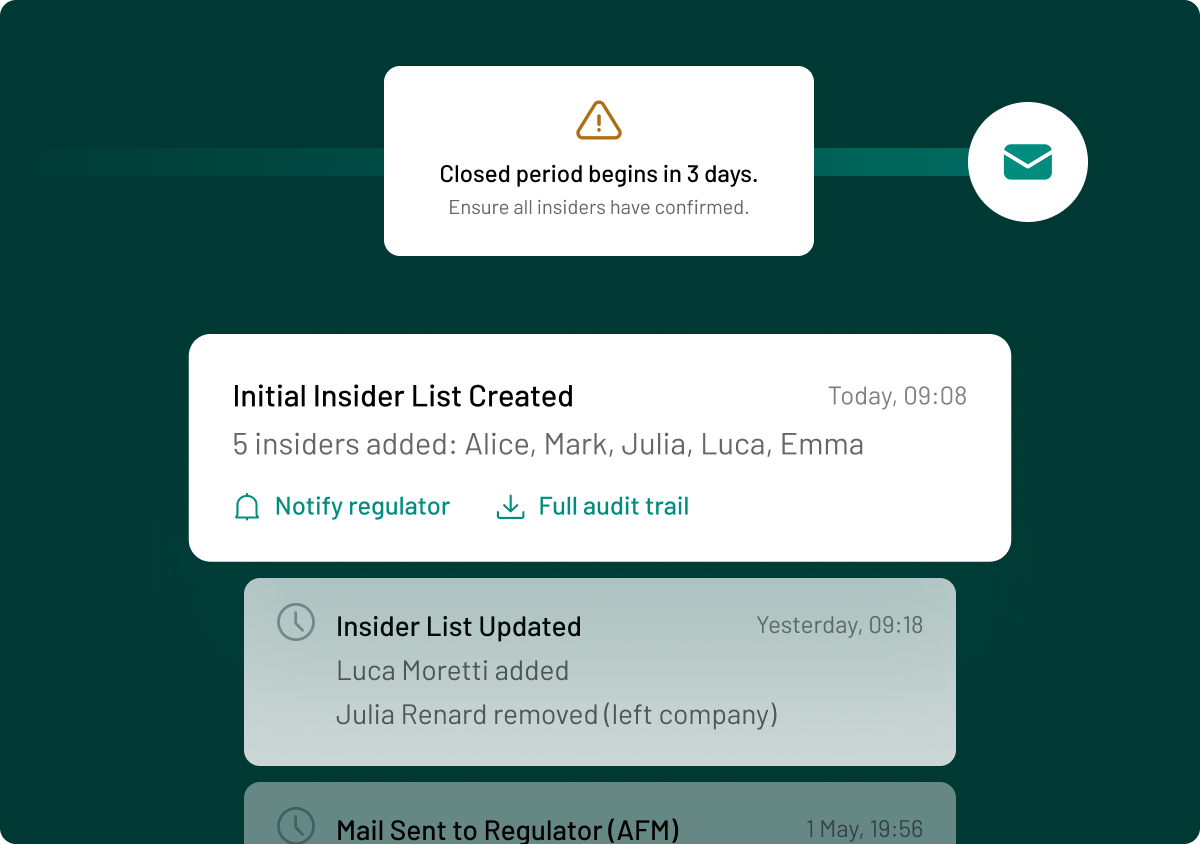
InsiderLog helps you manage insider lists efficiently and maintain full MAR compliance. It allows you to:
- Keep lists in the correct ESMA-compliant insider list requirements
- Automatically save and timestamp every version for a complete audit trail
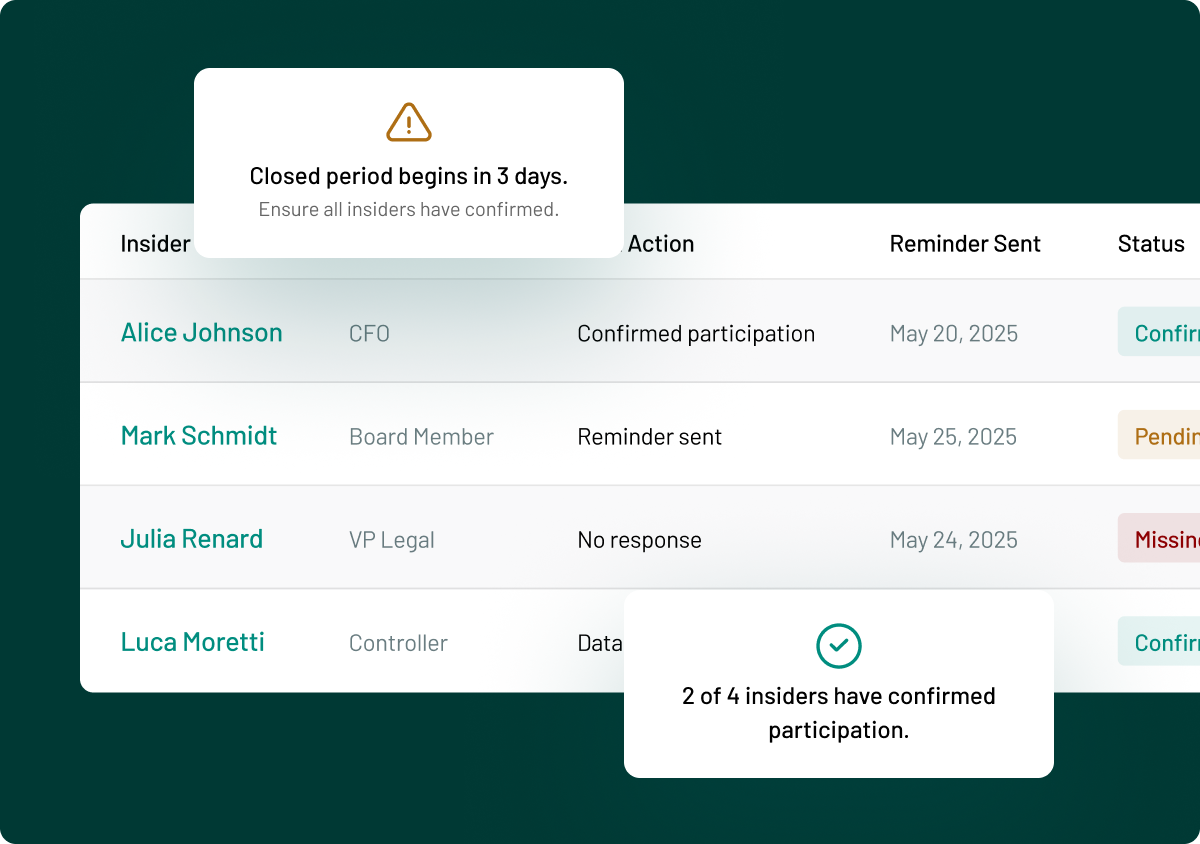
- Send automated emails to insiders to confirm awareness and obligations
- Reduce administrative workload and streamline compliance processes
Request a demo today to see how InsiderLog simplifies insider list management.