









.png)






.svg)
.svg)
.svg)








.png)
.png)






.jpg)

%20F%20(1).jpeg)







.webp)






 Login
Login
Although the trend is shifting, fewer than two-thirds (60%) of C-suite professionals feel that their boards are well equipped to assess their own performance and make the needed adjustments to thrive. In a competitive and turbulent market, the ability of directors to carry out a robust board evaluation and implement the results of that appraisal are essential for the progress of the company and the best interests of its investors and other stakeholders.
Corporate governance bodies across Europe suggest that companies undertake regular reviews of their work and effectiveness. For example:
- The AFEP-MEDEF Code in France recommends company boards review their operations every year. They should also undertake a formal evaluation every three years, led either by the nominations committee or an independent director, in association with an external consultant.
- In the Netherlands, the supervisory board should evaluate itself and the management board every year according to the Dutch Corporate Governance Code. An external assessment is required “periodically.”
- In the Irish Corporate Governance Code, it states that there should be annual board evaluations, with “regular” external reviews. Companies with a market capitalisation in excess of €750 million should undertake an external board review at least every three years.
Within evaluations, it is recommended that directors scrutinise:
- The membership of the board of directors
- How the board is organised
- The effectiveness of its operations, including the quality of its meeting agendas and board packs
- That the board is suitably prepared to discuss in detail important issues
- The efficiency of the board committees
- The contributions made by individual directors.
This article explores the strategic reasons for carrying out board evaluations, how to run effective board assessments and how to overcome the challenges you might face in the process.
Key takeaways
- Treat board assessments as urgent, since only about 60% of C-suite leaders believe their boards can assess themselves and improve.
- Follow leading governance practices by running an annual review and a formal externally assisted evaluation at least every three years for board development.
- Examine composition, organisation, meeting quality, committee effectiveness and individual contributions to spot gaps that weaken decisions in your board self-assessment.
- Use mixed methods, such as surveys, interviews, document review and observation to test behaviour, culture and decision quality, not just process.
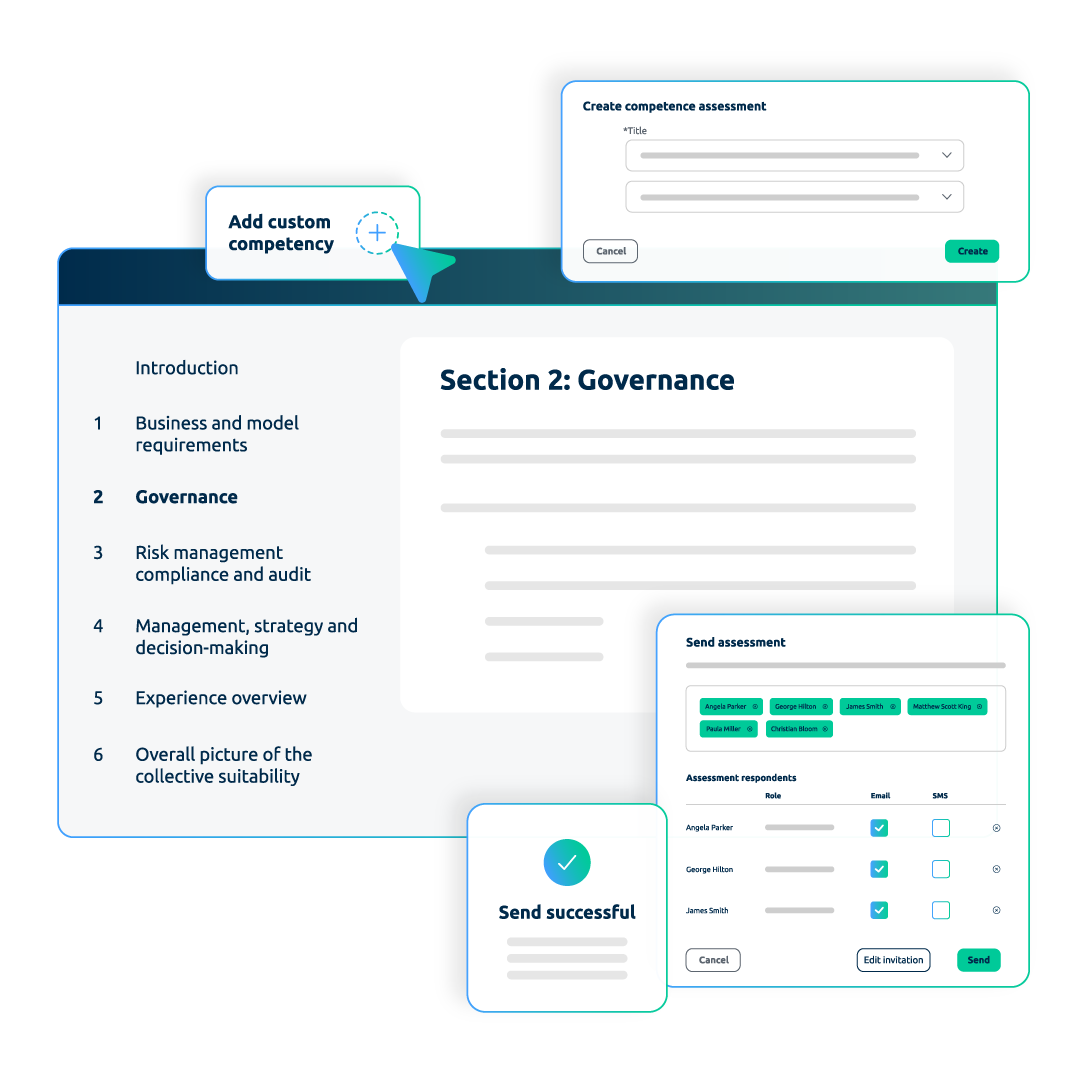
- Share surveys on email, SMS and board portals to increase response rates.
- Turn findings into a prioritised action plan with named owners, deadlines and follow-up so improvements stick.
- Pair annual internal reviews on board practices with periodic independent or hybrid board assessments to add objectivity, benchmarking and credibility.

Why board evaluation has become a strategic priority
- Drives board effectiveness
The concept of continuous improvement is grounded in the ability to be honest about your current board performance and find new ways to streamline and improve your processes in the future. By evaluating your board’s work on a regular basis, you find new ways to be more effective and efficient in your work, striving to achieve ever better results.
- Strengthen decision quality
The evaluation looks into the dynamics of how the board spends its time together, understanding what information is provided and the quality of meeting materials. It drills down on the skills that the board possesses and how debate works in a typical board meeting. This highlights gaps in skills, papers and processes that you can fix to help directors make faster, better decisions with clear rationales.
- Increase accountability
A board evaluation investigates whether actions are turned into tangible outcomes by the individuals or committees tasked with carrying them out. This removes the ability of directors to hide behind the collective and encourages them to take ownership of delivering on the decisions made around the boardroom table.
- Build transparency
The board must document and display how it works, whether facing an internal or external appraisal. During the evaluation, directors are encouraged to be honest and open about how they approach board work as an individual and as a team, making it easier for stakeholders reading the report to understand how the board operates. Directors can also take the opportunity to highlight what they think should improve and how that might happen.
- Support long-term value
The evaluation tests board composition, succession planning and the time spent by the board discussing strategy and future risk. This focuses oversight on long-term goals that seek to drive the board forwards, helping the company grow in a sustainable manner.
Types of board evaluation
Type | Explanation |
Internal board evaluations | The board evaluates itself through a range of different methods. It could be:
This is more cost effective than engaging an external evaluator every year, but someone needs to take ownership of the process to ensure it moves beyond a box-ticking exercise and really analyses the board’s work and output. |
External independent evaluations | Carried out by a qualified third party, with no connection to the company. The evaluator reviews board papers, observes meetings and conducts confidential interviews with board members. They can then benchmark your board against your peers and the legal obligations in your jurisdiction. They also look into board culture, composition, skill gaps, your current processes and the quality of your decision-making. The evaluator issues a report, usually with recommendations for improvements and an outlined action plan to guide you towards a more effective path. |
Hybrid evaluation models | The board carries out an internal review, but works with an independent party to provide external assurance. For example, the company secretary or governance committee might develop the scope, with the independent advisor designing the framework based on that scope. The internal team runs the surveys and interviews, with the external party observing meetings and challenging any outcomes that might demonstrate blind spots or biases. The parties generate a joint report, based on this process. |
Simplify your internal board evaluationsAdmincontrol’s board evaluation platform lets you tailor ready-made surveys to your needs, send them out in minutes, collect confidential responses and automate follow-ups with built-in reminders. |
The 7 steps to an effective board evaluation
1. Set goals
Consider what you want to achieve with the board evaluation. This will help you design the process and its scope more easily, aligning with the overall aim of the project.
On one level, your evaluation should look into how well your board, committees and directors have performed since the last assessment. However, you should also look deeper to understand how well your processes work, whether your board possesses the necessary skills to drive the company towards its goals and what the culture is like in your boardroom.
Think about the corporate governance matters that are pertinent to your company and bear this in mind whilst developing your evaluation.
2. Assign roles and responsibilities
For internal board evaluations, you should assign someone to lead the process. This could be the board chair, the company secretary or chair of the governance or nominations committee. In some circumstances, it could be a combination of different internal parties.
Those leading the evaluation process must be trusted within the organisation, ensuring that board members feel comfortable opening up to them, even if their responses will be confidential. The leader should also be committed to a deep analysis of the board and its function, not someone happy to stay at the surface level, just to tick the job off the governance list.
Provide them with the tools they need to carry out the task to the best of their ability. A board evaluation tool that ensures anonymity means that respondents can be truly open and candid in their answers. Choose a tool that also collates the data and generates a results report, allowing your leader to visualise the themes and make the process of reporting more straightforward.
For external evaluations, seek a qualified expert in the governance field and ascertain whether working with your business would lead to a conflict of interest. Once you find a suitable independent candidate, you can work with them to deliver a report that is based on your desired outcomes.
3. Determine whom to evaluate
Consider who should come under the scope of the evaluation. Here are the reasons to assess these stakeholders.
Board of directors The evaluation will test whether the board as a whole has the skills needed to face long-term challenges and the diversity required to solve problems in innovative ways. It also looks into the board's processes to analyse where it can improve. | Committees Committees are essential to the smooth running and high-level decision-making of the board, requiring them to dig deeply into topics and report findings clearly and promptly. In an evaluation, you should test this workflow to check if it functions as it should. | Individual directors Assessing your directors individually helps identify their strengths and highlight where they need to develop so they can enhance the value they provide to the board. This can also help you with succession planning and help inform the skills to look for. |
Chair It is essential to ensure your chair is effective in their leadership role and keeps the discussion balanced, highlighting decisions and assigning owners to action items. Assess how they interact with the CEO to understand whether there is good and productive communication. | Company secretary Look into whether the secretary delivers accurate and comprehensive papers and minutes in a timely manner that meets the regulatory requirements. Making sure the company secretary is working to improve the quality and auditability of the board’s work. | CEO Evaluate the CEO to ensure the organisation stays aligned all the way from the boardroom to daily operations. A robust CEO evaluation helps turn strategy into results and reinforces clear accountability from the chief executive. |
4. Make a list of evaluation topics
In line with the goals of your evaluation, pick out the areas of board work that you want to cover in the assessment. This will be different for every organisation and you should develop the list according to your governance priorities. However, common themes to focus on include:
- Analysis of your board meeting agendas, minutes and other documents in your board papers
- The board composition, its structure and the work of its committees
- Board dynamics, diversity, culture, communication and collaboration
- Meeting processes and outcomes
- Director and executive succession planning
- Board member onboarding and orientation
- Governance documents, such as guidelines and charters
- The performance of the board as a whole and of individual directors
- The performance of leadership, including the chair
- Oversight and risk management processes
- Investor engagement with the board of directors.
5. Design evaluation questions
When you have the topics you want to cover, you can work on the questions you need to ask. Aim for a mix of those that provide both qualitative and quantitative data to gain a comprehensive overview of the board’s effectiveness and performance.
Quantitative questions provide answers that can be counted or measured and might include having directors rate statements on a scale of 1 to 5, depending on how much they agree with them. These questions might also be used to gather facts, such as the average number of days the agenda is delivered before a meeting, for example. | Qualitative questions use who, what, how, why, when and where at the start to extract comments from directors. Although they are subjective answers, they can illustrate to the evaluator some of the issues and challenges that the board faces, helping to create a more wide-ranging view of the board than simply by asking quantitative questions. |
Example questions
Type | Example |
Quantitative | How confident are you that the board’s skills match the current strategy and risks? (1 to 5) |
What proportion of agenda time in the last three meetings was spent on decisions rather than updates? (%) | |
How long before the meeting are the board papers delivered in days? (number) | |
Qualitative | What one change would most improve meeting effectiveness next quarter? |
Give one example where a board challenge was addressed this year. | |
Which top risk needs deeper board attention next quarter and why? |
6. Choose the right evaluation method(s)
To evaluate your board, there are a number of methods you can utilise. Here are the most common board evaluation methods:
- Surveys and questionnaires are valuable methods for evaluating the board and its members. Once you have crafted the questions to reflect those matters that are a priority for your organisation, sending a survey to all board members with the same questions allows you to compare their answers on each topic and gain a clearer impression of any pressing issues. The anonymous nature of a survey means that your directors are less likely to be worried about being honest, making it easier to get to the root of challenges.
- Interviews and workshops can glean important information due to the conversational nature of the method. If there are any specific issues that have arisen or have the potential to, engaging in a private discussion with a skilled interviewer or a group conversation can help surface additional detail. However, there must be trust between the interviewer or facilitator and interviewees. The evaluator should also be knowledgeable about the company and the matters at hand to be able to steer the conversation appropriately.
- Observation and document review provide another angle for the evaluation, with the evaluator able to watch the board’s processes in action and dispassionately. This provides them with the opportunity to spot any opportunities or issues that those closer to the action might miss in the process of carrying out their work.
Save time creating and distributing evaluation surveysAdmincontrol provides a range of templates that you can tailor to your company’s exact needs without starting from scratch. Our board survey tool is based on best practice and allows you to distribute your questionnaires instantly within the board management solution. |
7. Analyse the results
Understanding the results of your board evaluation and using them to positively affect your company’s governance is a key step in the evaluation process. Collect the quantitative insights into a presentation to help visualise the data and what it says about the effectiveness of the board, the chair’s performance, the success of your meeting processes, compliance and other aspects of the evaluation.
Break down the scores into topics and track over time, benchmarking against your own previous scores and those publically available scores from peers. Use this to understand what the evaluation is telling you about the direction of travel, the areas in which your board is excelling and where you need to make improvements.
Process the qualitative data and extract recurring and interesting information that refers to the areas of focus.
Collate all outcomes into a report, describing the current state of the board and a plan of action that will improve processes and keep you moving in the right direction to meet your mission. Discuss this internally and then create messaging to contextualise the results before sharing it with shareholders and other external stakeholders.
Tools for board evaluations
There are multiple ways to run a board evaluation, using a range of different techniques and tools. This table provides examples of the most common approaches:
Tool | Best for | Why it works | Need to know |
Excel or Google Sheets | Very small boards, early-stage organisations, quick internal pulse checks | Cheap and flexible for scoring and simple charts | Weak anonymity and version control, manual chasing, harder to evidence process if challenged |
Word or PDF questionnaires | Formal-looking annual reviews where you need a fixed template | Easy to standardise questions and keep a record of what you asked | Manual distribution and collation, slow to analyse, confidentiality depends on how you collect replies |
Generic survey tools (such as Microsoft Forms, SurveyMonkey etc.) | Quick surveys with basic reporting | Faster distribution than documents, can automate some reminders depending on plan | Anonymity settings might be unclear to users, governance-style outputs still need manual shaping, limited board-specific workflows |
Admincontrol Board Evaluation solution | Boards that want confidentiality, structure and repeatable year-on-year evaluation | Distribute surveys quickly, keep responses anonymous, track participation with automatic reminders and get topic breakdowns and year-over-year comparisons, including completing surveys in the app | You still need robust scope and follow-through; the tool supports the process but must be used in-line with oversight and judgement. |
What a good board evaluation should include
Element | Examples |
Governance structures and processes | Clear roles, committee charters and an annual calendar. Well-run meetings with timely papers, accurate minutes and tracked actions. Documented decision and escalation processes. |
Board composition and expertise | A skills and experience matrix aligned to strategy and key risks. Appropriate independence and diversity. Live succession, effective induction and ongoing development. |
Decision-making and oversight | Agendas focused on decisions, not updates. Options with evidence, risks and trade-offs. Clear resolutions and systematic follow-through with measurable outcomes. |
Board dynamics and culture | Open, respectful challenge with balanced participation. Psychological safety. Conflicts of interest declared and managed. Constructive chairing that brings all voices in. |
Alignment with strategic goals | Board time and KPIs tied to strategic pillars. Regular review of progress, resource allocation and course-corrections to keep strategy on track. |
Risk and compliance oversight | Defined risk appetite used in decisions. Concise risk reporting. Robust controls, audit and regulatory compliance. Readiness for incidents and material ESG risks. |
Internal vs external evaluation
Here are the key differences between internal and external evaluation:
Aspect | Internal evaluation | External evaluation |
Who runs it | Company secretary or governance committee | Independent specialist with no ties to the company |
Independence | Lower: risk of blind spots or bias | Higher: fresh perspective and challenge, but potentially less trust from interviewees |
Cost and speed | Lower cost, faster to organise | Higher cost, longer lead time |
Method and tools | Surveys, interviews and document reviews using in-house templates | Observation, benchmarking and culture testing, as well as interviews and surveys |
Practical outputs | Prioritised action list owned by the board and shared with stakeholders | Prioritised recommendations, action plan and follow-up review |
A mixture of internal and external evaluations is recommended by many corporate governance organisations, with many suggesting annual internal appraisals and an external review every three years. You might also want to consider an external evaluation after major events, such as a crisis, merger or change of leadership.
Best practices for conducting board evaluations
- Take time to draft and redraft the questions for your survey so that they are targeted at the right audience (board member, chair, committee member) and will encourage answers that are valuable to help you improve the performance of your board as a whole.
- Structure clear and actionable reports that highlight the most important outcomes and show a clear pathway to address issues and improve governance within your organisation.
- Identify systemic vs individual issues so you understand whether your remedies require improved training and coaching or a complete restructuring of your current processes.
- Prioritise improvement areas so they align with your organisation’s goals and mission or reflect the urgency with which issues must be fixed.
- Use a mix of methods to elicit both qualitative and quantitative answers from participants, as well as finding the ways that make them most comfortable sharing insights into their view of the board and its effectiveness.
- Protect the confidentiality of board members to allow them to be candid in their feedback without fear of repercussions.
What should boards look for in board evaluation software?
Here are the features you should consider when you look for board evaluation software to carry out the assessment process for your boards of directors:
- Confidentiality for respondents to allow them to be more open and honest when sharing their insights on the work of the board, the committees and their colleagues.
- Templates to provide pre-written questions, based on board evaluation best practices, saving time creating your board’s survey.
- The ability to tailor templates to your specific needs, removing questions that aren’t relevant and adding your own questions if needed.
- A range of delivery routes, depending on individual preference. You should be able to send the survey via email, SMS and your board portal to ensure you reach all stakeholders.
- Automated reminders to stakeholders to fill in their answers to the survey. A digital platform can carry this out without compromising the anonymity of those answering the questions.
- Clear reports generated from the responses of board members, collating their answers and displaying collected insights.
- A breakdown of scores for each topic area so you can dive into specific aspects of board work and understand what is happening. This makes it easier to quickly identify the highest and lowest scoring areas.
- Analytics to allow you to easily compare scores survey on survey and year on year, making it simpler to track progress.
Make every board evaluation countAdmincontrol gives you everything you need to run efficient, structured internal board evaluations, without the manual work. Save time, increase response rates and generate boardroom-ready reports that make it easy to share outcomes and agree next steps. |
An effective board evaluation is an essential part of your governance process, helping you understand what is working and where your board needs to improve to help the company meet its goals. Whilst most governance leaders recommend an external review every two to three years, carrying out annual internal board assessments is a powerful tool for ensuring your processes are effective and robust enough to help you drive value into the future.
FAQ
A board review is a lighter health check focused on quick improvements, while a board evaluation is a deeper, evidence-based assessment of composition, behaviours, decision quality and outcomes.
Run an internal evaluation every year and commission an external one every two to three years or after major events such as a merger or crisis.
The governance committee or company secretary can lead internal reviews, but an independent adviser should run periodic external evaluations to add objectivity and benchmarking.
It maps skills against strategy, flags gaps and readiness and turns findings into a timed pipeline for chair, committee and director roles.
There are a number of ways to sell the process to resistant individuals:
- Build a culture of openness that values feedback and the opportunity to grow
- Engage the chair as a change leader and have them commit to putting in place recommendations
- Embed evaluation into governance cycles so it becomes an integral part of the board calendar.
Treat them as a performance plan; prioritise the top few fixes, set deadlines and show progress quickly to rebuild confidence.
Clear scope and independence, evidence-based findings, a focused action plan with owners and dates and a short public summary that shows your progress year on year.