









.png)




.svg)
.svg)
.svg)







.png)
.png)






.jpg)

%20F%20(1).jpeg)







.webp)






 Login
Login
Key Facts at a Glance
| Fact | Detail |
|---|---|
| What is an LEI? |
A unique 20-character alphanumeric code that identifies a legal entity in financial transactions |
| Standard |
ISO 17442 |
| Governing body |
Global Legal Entity Identifier Foundation (GLEIF), based in Basel, Switzerland |
| Regulatory oversight |
Regulatory Oversight Committee (ROC) — 70+ international public authorities |
| Active LEIs worldwide |
2.6 million+ (as of 2025) |
| Jurisdictions covered |
90+ countries recognised by the ROC |
| Who issues LEIs? |
GLEIF-accredited Local Operating Units (LOUs), including Euronext Dublin |
| Renewal frequency |
Annual — LEIs must be renewed every 12 months |
| Data availability |
Fully open — all LEI data is free and publicly searchable at search.gleif.org |
| Origin |
G20 mandate (2012), following the global financial crisis (2008) |
The History of the Global LEI System
The LEI system did not emerge from a single regulatory decision — it was the product of years of international coordination following a global crisis.
2008 — Financial Crisis: The collapse of Lehman Brothers and the ensuing financial crisis revealed a critical problem: regulators and market participants had no common way to identify who owed what to whom across the global financial system. Legal entities were identified differently in different countries, by different institutions, using different codes. The result was opacity at the worst possible moment.
2012 — G20 Mandate: The G20, acting on recommendations from the Financial Stability Board (FSB), mandated the creation of a global system to uniquely identify legal entities in financial transactions. The Regulatory Oversight Committee (ROC) was established to govern the system.
2014 — GLEIF Founded: The Global Legal Entity Identifier Foundation (GLEIF) was established in Basel, Switzerland, as the global operator of the LEI system. GLEIF began accrediting Local Operating Units (LOUs) to issue LEIs.
2017 — MiFID II: The Markets in Financial Instruments Directive II came into force across the EU, making LEI mandatory for all legal entities executing regulated financial transactions — establishing the foundational 'no LEI, no trade' principle.
2019–2024 — Expansion: LEI requirements expanded under SFTR, DORA, and various non-EU regulatory frameworks. The vLEI (verifiable LEI) was introduced by GLEIF as a cryptographic digital credential extension of the LEI system.
2025+ — GLEIF 2.0 Era: The LEI system continues to evolve with the vLEI ecosystem, connecting traditional LEI data to digital identity infrastructure for automated trust in financial and corporate transactions. Check our article GLEIF 2.0 and the vLEI.
The Main Components of the Global LEI System
The Global LEI System is built on three interlocking components. This is how the LEI system works:
1. The Regulatory Oversight Committee (ROC)
The ROC is a voluntary body of more than 70 public authorities — central banks, securities regulators, and government ministries from around the world — that provides high-level governance oversight of the LEI system. The ROC ensures that the system serves the public interest and meets the regulatory needs of its member jurisdictions.
2. The Global Legal Entity Identifier Foundation (GLEIF)
GLEIF is the operational body that manages the global LEI database, sets data quality standards, accredits and monitors LOUs, and publishes all LEI data as freely accessible open data. GLEIF is the authoritative source for LEI data quality and the ultimate repository of all LEI records issued worldwide.
3. Local Operating Units (LOUs)
LOUs are the entities that directly interface with legal entities applying for LEIs. Each LOU is accredited by GLEIF and operates under strict data quality requirements. Euronext Dublin — operating through the Euronext Direct portal — is a GLEIF-accredited LOU serving entities in 90+ jurisdictions. LOUs are responsible for validating application data, issuing LEI codes, managing renewals, processing updates, and handling transfers.
Where Is the Global LEI System Used?
The LEI is embedded across a wide and growing range of regulatory and commercial contexts. Below you can find the reasons why the LEI code is essential:
- Financial transaction reporting — MiFID II, EMIR, SFTR (derivatives, securities, and securities financing transactions)
- Trade execution — the 'no LEI, no trade' rule under MiFID II for eligible counterparties
- KYC and AML — entity verification in client onboarding processes
- Digital operational resilience — ICT third-party service provider registers under DORA
- Sustainable finance — entity identification in SFDR and CSRD disclosures
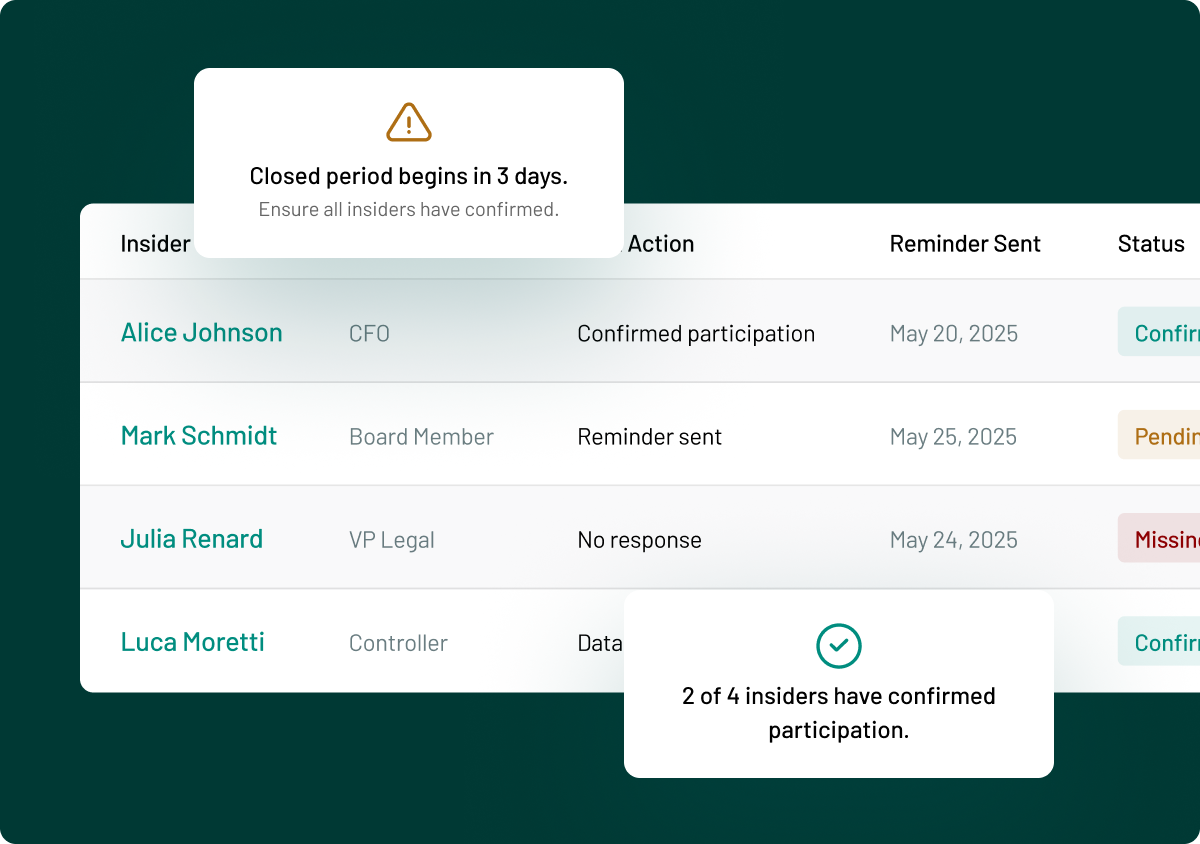
- Market abuse compliance — insider lists and PDMR transaction reports under MAR
- Public procurement — entity identification in government contract processes
- Cross-border M&A and corporate transactions — entity identification in deal documentation
How to Get an LEI Through Euronext Direct
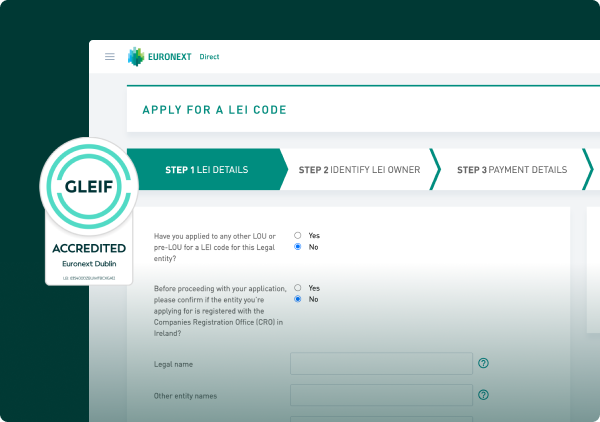
Euronext Direct is the GLEIF-accredited LEI issuance platform operated by Euronext Dublin. Getting your LEI is a straightforward online process:
- Create an account at direct.euronext.com
- Enter your legal entity's details: legal name, registered address, jurisdiction, and company registration number
- Upload any required supporting documentation (e.g., certificate of incorporation)
- Complete secure online payment for your LEI application
- Your LEI is issued — typically within one business day — and immediately published in the GLEIF Global LEI Index
For organisations managing multiple LEIs, Euronext Direct offers bulk application processing with a 33% discount on 10 or more new registrations. LEI transfers from other LOUs are accepted free of charge.
Related Topics
- Why the LEI Code Is Essential for Financial and Legal Transactions
- How the Global LEI System Works: A Complete Guide
- How to Look Up a Company's LEI in the GLEIF Database
- GLEIF 2.0 and the Evolution of the LEI System
- How to get an LEI' section
- Euronext LEI solutions
Frequently Asked Questions
The LEI system is global. While much of the early regulatory adoption happened in Europe (under MiFID II, EMIR, SFTR), the system now covers 90+ jurisdictions worldwide. Major markets in Asia, the Americas, and Oceania also reference LEI in their regulatory frameworks. The system is governed internationally by the ROC and GLEIF, not by any single national authority.
The LEI system is regulated internationally by the Regulatory Oversight Committee (ROC), a voluntary body of over 70 public authorities from around the world. GLEIF is the operationally responsible entity, accredited by the ROC. Individual LOUs are subject to GLEIF accreditation requirements and, in some jurisdictions, national financial regulation.
Yes. All LEI reference data — including entity names, addresses, parent relationships, and LEI status — is freely accessible to anyone through the GLEIF Global LEI Index at search.gleif.org. This open data model is a core principle of the LEI system: transparency requires that the data be universally accessible at no cost.
Yes. You can search for any entity's LEI, verify its status, and view its full reference data record — including parent entity information — for free at search.gleif.org. For a step-by-step guide to LEI lookup, see our guide: How to Look Up an LEI in the GLEIF Database.