









.png)




.svg)
.svg)
.svg)







.png)
.png)






.jpg)

%20F%20(1).jpeg)







.webp)






 Login
Login
This article explains why the LEI code matters, which regulations require it, and what the consequences are for entities that operate without one. It also outlines how Euronext Direct — a GLEIF-accredited Local Operating Unit — simplifies the process of obtaining and maintaining your LEI.
What Is an LEI Code?
An LEI (Legal Entity Identifier) is a 20-character alphanumeric code structured according to the ISO 17442 standard. Each LEI is unique to one legal entity and contains two layers of information: the entity's reference data (legal name, registered address, country of formation) and relationship data (direct and ultimate parent entities). LEI codes are issued by Local Operating Units (LOUs) accredited by the Global Legal Entity Identifier Foundation (GLEIF), the international body that governs the LEI system.
The LEI was created in response to the 2008 financial crisis, when regulators discovered that the absence of a universal identifier for financial entities had made it impossible to accurately map exposures and counterparty risk across the global system. The G20 mandated its creation in 2012. Today, more than 2.6 million active LEIs have been issued across more than 90 jurisdictions worldwide.
What Happens Without a Valid LEI?
The consequences of not having an active, valid LEI are immediate and commercially significant. Financial market participants and regulated entities that cannot provide a valid LEI face the following outcomes:
- Cannot execute or report trades under MiFID II: investment firms and trading venues are prohibited from executing a transaction on behalf of a client that is required to have an LEI but does not have one — a principle commonly summarised as 'no LEI, no trade'.
- Cannot report derivatives under EMIR or SFTR: both legs of a trade require valid LEIs for counterparty identification. Missing or lapsed LEIs result in rejected reports and potential sanctions.
- Cannot participate in ICT third-party risk registers under DORA: the Digital Operational Resilience Act requires LEIs for the identification of ICT third-party service providers in financial entities' reporting.
- Risk regulatory penalties: national competent authorities (NCAs) across the EU have issued fines and warnings for repeated failures to maintain valid LEIs.
-
Damaged counterparty relationships: a lapsed or missing LEI can block onboarding by counterparties who are themselves required to verify LEI validity before executing transactions.
| A lapsed LEI carries the same practical consequence as having no LEI at all. Annual renewal is mandatory. Euronext Direct sends renewal reminders and processes renewals within 24 hours. |
|---|
LEI Requirements Under Key EU Regulations
The LEI obligation is embedded across multiple pillars of EU financial regulation. The table below maps the major regulatory frameworks to their specific LEI requirements:
| Regulation | LEI Requirement |
|---|---|
| MiFID II / MiFIR (Markets in Financial Instruments Directive) |
LEI required for all legal entities executing or reporting investment transactions. Trading venues and investment firms apply the 'no LEI, no trade' rule for eligible counterparties. See here the MiFID II requirements |
| EMIR (European Market Infrastructure Regulation) |
Both counterparties to OTC derivatives contracts must have valid LEIs. LEI is required in all trade reports submitted to authorised trade repositories. |
| SFTR (Securities Financing Transactions Regulation) |
LEI required for both counterparties and the entity responsible for reporting. Any SFT — repo, securities lending, buy-sell-back — must be reported with valid LEIs. |
| DORA (Digital Operational Resilience Act) |
Financial entities must register the LEIs of ICT third-party service providers. LEI used to identify entities in ICT incident reports and register of information. |
| Solvency II / AIFMD / UCITS V |
LEI used for fund and asset manager identification in regulatory reporting to national competent authorities. |
| MAR (Market Abuse Regulation) |
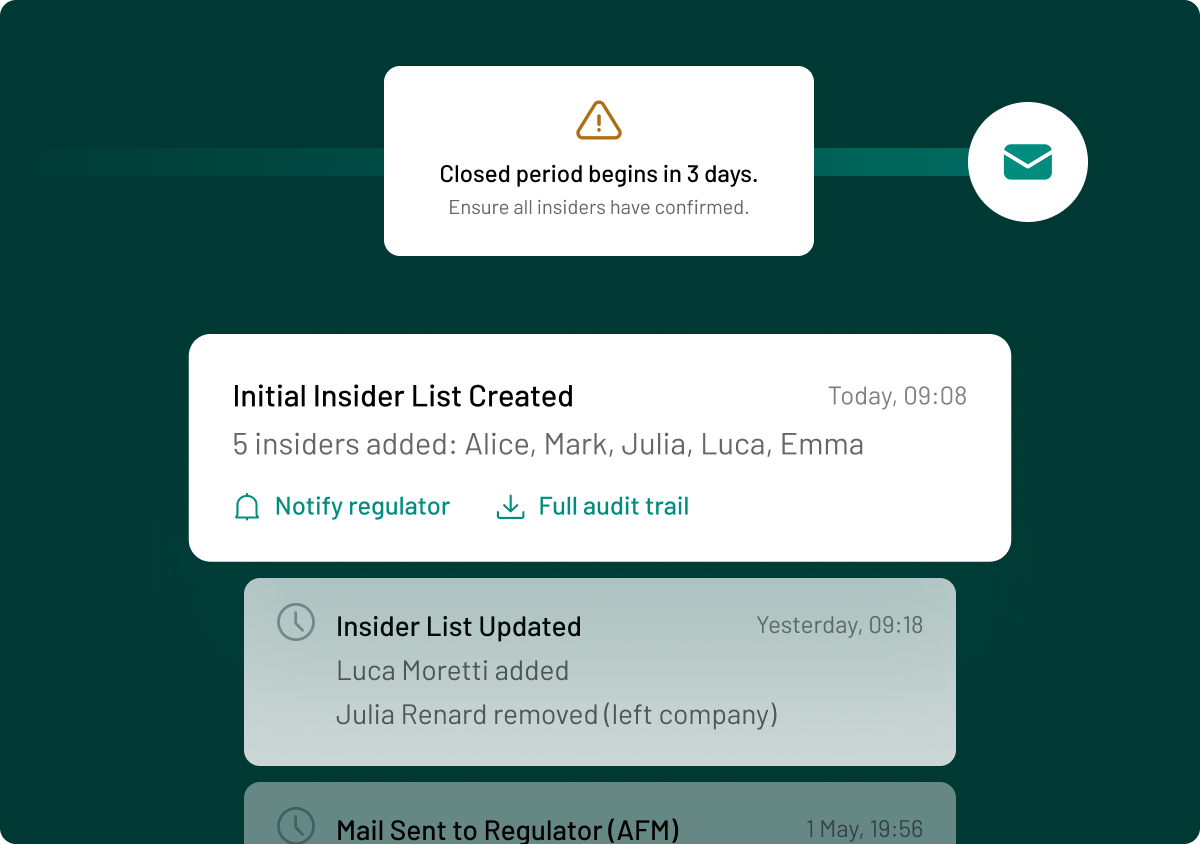
LEI used to identify legal entities on insider lists and in transaction reports under Article 19 (PDMR transactions). |
The LEI in Legal Transactions: Beyond Trading
While the LEI originated in financial markets regulation, its application has expanded significantly into legal and corporate transactions. Today, legal counsel and corporate secretaries increasingly encounter LEI requirements in the following contexts:
KYC and AML Verification
Know Your Customer (KYC) and Anti-Money Laundering (AML) frameworks now routinely incorporate LEI verification as a first-pass entity validation step. A valid, active LEI provides instant confirmation of a legal entity's name, jurisdiction of formation, and corporate structure — significantly accelerating client onboarding and third-party due diligence workflows.
Cross-Border M&A and Corporate Transactions
In cross-border mergers, acquisitions, and joint ventures, LEIs are increasingly referenced in transaction documentation to uniquely identify all parties (which adds importantce to the Global LEI System). Post-transaction, entities that are merged, dissolved, or restructured must update their LEI relationship data to reflect the new corporate structure — a requirement that falls to the compliance or legal team to manage especially through a multi-jurisdictional regulatory compliance framework.
ESG Reporting and Sustainable Finance
The EU Sustainable Finance Disclosure Regulation (SFDR) and the Corporate Sustainability Reporting Directive (CSRD) use LEI to identify financial market participants and companies in sustainability disclosures. As ESG reporting obligations expand, having a valid LEI is increasingly a prerequisite for institutional engagement.
Government Procurement and Public Contracts
Several EU member states and international institutions have introduced LEI as a unique identifier in public procurement processes, grant applications, and subsidy reporting — particularly for corporate entities transacting with public bodies above defined thresholds.
Who Needs an LEI?
An LEI is required for any legal entity that engages in regulated financial transactions or is subject to regulatory reporting obligations. This includes:
- Banks, investment firms, and broker-dealers
- Insurance companies and pension funds
- Asset managers, fund managers, and collective investment vehicles
- Non-financial corporates trading OTC derivatives for hedging purposes
- Listed companies (for regulatory disclosures and insider lists under MAR)
- ICT third-party service providers named in DORA registers
- Legal entities engaging in securities financing transactions (repos, securities lending)
- Any company seeking to participate in EU public procurement above defined thresholds
Individual natural persons do not require an LEI. LEIs are issued to legal entities only — companies, partnerships, trusts, government bodies, and other organised entities with legal personality by LEI services providers.
How Euronext Direct Simplifies LEI Compliance
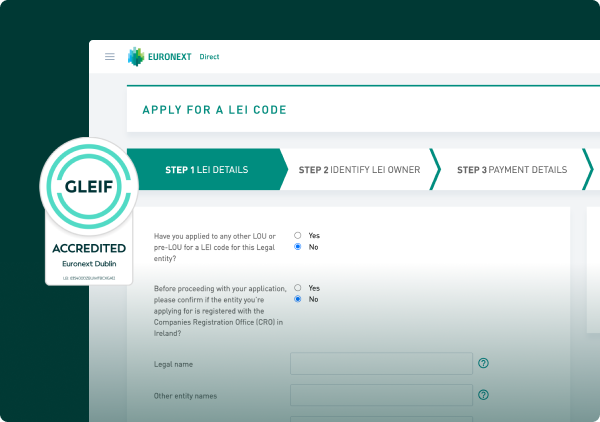
Euronext Direct is the LEI issuance platform operated by Euronext Dublin, a GLEIF-accredited Local Operating Unit (LOU). As a regulated entity within the Euronext Group — one of Europe's leading exchange operators — Euronext Direct combines the trust and infrastructure of an established financial institution with the simplicity of a fully digital application process. here is how the LEI system works :
- Apply online in minutes: create a secure account on the Euronext Direct portal, enter your entity's legal details, and submit supporting documentation — all in one streamlined flow.
- Global coverage in 90+ jurisdictions: Euronext Direct issues LEIs to entities in over 90 jurisdictions recognised by the Regulatory Oversight Committee, regardless of the entity's country of incorporation.
- Free LEI transfers: transfer your existing LEI from another LOU to Euronext Direct at no cost, with no compliance interruption.
- Annual renewal management: Euronext Direct sends renewal reminders before expiry and processes renewals within 24 hours to ensure your LEI remains active.
- Volume discounts: organisations managing 10 or more LEIs benefit from a 33% discount on new registrations.
- Dedicated support: a specialist LEI team is available to assist at every stage of the registration, renewal, update, or transfer process.
Related Topics
- What Is the Global Legal Entity Identifier (LEI) System?
- How the Global LEI System Works: A Complete Guide
- How to Look Up a Company's LEI in the GLEIF Database
- GLEIF 2.0 and the Evolution of the LEI System
Frequently Asked Questions
Not all companies — but all legal entities that execute or report regulated financial transactions are required to have a valid LEI. This includes banks, investment firms, funds, and non-financial corporates trading OTC derivatives. Listed companies also require an LEI for MAR-related disclosures. If your entity is subject to MiFID II, EMIR, SFTR, DORA, or similar regulation, an LEI is mandatory.
An expired (lapsed) LEI has the same effect as no LEI: your entity may be blocked from executing trades, submitting regulatory reports, or completing KYC verification with counterparties. LEI renewal is an annual requirement. Euronext Direct provides renewal reminders and processes renewals within 24 hours. You can renew your LEI with Euronext Direct.
In the majority of cases, LEI applications submitted through Euronext Direct are processed within one business day. Straightforward applications for entities with publicly available registration information are often completed within hours.
Yes. Euronext Direct offers free LEI transfers from any other GLEIF-accredited Local Operating Unit. The transfer process involves no downtime and no change to your LEI code — only the LOU managing the LEI changes.
Yes. Any legal entity — regardless of where it is incorporated — that wishes to execute regulated transactions in EU markets or report to EU regulators must obtain a valid LEI. Euronext Direct issues LEIs to entities in over 90 jurisdictions worldwide.