









.png)




.svg)
.svg)
.svg)







.png)
.png)







.jpg)

%20F%20(1).jpeg)







.webp)






 Login
Login
This guide answers all of those questions — giving compliance professionals, operations managers, and corporate secretaries a complete, jargon-free understanding of how the Global LEI System works from the ground up.
The Purpose of the LEI System
Before the LEI existed, there was no single, globally accepted way to identify a legal entity across different jurisdictions, regulatory systems, and financial institutions. Banks maintained their own proprietary entity identifiers. Regulators in different countries used different national codes. The result, exposed catastrophically during the 2008 financial crisis, was that no one could reliably map exposures, trace ownership chains, or quantify systemic risk across the global financial system.
The Financial Stability Board (FSB) — an international body that monitors global financial systems — identified the absence of a universal legal entity identifier as a critical gap. In 2012, the G20 mandated the creation of a global LEI system. The goal was simple but transformative: to give every legal entity engaged in financial markets a unique, universal identifier — the way individuals have passport numbers — so that any transaction could be traced back to an identified, verifiable legal person.
Today the LEI system serves three core functions. First, identification: establishing who the participants in any financial transaction are. Second, transparency: enabling regulators, researchers, and market participants to understand ownership structures and corporate relationships. Third, interconnection: providing a common reference point that connects data across different reporting systems, regulators, and jurisdictions.
How the LEI System Is Structured
The Global LEI System operates through a three-tier governance and operational structure:
| Level | Body |
Role |
|---|---|---|
| Level 1 — Governance |
Regulatory Oversight Committee (ROC) |
A global body of over 70 public authorities (central banks, financial regulators, government ministries) that oversees the LEI system's governance and policy framework. The ROC endorses GLEIF as the LEI system operator. |
| Level 2 — Operations |
Global Legal Entity Identifier Foundation (GLEIF) |
A not-for-profit foundation based in Basel, Switzerland, that manages the global LEI database, accredits LOUs, sets data quality standards, and publishes the full LEI dataset as open data. |
| Level 3 — Issuance |
Local Operating Units (LOUs) |
GLEIF-accredited organisations that directly issue, renew, update, and manage LEIs for legal entities. LOUs operate in specific jurisdictions or globally. Euronext Dublin is a GLEIF-accredited LOU, issuing LEIs via Euronext Direct to entities in 90+ jurisdictions. |
This structure ensures that the LEI system is globally consistent (governed by international standards) while operationally distributed (issued locally by entities with regulatory accountability in their markets). GLEIF publishes all LEI data as open, freely searchable data through the Global LEI Index — ensuring that any entity can look up any LEI at no cost. Check here to see how to look up an LEI in the GLEIF database.
What an LEI Code Contains
Each LEI is a 20-character alphanumeric code structured according to ISO 17442. The code itself is divided into three segments:
| Segment | Description |
|---|---|
| Characters 1–4 (LOU prefix) |
Identifies the Local Operating Unit that issued the LEI. Each LOU has a unique 4-character prefix assigned by GLEIF. |
| Characters 5–18 (Entity-specific) |
A unique alphanumeric string that identifies the specific legal entity. This portion is generated by the issuing LOU and is unique within the global system. |
| Characters 19–20 (Check digits) |
Two numeric check digits calculated using the ISO 7064 Mod 97-10 algorithm, used to validate the integrity of the full LEI code. |
Beyond the code itself, each LEI is accompanied by a data record — the LEI Reference Data — which contains key information about the legal entity. This reference data is standardised across all LOUs and includes:
- Legal name of the entity (in the local language and in transliteration where applicable)
- Legal address and headquarters address
- Country and jurisdiction of registration
- Company registration number (from the relevant national company registry)
- Entity status: Active, Inactive, or Pending
- LEI renewal date and date of first issuance
- Direct parent entity (if applicable) — the lowest-level entity that consolidates the child entity
- Ultimate parent entity (if applicable) — the highest-level entity in the ownership chain
|
The parent relationship data — 'who owns whom' — is what transforms the LEI from a simple identifier into a tool for mapping corporate structures and systemic risk across global markets. |
The LEI Lifecycle: From Application to Annual Renewal
Obtaining and maintaining an LEI involves a defined lifecycle. Understanding each stage helps compliance teams plan their workflows and avoid lapses that could disrupt business operations.
Step 1 — Application
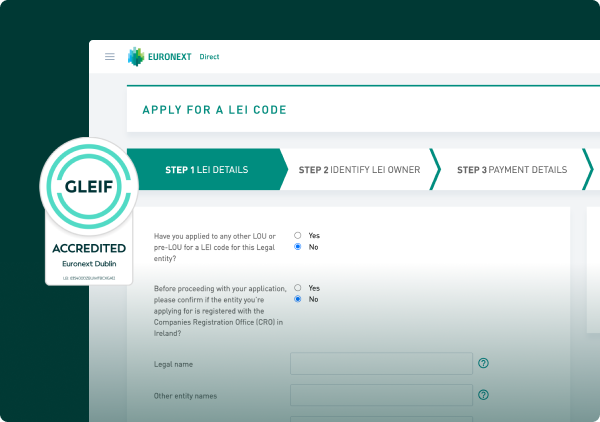
A legal entity applies for an LEI through a GLEIF-accredited LOU — such as Euronext Direct. The application requires the entity to provide its legal name, registered address, jurisdiction of formation, and company registration number. Supporting documentation (certificate of incorporation or equivalent) may be requested to validate the information against the relevant national registry.
Step 2 — Validation and Issuance
The LOU validates the submitted data against authoritative public sources (national business registries, GLEIF reference lists). Once validated, the LEI code is generated, the reference data record is created, and the LEI is published in the GLEIF Global LEI Index. Issuance typically occurs within one business day. For Euronext Direct, most straightforward applications are completed within hours.
Step 3 — Active LEI
Once issued, the LEI is active and publicly searchable. The entity can immediately use its LEI in regulatory reports, trading documentation, and counterparty onboarding processes. The LEI remains active for 12 months from the date of issuance.
Step 4 — Annual Renewal
LEIs must be renewed every 12 months. The renewal process requires the entity (or its designated manager) to confirm that the LEI reference data remains accurate and up to date. Euronext Direct automatically sends renewal reminders before expiry and processes renewals within 24 hours of submission. An LEI that is not renewed becomes 'Lapsed' — which has the same practical effect as not having an LEI at all.
Step 5 — Updates and Corrections
Any change to the legal entity's reference data — a name change, address change, merger, acquisition, or change in parent relationships — must be reflected in the LEI record. Euronext Direct allows entities to submit updates free of charge through the portal. Keeping LEI data accurate is both a regulatory obligation and a practical necessity for counterparties relying on the GLEIF database for due diligence.
Step 6 — Transfer (Porting) Between LOUs
An entity may transfer its existing LEI from one LOU to another at any time — for example, to consolidate LEI management with a single provider or to benefit from better pricing or service. The LEI code does not change during a transfer. Euronext Direct accepts transfers from any GLEIF-accredited LOU at no cost, with no interruption to the LEI's active status.
Who Needs an LEI? Entity Types and Jurisdictions
| Entity Category |
Regulatory Driver(s) |
|---|---|
| Banks and credit institutions | MiFID II, EMIR, SFTR, DORA |
| Investment firms and broker-dealers | MiFID II, EMIR |
| Asset managers and fund managers (UCITS, AIFMD) | UCITS V, AIFMD, EMIR |
| Insurance companies and pension funds |
Solvency II, EMIR |
| Listed companies |
MAR, MiFID II (transaction reporting) |
| Non-financial corporates trading OTC derivatives |
EMIR |
| ICT third-party service providers (fintech, cloud, software) |
DORA |
| Entities in public procurement above thresholds |
Various national procurement regulations |
Why Choose Euronext Direct as Your LEI Provider?
Euronext Direct is the LEI issuance platform of Euronext Dublin — one of Europe's major exchange operators and a GLEIF-accredited Local Operating Unit. Choosing LEI services from Euronext Direct as your LOU means working with a regulated, established financial institution that combines digital simplicity with deep regulatory expertise.
- GLEIF-accredited: Euronext Dublin holds full GLEIF accreditation, ensuring your LEI is recognised in all jurisdictions that accept GLEIF-accredited LEIs.
- 90+ jurisdiction coverage: LEIs issued by Euronext Direct are valid for entities incorporated anywhere in the 90+ jurisdictions recognised by the Regulatory Oversight Committee.
- Transparent, competitive pricing: flat-rate pricing with no hidden fees. A 33% volume discount applies to bulk registrations of 10 or more LEIs.
- Free LEI transfers: transfer your existing LEI from any other LOU to Euronext Direct at no charge, with no change to your LEI code and no compliance interruption.
- Expert support team: a dedicated LEI support team — reachable at leiqueries@euronext.com — provides guidance throughout the application, renewal, and update process.
- Part of the Euronext Group: the trust and governance standards of one of Europe's leading exchange infrastructure providers, applied to your LEI management.
Related Topics
- Why the LEI Code Is Essential for Financial and Legal Transactions
- What Is the Global Legal Entity Identifier (LEI) System?
- How to Look Up a Company's LEI in the GLEIF Database
- GLEIF 2.0 and the Evolution of the LEI System
Frequently Asked Questions
Most applications submitted through Euronext Direct are processed within one business day. For entities with straightforward, publicly verifiable registration data, issuance can occur within a few hours. More complex cases — such as entities requiring additional documentation or with unusual corporate structures — may take up to two to three business days.
No. Your LEI code never changes when you transfer between LOUs. Only the managing LOU changes. Your LEI data, status, and history remain intact throughout the transfer process.
Listed companies are subject to MiFID II transaction reporting and MAR obligations, both of which require a valid LEI for the issuer. If your company is listed on an EU-regulated market, you almost certainly require an LEI. Contact your compliance adviser for guidance specific to your situation.
A company registration number is issued by a national business registry and is only unique within that country. An LEI is globally unique — no two entities share the same LEI — and is recognised across all jurisdictions that participate in the GLEIF system. The LEI also carries parent relationship data that a company registration number does not.
No. LEIs are issued to legal entities only — companies, partnerships, trusts, funds, government bodies, and other organised entities with legal personality under the laws of their jurisdiction. Natural persons acting in an individual capacity do not receive LEIs.