









.png)






.svg)
.svg)
.svg)







.png)
.png)






.jpg)

%20F%20(1).jpeg)







.webp)






 Login
Login
closing binder
What is a Closing Binder?
A closing binder is the final organised collection of documents created at the end of a mergers and acquisitions (M&A) transaction. It acts as the official record of the deal, bringing together all signed agreements, approvals and supporting materials in one place.
Closing binders are important because they provide evidence of what was agreed, who approved the transaction and which obligations each party accepted. They are used for legal, compliance, tax and operational purposes long after the deal closes.
Historically, closing binders were physical folders prepared by legal advisors. Today, they are usually digital and stored securely within a virtual data room (VDR).
Why are closing binders important?
M&A transactions generate large volumes of documentation across multiple parties and jurisdictions. Without a properly organised closing binder, it can become difficult to prove what was signed or to locate key documents later.
A closing binder helps companies:
- Create a definitive transaction record
- Support regulatory and audit requirements
- Simplify post-deal integration
- Reduce disputes over transaction terms
- Improve long-term document retention and governance
For example, if questions arise later about indemnities, payment obligations or disclosure issues, the closing binder provides the authoritative reference point.
What documents are included in a closing binder?
The exact contents depend on the structure of the transaction, but closing binders usually contain all executed and finalised deal documents. Typical contents include:
Document category | Examples |
Core transaction documents | Share purchase agreement (SPA), asset purchase agreement (APA), disclosure letter |
Corporate approvals | Board resolutions, shareholder approvals, powers of attorney |
Financial documents | Funds flow statements, payment confirmations, completion accounts |
Regulatory documents | Competition approvals, regulatory consents, compliance filings |
Ancillary agreements | Employment contracts, escrow agreements, transition service agreements |
IP and operational transfers | Trademark assignments, software licences, asset transfer documents |
How are closing binders organised?
A well-prepared closing binder should be easy to navigate and fully searchable. Most binders are organised either:
- Chronologically
- By transaction category
- By legal entity or jurisdiction
Digital closing binders often include:
- Indexed folders
- Document numbering systems
- Hyperlinked tables of contents
- Version histories
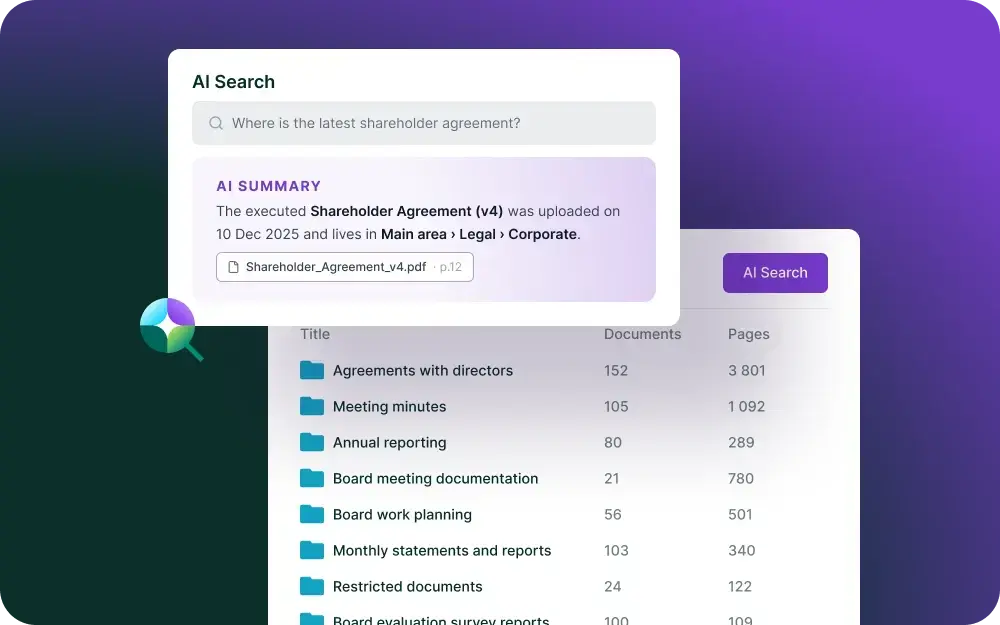
- Search functionality
Strong organisation reduces the risk of missing documents and makes future reviews significantly easier.
Digital closing binders and VDRs
Most modern transactions now use digital closing binders stored within a VDR rather than physical folders. This approach provides several advantages:
- Faster document retrieval
- Centralised storage
- Secure access controls
- Easier collaboration across jurisdictions
- Better auditability and retention management
VDR platforms also maintain audit trails showing:
- Who uploaded documents
- When changes occurred
- Which versions were finalised
- Who accessed the records.
Who uses a closing binder?
Many stakeholders rely on closing binders after the transaction completes. Common users include:
- Legal teams
- Corporate secretaries
- Finance and tax advisors
- Compliance teams
- Auditors
- Post-merger integration teams
- Regulators where required
For example, finance teams may need the binder to verify payment obligations or tax treatment, while operational teams may use it to understand transition agreements and integration responsibilities.
Common mistakes when preparing closing binders
Poorly prepared binders can create confusion and increase your legal risk. Common issues include:
- Missing signed versions of agreements
- Incorrect or outdated documents
- Weak version control
- Missing schedules or exhibits
- Poor indexing and organisation
- Failure to include approvals or regulatory consents
These problems can delay audits and create operational uncertainty after completion.
Related terms
View all termsDefinition of Insider Trading
Insider trading is when a person in possession of confidential information uses ...
Market Abuse Regulation (MAR) Outlined
The Market Abuse Regulation (MAR) came into effect in 2016 to ensure a uniform ...
Definition of Market Manipulation
Market manipulation, a form of market abuse, is the illegal act of artificially ...