










.png)






.svg)
.svg)
.svg)








.png)
.png)







.jpg)

%20F%20(1).jpeg)







.webp)






 Login
Login
An effective board evaluation action plan has four non-negotiable elements: a clearly named owner for each item, defined milestones, a follow-up cadence integrated into the regular board agenda, and a link to broader strategy and risk oversight. Without these elements, even a well-conducted evaluation produces what the panel at The Decisive Board webinar called introspection rather than improvement: a report that sits in a drawer while the same patterns repeat next year. The fix is less about analytical depth than about disciplined execution.
- A board evaluation without an action plan is wasted money and wasted directors' time.
- Each action item needs a named owner; "the board" is not an owner.
- Milestones with target dates make progress visible and force timely correction when an item is slipping.
- A single coordinator (typically the lead independent director or the chair of the nomination committee) tracks the entire plan and reports progress to the full board.
- Action items must connect to strategy, risk oversight, and agenda design; isolated improvements rarely stick.
- The CEO and corporate secretary play active roles, especially on items that involve information flow and meeting preparation.
Why most action plans fail to deliver
Action plans fail for predictable reasons, and the failure modes are largely independent of the quality of the evaluation that produced them. Caroline Ruellan, President of SONJ Conseil, captured the central risk during the webinar: a board can do a very good evaluation, spend a great deal of money and time, and still produce nothing useful, because no one ensures continuity between sessions.
The most common failure modes:
- No named owner. When everyone is responsible, no one is. "The board will improve information flow" is not an action; it is a wish.
- No milestones. Items without target dates drift indefinitely. Without an interim checkpoint, the board only discovers the slippage at the next annual evaluation.
- No follow-up cadence. Action items must surface on subsequent board agendas. If they do not, they vanish.
- Disconnection from strategy. Improvements presented as standalone governance fixes, with no link to strategy, risk, or oversight, struggle to compete with operational priorities.
- Short-termism. Florence Priouret, Chair of the SFAF Board of Directors, observed that without an annual evaluation cycle, boards take only short-term actions and forget the rest. The discipline is built by the cadence, not by the report.
The four elements of an effective action plan
A board action plan that delivers measurable change has four elements, in this order:
1. Named ownership. Each action item has one accountable owner. That owner is a person, not a body. "The chair will introduce a quarterly cyber risk deep dive" is workable. "The board will improve cyber oversight" is not.
2. Milestones with target dates. Each item has a small number of interim milestones with specific dates. A typical structure: definition of the change, first delivery at the next regular meeting, follow-up review at the meeting after, and confirmation of completion at a fixed point.
"A stronger action plan is an action plan with milestones. It is important to dedicate the right means, to have follow-up and correction, and persons responsible for each item — otherwise, some things may be not treated."
3. Integrated follow-up cadence. Items appear on subsequent board agendas as standing review points until they are closed. The corporate secretary maintains the log. The lead independent director (or nomination committee chair) reports progress to the full board at each meeting.
4. Connection to strategy and risk. Each item is linked, where relevant, to a specific strategic priority, risk category, or oversight responsibility. This is what makes the plan land. Directors will engage with action items that touch the business; they will tune out items framed as procedural housekeeping.
Who owns what: assigning roles
The action plan needs a single coordinator who owns the whole document, plus a named owner for each individual item. The coordinator role typically falls to the chair of the nomination committee or the lead independent director, both of whom have natural standing to push back when an action is not progressing.
Caroline Ruellan was explicit about why the coordinator role matters: someone has to make sure the ball does not fall into the same shortcomings the board has already seen. That someone is the coordinator, supported operationally by the corporate secretary.
The CEO and senior management are not bystanders. Many action items will involve changes to the information they provide to the board, the timing of board packs, the briefing material on strategic projects, or the way risk reports are structured. The CEO is therefore an active participant in delivering the plan, not just a recipient of it.
| Role | Responsibility in the action plan |
|---|---|
| Lead independent director / chair of nomination committee | Owns the plan as a whole; reports progress to the full board at each meeting; flags items at risk of slippage. |
| Chair of the board | Champions the plan; integrates items into the agenda; models the behaviour the plan calls for. |
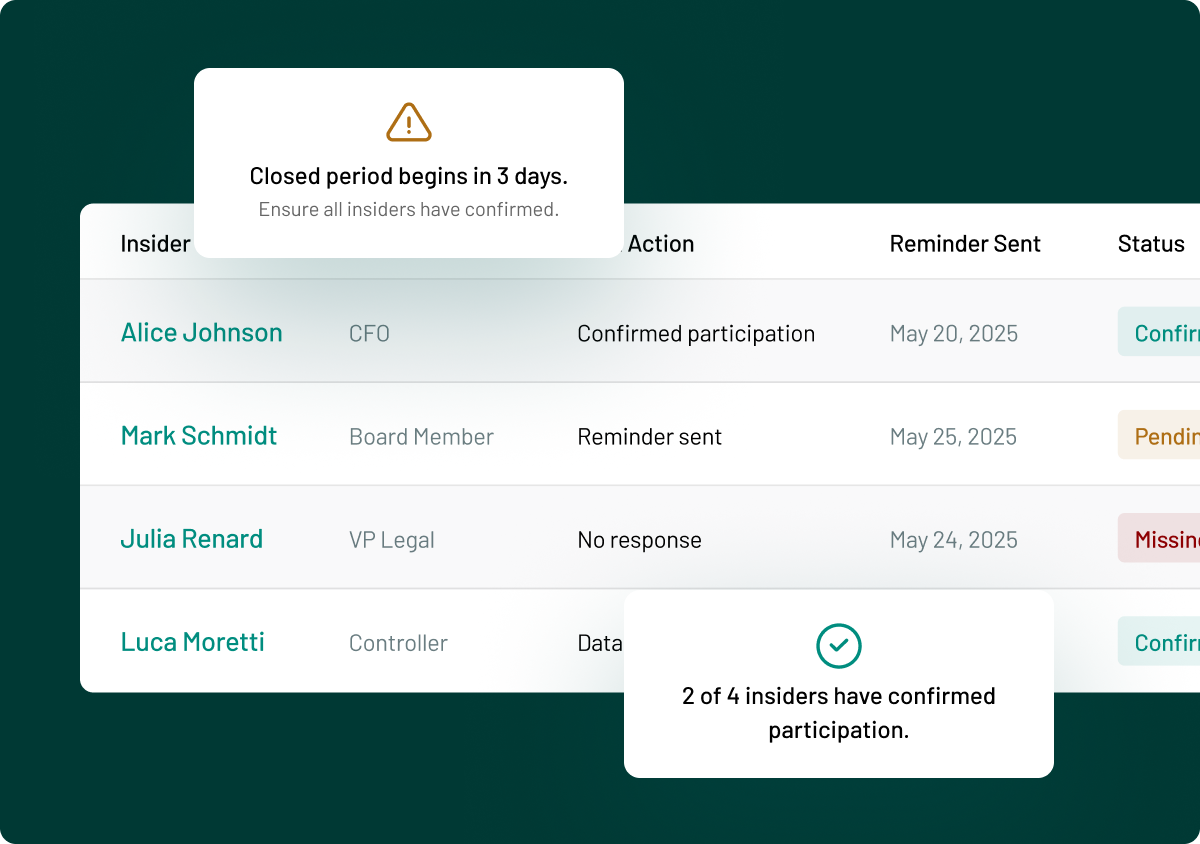
| Corporate secretary | Maintains the action log; ensures items appear on agendas; tracks evidence of completion. |
| CEO | Delivers items that involve management (information flow, briefings, risk reports). |
| Committee chairs | Own items relevant to their committee's remit (audit, risk, remuneration, nomination). |
| Individual directors | Own personal development items (training, skill gaps, contribution improvements). |
Integrating the plan into board work
An action plan only works if it is part of the regular rhythm of the board, not a separate administrative track. Integration happens at three levels.
Agenda design. Action items appear as standing review points on the agenda for the next two or three meetings. The chair and corporate secretary collaborate to schedule them at meaningful moments, not at the end of the agenda when time has run out.
Strategic alignment. Items connected to strategy or risk are reviewed alongside the relevant strategic discussion. If the action plan calls for a quarterly cyber risk deep dive, the board's risk committee owns the slot and reports back to the full board.
Information flow. The corporate secretary's documentation is part of the board pack, not a separate annex. Admincontrol Board Portal allows action items to be linked directly to the agenda items they relate to, so directors can see context, history, and progress in one place.
"You should integrate that action plan with board work. Make sure that you link actions to strategy, planning, risk oversight embedded into agendas — and make sure that you actually evaluate from time to time."
Florence Priouret also recommends that boards keep their board charter alive: not just a document filed at the start of the year, but a working reference reviewed periodically. Items in the action plan should connect back to the charter where relevant, ensuring the plan reinforces (rather than replaces) the board's foundational governance document.
A sample action plan structure
An action item should be specific enough that completion is unambiguous. A useful template:
| Field | Example |
|---|---|
| Finding | Board agenda is dominated by operational compliance items; less than 30% of time spent on long-term strategy. |
| Action | Restructure agenda to allocate 70% strategy, 20% risk, 10% compliance. |
| Owner | Chair of the board, supported by corporate secretary. |
| Milestone 1 | New agenda template approved at next board meeting. |
| Milestone 2 | Time-allocation review at the meeting after that, with corrective action if needed. |
| Closure criterion | Three consecutive meetings within target time-allocation bands. |
| Strategic link | Aligns with three-year growth strategy approved at last strategic offsite. |
The template above is recognisable from the Admincontrol customer example shared during the webinar: a board that believed it had a balanced agenda but learned through evaluation that compliance items were crowding out strategy. After restructuring to 70% strategy, 20% risk, 10% compliance, decision-making improved measurably and directors aligned on growth priorities. The action plan turned a finding into a result. Admincontrol Board Evaluation includes the structured action-plan tracking that makes this kind of follow-through routine.
Frequently Asked Questions
Five to eight is typical. A plan with twenty items is unlikely to be tracked seriously; a plan with one or two is unlikely to reflect the breadth of an honest evaluation. Prioritise the items that will have the biggest impact on board effectiveness and governance quality.
Detailed action items remain confidential, but a high-level summary should appear in the corporate governance section of the annual report. ecoDa explicitly encourages shareholders to engage more actively with the evaluation process and its outcomes, which means the company should provide enough disclosure for that engagement to be meaningful.
The board sets the action plan; the CEO does not have a veto over items that concern board oversight. That said, items involving management input typically benefit from genuine dialogue. The lead independent director should engage the CEO early to surface objections and refine the implementation, not after the plan is finalised.
Progress is reviewed at every board meeting as a standing agenda item, and comprehensively at the next annual evaluation. Year-over-year benchmarking shows whether the issues identified previously are genuinely closing.
Slippage should be flagged at the next regular meeting, not at the next annual evaluation. The coordinator (lead independent director or nomination committee chair) and the named owner should agree a corrective step: a revised milestone, additional resources, or escalation to the full board. Quietly carrying an item forward, year after year, defeats the purpose of having an action plan.
A board evaluation is only as valuable as the action plan it produces. Admincontrol Board Evaluation gives boards the structure to track owners, milestones, and year-over-year progress.
Discover Admincontrol Board Evaluation