









.png)






.svg)
.svg)
.svg)









.png)
.png)







.jpg)

%20F%20(1).jpeg)







.webp)






 Login
Login
Most board evaluations fall short of their potential because they suffer from three recurring weaknesses: lack of structured follow-up, unclear purpose, and superficial feedback. Boards that fail to address these flaws repeat the same patterns year after year, producing reports that sit in a drawer instead of decisions that improve governance. This was the central diagnosis of the panel at The Decisive Board, a webinar hosted by Euronext Corporate Solutions with leaders from ecoDa, Admincontrol Board Evaluation, SFAF, and SONJ Conseil.
- Three failure modes account for most weak board evaluations: lack of follow-up, unclear purpose, and superficial feedback.
- Without an action plan with named owners and milestones, insights become introspection rather than improvement.
- Generic questionnaires asking "how well does the board function?" produce little actionable insight; effective evaluations probe board dynamics, decision quality, and the board-management interface.
- Annual evaluations with year-over-year benchmarking turn one-off reports into a measurable trajectory of improvement.
- Confidentiality and chair sponsorship are non-negotiable: directors only give honest feedback when anonymity is genuinely protected.
Failure 1: Lack of structured follow-up
The first and most common failure is a board evaluation that ends with a report rather than a roadmap. Møyfrid Øygard, CEO of Admincontrol, put it bluntly during the webinar: too many evaluations conclude with a document that sits unread in a drawer, and boards repeat the same patterns year after year because no one is accountable for change.
"Too many evaluations end with a report that sits in our drawer. Without systematic follow-up, insights remain unused, and boards repeat the same patterns year after year."
Florence Priouret, Chair of the SFAF Board of Directors, and Caroline Ruellan, President of SONJ Conseil and of Le Cercle des Administrateurs, both reinforced the same point. A strong action plan is one with named owners, milestones, and a designated coordinator, typically the chair of the nomination committee or the lead independent director. Without this scaffolding, the evaluation becomes an exercise the board endures rather than an instrument it uses.
The discipline has a parallel in regular board work: every session must build on the last. If the board cannot maintain continuity between meetings on routine matters, it will not maintain continuity on evaluation findings. This is where a robust Admincontrol Board Portal earns its place, by giving the corporate secretary and the chair a structured way to track action items and surface them on every subsequent agenda.
Failure 2: Unclear purpose and a compliance mindset
The second failure is treating board evaluation as a regulatory chore rather than a governance tool. Many boards conduct evaluations because the corporate governance code requires it, not because they are committed to improvement. The result is what the panel called a compliance mindset: a superficial exercise designed to satisfy the audit trail, not to change behaviour.
This mindset shows up in the framing. Boards that frame evaluation as "we have to do this for the annual report" produce questionnaires answered defensively. Boards that frame it as "we need to be sharper than activist investors at spotting our own weaknesses" produce candid, useful data. Caroline Ruellan made the point directly: governance is not a compliance tool; it is the company's capacity to engage in the best decision-making process in its own best interest.
"This exercise is not a compliance exercise. Governance is not a compliance tool — it is the capacity of the company to engage in the best decision-making process in its own best interest."
The fix is to set the purpose explicitly at the start. Beatrice Richez-Baum, Director General of ecoDa, recommends that the board allocate dedicated time to discuss the scope, methodology, and roles before any survey is launched. Are you assessing the collective body, individual contributions, the chair's leadership, or the relationship between the board and the C-suite? An evaluation that tries to do all of this without prioritisation produces no clear conclusions on any of it.
Failure 3: Superficial feedback that fails to surface dynamics
The third failure is methodological. Generic questionnaires that ask "how well does the board function?" or "are meetings well organised?" produce little actionable insight. They fail to address the nuanced dynamics that actually drive effective governance: how decisions get made, who challenges whom, where information asymmetry is concealed, and whether the chair facilitates honest debate or dominates it.
Effective evaluations probe specifics. The panel highlighted several questions that consistently surface real issues:
- How much time did the board spend on long-term strategy versus operational compliance? (One Admincontrol customer rebalanced from a roughly even split to 70% strategy, 20% risk, 10% compliance after their evaluation revealed an imbalance the directors had not perceived.)
- Are board members getting complete, unbiased information on time, or are they receiving filtered packs?
- Does the chair guide the discussion without dominating it, ensuring every voice is heard?
- Is there courage in the room to challenge management, or has consensus replaced challenge?
These questions surface board dynamics, which Beatrice Richez-Baum described as the most important dimension of any evaluation. Hard skills (financial literacy, sector expertise, cyber knowledge) are relatively easy to assess. Soft skills (courage to challenge, intellectual honesty, group cohesion) are far harder, and they are precisely where dysfunction tends to hide.
| Failure mode | Symptom | Fix |
|---|---|---|
| Lack of follow-up | Report sits in a drawer; same patterns repeat next year. | Action plan with milestones, named owners, and a coordinator (lead director or nomination committee chair). |
| Unclear purpose | Compliance mindset; defensive answers; no prioritisation. | Set explicit objectives upfront; align on scope, methodology, and roles before launching. |
| Superficial feedback | Generic questions; soft-skill blind spots; no benchmarks. | Tailored questions on dynamics, year-over-year benchmarking, confidential one-to-one interviews. |
Fixing the three failures: a practical framework
A board evaluation that fixes all three failures has a recognisable shape. It runs annually, produces a measurable trajectory through year-over-year comparison, ends with a written action plan tied to specific board agendas, and assigns one person, usually the lead independent director or the chair of the nomination committee, to track follow-through. It also invites the senior management team to assess the board, not just the board to assess itself, because the relationship between the two bodies is where most governance value is created or lost.
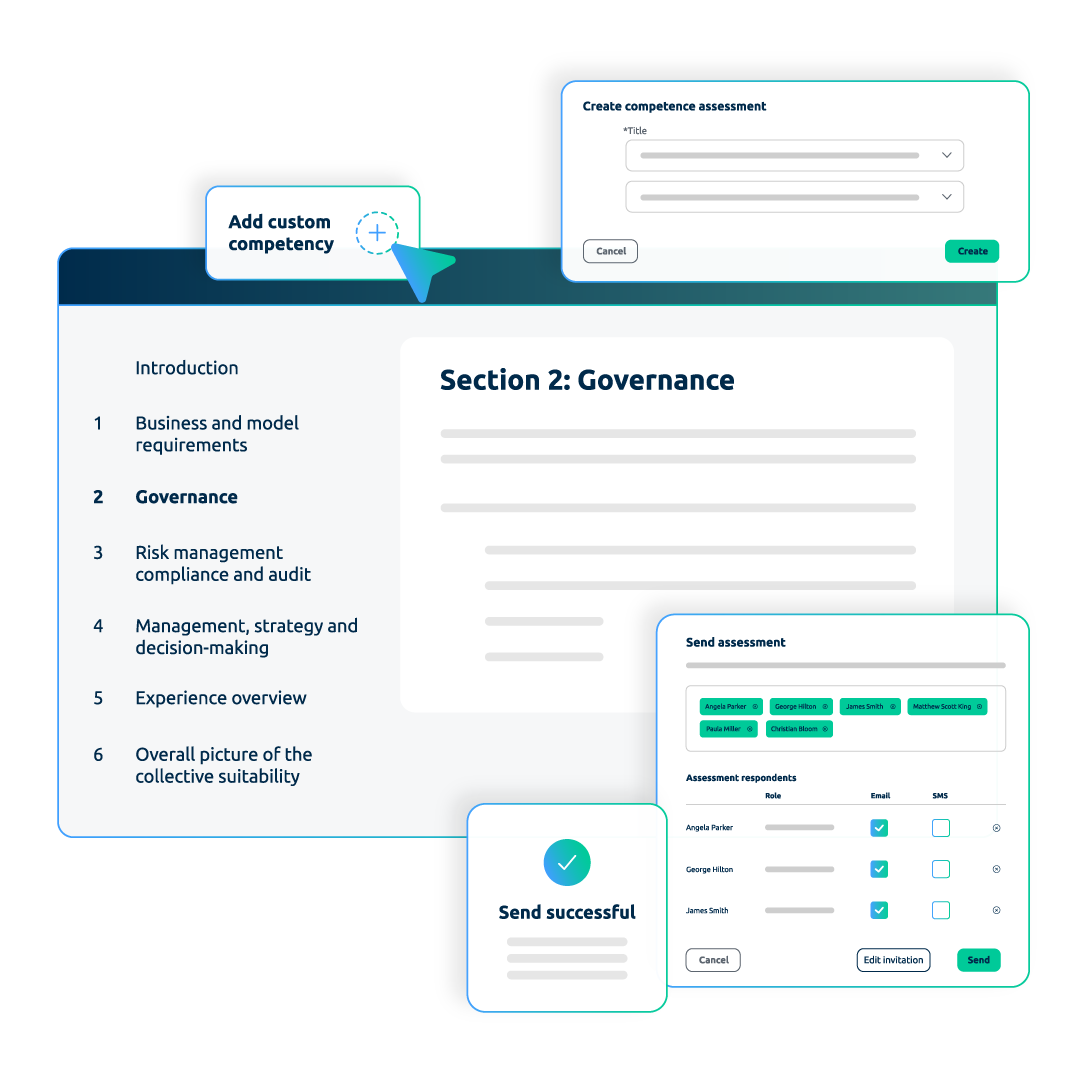
This is the model Admincontrol has built into its Admincontrol Board Evaluation solution: five evaluation categories (forward-looking strategy, three dimensions of board effectiveness, and backward-looking control and reporting), confidential surveys, year-over-year benchmarking, and structured reports that translate findings into next steps rather than concluding statements.
Frequently Asked Questions
Reliable industry-wide statistics are scarce, but the consistent message from governance practitioners is that a significant share of evaluations stop at the report stage. The differentiator between evaluations that produce change and those that do not is the presence of an action plan with named owners, milestones, and a follow-up cadence built into subsequent board agendas.
Best practice combines both cadences. ecoDa recommends an external evaluation at least every three years to provide an objective benchmark, supplemented by lighter internal evaluations in the intervening years. Admincontrol recommends conducting an internal evaluation annually to capture year-over-year trends and maintain momentum on the action plan.
The action plan should have a single accountable owner. In most listed companies, this is the chair of the nomination committee or the lead independent director. The corporate secretary typically coordinates day-to-day tracking and ensures action items appear on subsequent board agendas.
Confidentiality is the single biggest unlock. Directors only give honest feedback when they trust that responses will remain anonymous. Combine that with tailored questions on dynamics (decision-making, challenge, information flow) rather than generic statements, and supplement quantitative scores with one-to-one interviews where harder issues can surface.
The nomination committee handles this scenario, which is one structural reason the chair should not sit on that committee. An external facilitator or consultant adds the independence needed to deliver uncomfortable findings to the chair. Benchmarks and objective data points make these conversations significantly easier than reliance on opinions alone.
Boards that treat evaluation as a strategic tool, not a compliance task, see measurable improvement year after year. Admincontrol Board Evaluation gives you the structure, confidentiality, and benchmarking to make that shift.
Explore Admincontrol Board Evaluation