









.png)





.svg)
.svg)
.svg)








.png)
.png)







.jpg)

%20F%20(1).jpeg)







.webp)






 Login
Login
Three board evaluation models exist: external (an independent third party conducts the full exercise), internal (the board assesses itself), and hybrid (an internal evaluation supported by an external facilitator). According to ecoDa, the European Confederation of Directors' Associations, most European corporate governance codes call for an external evaluation at least every three years, with internal evaluations conducted in the intervening years. The hybrid model is increasingly recommended as the most balanced approach.
- External evaluations use an independent consultant, run every three years on average, and produce the most objective, granular benchmark.
- Internal evaluations happen between externals, are lighter and less expensive, and can be conducted annually to maintain momentum.
- Hybrid evaluations combine internal ownership with an external facilitator who designs the framework, gathers feedback, and surfaces blind spots.
- Avoid using a search firm or headhunter as your external evaluator; it creates a conflict of interest that compromises objectivity.
- Whichever model you choose, internal evaluations must meet the same baseline standards as external ones to be credible.
External evaluation: the objective benchmark
An external evaluation involves an independent third party who conducts the full exercise, from designing the framework to interviewing directors and presenting findings. Most major European corporate governance codes recommend this model at least every three years. The added duration matters: a consultant needs time to gain real insight into how the board functions, which governance practices are used, and where dynamics break down.
"External evaluation usually takes place every three years. That is at least what the main corporate governance codes recommend in Europe."
The advantages are objectivity and depth. External evaluators bring a benchmark perspective the board cannot generate from inside its own room. They typically include one-to-one confidential interviews with each director and members of senior management, producing the most granular and least biased view of board performance.
One critical caution: do not appoint a consultant who faces a conflict of interest. Beatrice Richez-Baum, Director General of ecoDa, made this point during the Decisive Board webinar hosted by Euronext Corporate Solutions. If your external evaluator is also the search firm responsible for selecting board members, the assessment is structurally compromised. The same firm cannot credibly evaluate the directors it just placed.
"It is important that the consultant does not face any conflict of interest. We would not like companies to turn to a headhunter who would be responsible to select board members and then would be involved in the assessment process."
Internal evaluation: the annual cadence
Internal evaluations are conducted by the board itself, often coordinated by the corporate secretary or the chair of the nomination committee. They are faster, cheaper, and easier to repeat. Most boards using this model run them annually, in line with Admincontrol's recommendation that annual evaluation is essential to capture year-over-year trends and sustain momentum.
The trade-off is depth. Internal evaluations tend to be lighter in analysis and more vulnerable to corporate politics. Directors who must report to the chair rarely deliver fully candid feedback in a process the chair sponsors. The risk is a polished but superficial picture of a board that is, in reality, struggling.
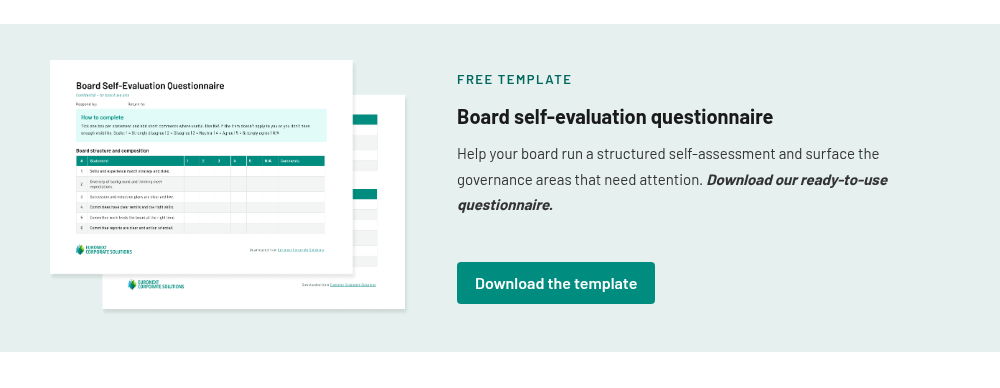
To work, internal evaluations must meet the same baseline standards as external ones: a clear purpose set at the outset, defined roles for the chair, lead independent director, and corporate secretary, genuine confidentiality so directors speak honestly, and an action plan with milestones at the end. Without those guardrails, the internal model becomes the box-ticking exercise governance codes intended to prevent.
Hybrid evaluation: the balanced middle path
The hybrid model is an internal evaluation supported by an external facilitator. The facilitator designs the questionnaire, gathers feedback (often through anonymous interviews), and guides the board through the process. The board retains ownership; the facilitator brings independence and methodology.
ecoDa sees significant value in this approach because it addresses two recurring problems at once. It introduces an outside perspective without committing to the cost and disruption of a full external review every year, and it surfaces blind spots that an internal-only process would miss. Florence Priouret, Chair of the SFAF Board of Directors, noted during the same webinar that hybrid processes are particularly useful when there is a concern about the chair, since the external facilitator can deliver findings the board itself would struggle to articulate.
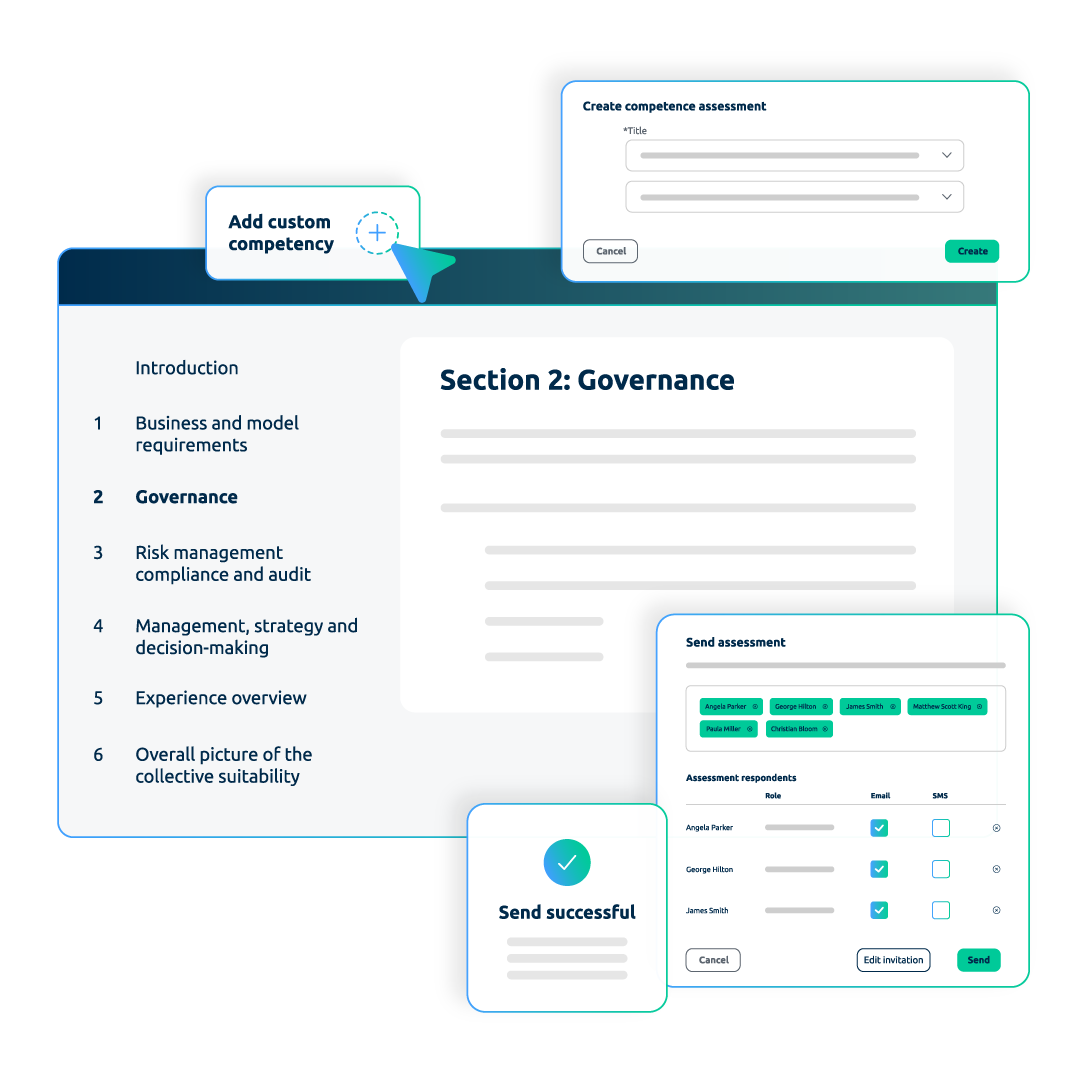
The hybrid model is also where modern Admincontrol Board Evaluation tools deliver the most leverage. The platform provides the structured questionnaire, the confidential survey infrastructure, and the year-over-year benchmarking, while the external facilitator provides judgement on the qualitative findings.
Side-by-side comparison
| Dimension | External | Internal | Hybrid |
|---|---|---|---|
| Cadence | Every 3 years (governance code minimum) | Annual | Annual or biennial |
| Cost | High | Low | Moderate |
| Depth of analysis | Granular; one-to-one interviews | Lighter; risk of superficiality | Structured; facilitator probes blind spots |
| Objectivity | Highest | Vulnerable to corporate politics | Strong; facilitator brings independence |
| Ideal use | Periodic objective benchmark; reset | Annual continuity; tracking action plan | Sensitive findings (e.g. concerning the chair) |
| Lead actor | External consultant | Lead director, nomination committee, corporate secretary | Internal owner with external facilitator |
How to choose: a decision framework
The right model depends on three factors: the cycle of your last evaluation, the sensitivity of the findings you expect, and the seniority of the issues on your board's agenda. A board that has just completed an external evaluation should run lighter internal exercises in the following two years to track progress. A board approaching the three-year mark, or one that has weathered a strategic shock or a leadership transition, should commission an external evaluation.
The hybrid path is the right answer when an internal evaluation feels too soft for the moment but a full external review is excessive. It is also the right answer when findings might concern the chair: an external facilitator, working with the nomination committee, can deliver feedback the chair cannot reasonably solicit from inside the room.
Whichever path you take, the underlying infrastructure should be the same: confidential surveys, structured questions on dynamics rather than generic statements, year-over-year benchmarking, and a written action plan with named owners. That is the operating model behind Admincontrol Board Evaluation, which supports all three approaches with the same underlying data.
Frequently Asked Questions
ecoDa recommends an external evaluation at least every three years. This cadence is consistent with the requirements of most major European corporate governance codes and gives the consultant enough time to develop a meaningful benchmark for the board's performance.
No. Using a search firm or headhunter to evaluate directors it has placed creates a structural conflict of interest. ecoDa explicitly recommends that companies separate the two engagements to preserve the independence of the evaluation.
An external facilitator designs the framework, runs anonymous interviews, surfaces blind spots, and provides an independent voice when delivering uncomfortable findings. The board retains ownership of the process; the facilitator brings methodology and independence.
Internal evaluations alone rarely deliver the objectivity required by major governance codes. Most listed companies are expected to combine annual internal evaluations with a periodic external one. The depth gap between the two is precisely why governance codes require the external review at fixed intervals.
Non-listed companies, family businesses, NGOs, and public bodies all benefit from external evaluations, particularly when seeking new investors, professionalising governance, or addressing leadership transitions. The cadence may be less prescriptive than for listed companies, but the underlying logic of independence and objectivity applies equally.
Most boards run a combination of all three models over a three-year cycle. Admincontrol Board Evaluation supports each one with structured questionnaires, confidentiality, and year-over-year benchmarking.
Discover Admincontrol Board Evaluation