









.png)




.svg)
.svg)
.svg)







.png)
.png)







.jpg)

%20F%20(1).jpeg)







.webp)






 Login
Login
The security architecture of a virtual data room (VDR) is its most important characteristic. In M&A, due diligence, and capital market transactions, the documents stored in a VDR represent some of the most commercially sensitive information in existence: financial projections, IP portfolios, personnel records, and deal strategy. A VDR built on inadequate security is not a transaction tool; it is a liability. The key security features to validate are: AES-256 encryption, multi-factor authentication, granular access controls, dynamic watermarking, a complete audit trail, ISO 27001 and SOC 2 Type II certification, and GDPR-compliant EU data residency. Admincontrol Data Room from Euronext Corporate Solutions delivers this security architecture as the platform foundation for European regulated transactions.
- AES-256 encryption at rest and TLS 1.2/1.3 in transit are the minimum encryption standards for any VDR handling transaction documents.
- MFA is non-negotiable: credential theft is the primary attack vector for VDR breaches, and it is entirely preventable with mandatory multi-factor authentication.
- Dynamic watermarking provides both deterrence and forensic capability: it discourages leakage and enables tracing if it occurs.
- EU data residency is a hard compliance requirement for European entities under GDPR and DORA. US-hosted platforms create legal risk that EU-native providers eliminate.
- ISO 27001 and SOC 2 Type II are not differentiators. They are baseline requirements. Any provider without both should not handle sensitive transaction documents.
1. Encryption: At Rest and In Transit
Encryption is the foundation layer of VDR security. Two distinct states require protection:
Encryption at rest protects documents stored on the provider's servers from exposure in the event of a server breach or physical hardware theft. The minimum standard is AES-256 (Advanced Encryption Standard with 256-bit key length), the same standard used by national security agencies and financial institutions globally. Some providers offer customer-managed encryption keys (CMEK), allowing clients to hold and control their own encryption keys rather than relying on the provider. This is the highest tier of at-rest protection and is relevant for entities with the most sensitive document requirements.
Encryption in transit protects documents during upload, download, and in-browser viewing. The minimum standard is TLS 1.2 (Transport Layer Security); TLS 1.3 is preferred. Legacy SSL protocols are insufficient and should be a disqualifying criterion.
| Encryption State | Minimum Standard | Best Practice |
|---|---|---|
| At rest (stored documents) | AES-256 | AES-256 with customer-managed keys (CMEK) |
| In transit (upload / download / viewing) | TLS 1.2 | TLS 1.3 |
2. Authentication and Access Control
Multi-factor authentication (MFA) must be mandatory for all users, not optional. Credential theft, phishing, and account compromise are the most common vectors for data room breaches. MFA eliminates the risk of a stolen password being sufficient for access. Acceptable MFA methods include authenticator apps (TOTP), SMS codes, and hardware tokens. Email-link authentication is insufficient for high-value document environments.
Single Sign-On (SSO) integration via SAML 2.0 or OAuth 2.0 allows organisations to manage VDR access through their existing identity provider (Active Directory, Okta, etc.), centralising access control and enabling instant account de-provisioning when an employee leaves or a deal participant's role ends.
IP restriction: Limiting access to defined corporate IP ranges adds a geographic security layer: documents can only be accessed from within known, secure network environments. This is particularly relevant for the most sensitive document categories (financial models, IP schedules).
Session timeout controls: Inactive sessions should expire automatically after a defined period, preventing unauthorised access from unattended authenticated sessions.
3. Document-Level Security Controls
Access control at the room level is insufficient. Robust VDR security provides independent controls for each document and folder:
Dynamic watermarking: Every page viewed by every external user should display a dynamic watermark containing the user's name, email address, and current timestamp. This serves two functions: deterrence (users are aware their actions are traceable) and forensics (if a watermarked document appears outside the data room, the source user can be identified). Dynamic watermarks must be resistant to removal. Static overlays that can be cropped or masked are insufficient.
Fence view / secure viewing mode: This feature renders only a portion of the document clearly at any one time, with the rest blurred, preventing effective screen capture of sensitive content. Most effective for documents with individual data items (salary schedules, financial line items) where bulk capture would otherwise extract value.
Download and print restriction: View-only access without download or print rights should be configurable per user group at the folder level. This is a recommended configuration for the most sensitive document categories (HR data, pricing, and IP) in competitive M&A processes.
Instant access revocation: The ability to revoke a user's access immediately and silently (without triggering a notification to the user) is essential when a participant exits a process or a deal falls through.
4. Audit Trail and Activity Monitoring
The audit trail is both a security control and a compliance asset. A complete VDR audit trail logs:
- Every document view event, with file name and folder path
- Every download and print event, with file name and timestamp
- Every access attempt, including failed authentication
- Every Q&A question submitted and response provided
- Every permission change, user addition, and access revocation
- Administrator actions including file uploads, folder creation, and settings changes
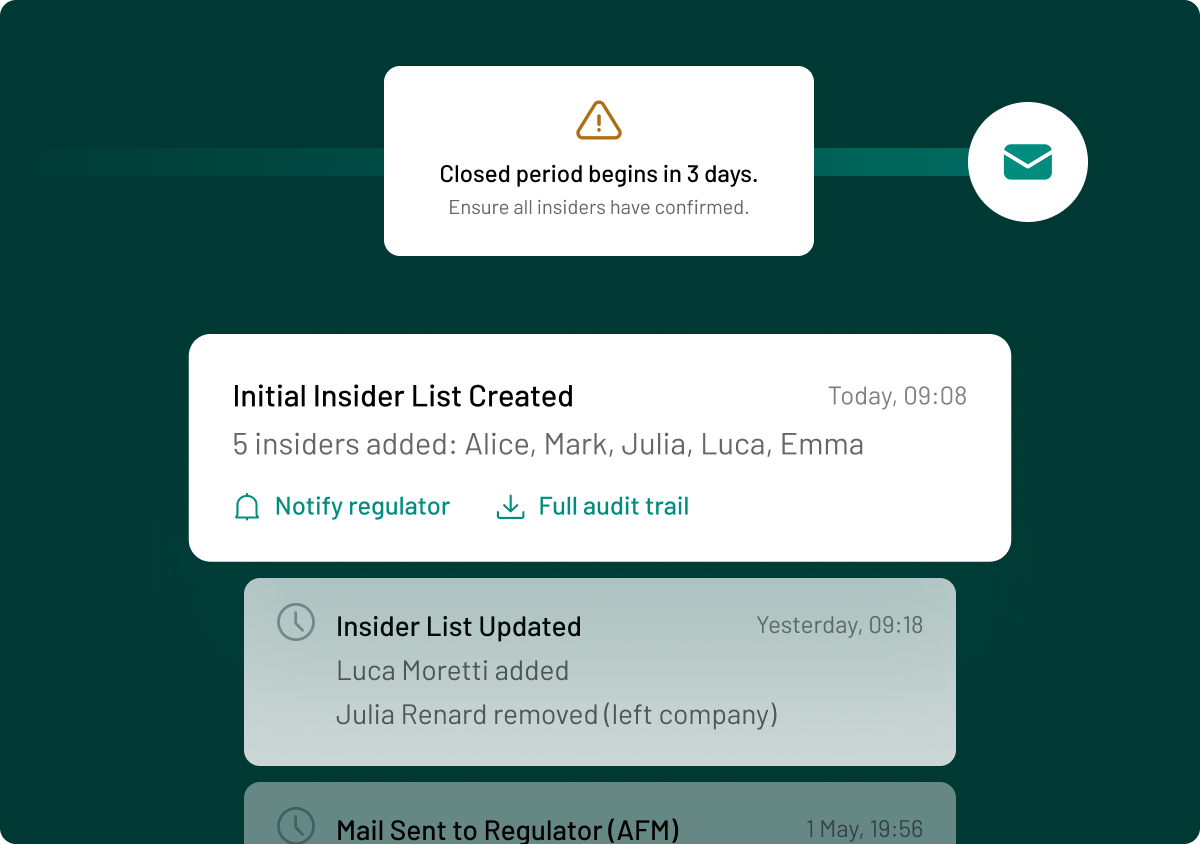
The audit log must be immutable: it should not be possible for administrators to delete or modify log entries. Exportable in PDF and structured data (CSV, JSON) formats for legal discovery, regulatory inspection, and internal compliance reporting.
Real-time activity alerts (notifications when unusual behaviour is detected, such as a user downloading an atypically large volume of documents in a short period) add an active monitoring layer to the passive logging function.
| Admincontrol Data Room: ISO 27001 certified, EU-hosted, GDPR aligned. Built for European regulated transactions. Explore Admincontrol Data Room |
|---|
5. Security Certifications
ISO 27001 is the international standard for information security management systems (ISMS). Certification requires an independent audit of the provider's security policies, risk management processes, incident response procedures, and technical controls. ISO 27001 certification must be current (renewed annually). A certificate issued three years ago and not renewed provides no assurance about current security practices.
SOC 2 Type II (Service Organization Control 2) assesses operational security controls over a period of six to twelve months. Unlike a point-in-time audit, SOC 2 Type II validates that security controls were in place and functioning continuously, which is a more meaningful assurance than Type I for ongoing transaction environments.
Both certifications should be requested in current form before any VDR procurement decision. Providers unable or unwilling to produce them should not handle sensitive transaction documentation.
6. Data Residency and Regulatory Compliance
For European organisations, data residency is not a preference. It is a legal requirement that can affect transaction validity and regulatory standing:
GDPR: Personal data relating to EU individuals (present in any HR document, personnel contract, or client data file in a due diligence data room) must be processed in compliance with GDPR. Storage on US-hosted infrastructure triggers cross-border transfer requirements that must be addressed with Standard Contractual Clauses or equivalent mechanisms. EU-hosted VDRs eliminate this requirement.
CLOUD Act: US law that can compel US companies to produce data stored anywhere in the world to US authorities, regardless of the data's origin or content. European companies that store transaction documents on US-hosted platforms expose themselves to this jurisdiction. EU-hosted platforms do not.
DORA: Financial entities subject to the Digital Operational Resilience Act must contractually manage ICT third-party risks. VDR providers must be able to provide DORA-compliant data processing agreements including data security obligations, incident notification requirements, and audit rights.
Security Validation Checklist
| Security Criterion | Requirement | How to Verify |
|---|---|---|
| Encryption at rest | AES-256 minimum | Request security whitepaper |
| Encryption in transit | TLS 1.2 or 1.3 | SSL Labs test or security documentation |
| Multi-factor authentication | Mandatory for all users | Trial account test |
| ISO 27001 certification | Current certificate | Request current certificate (not older than 12 months) |
| SOC 2 Type II | Current report | Request current SOC 2 Type II report |
| Data residency | EU for European entities | Request contractual confirmation of server location |
| GDPR data processing agreement | Current GDPR-compliant DPA | Request DPA before contract signature |
| Dynamic watermarking | User ID + IP + timestamp on every page | Trial account test with sample document |
Frequently Asked Questions
AES-256 encryption and mandatory multi-factor authentication are the two most important security features, functioning as the first line of defence. Encryption protects documents from breach; MFA prevents credential compromise. Without both, no other security feature provides meaningful protection. ISO 27001 and SOC 2 Type II certifications provide independent validation that these and other controls are properly implemented and maintained.
Dynamic watermarking deters document leakage by making every user aware that their identity is embedded in every page they view. If a watermarked document appears outside the data room (through screenshot, photograph, or unauthorised sharing), the embedded user identity and timestamp enable forensic identification of the source. Static watermarks that display only the company name are insufficient; the watermark must be user-specific and dynamic.
GDPR compliance for a VDR means the provider processes personal data in accordance with the regulation's principles: lawful basis, data minimisation, purpose limitation, and data subject rights. In practice, it requires: a GDPR-compliant data processing agreement between you and the provider; EU data residency to avoid cross-border transfer issues; the ability to delete specific personal data on request; and records of processing activities. Any VDR handling HR documents, client data, or personnel information in an M&A data room must operate under a GDPR-compliant framework.
ISO 27001 is an international standard that validates the design and implementation of a provider's information security management system (ISMS): the policies, processes, and controls governing how security is managed. SOC 2 Type II validates that specific security controls were operating effectively over a defined period (typically six to twelve months). ISO 27001 is the framework; SOC 2 Type II is evidence of operational effectiveness over time. Both are required for enterprise VDR security assurance: one without the other leaves gaps.
Encryption, MFA, dynamic watermarking, ISO 27001, SOC 2 Type II, and EU data residency are not premium features. They are the baseline your transaction documents require. Admincontrol Data Room from Euronext Corporate Solutions delivers this security architecture as standard, with GDPR and DORA alignment built in for European regulated entities.
Explore Admincontrol Data Room