









.png)




.svg)
.svg)
.svg)







.png)
.png)





.jpg)

%20F%20(1).jpeg)







.webp)






 Login
Login
.svg)
.png)

Faster to open
Choose a template, adjust it, and the data room is ready for documents in minutes rather than days.

Yours to change
Every template is a starting point: move, add, rename or delete folders until the structure fits the deal in front of you.

Consistent across deals
Teams running several processes at once work from the same index every time, so nothing is filed differently from one data room to the next.

Easier for buyers
A numbered index in a familiar due diligence order means bidders find documents themselves instead of asking where things are.
rEADY-MADE STructures
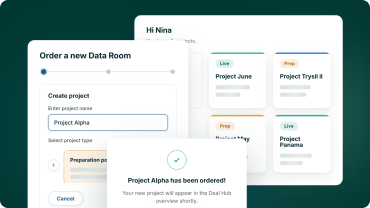
Five templates built on how deals are actually organised
These are not generic filing trees. They follow the way deal teams use the data room in live transactions, so the categories a buyer expects are in place before anything is uploaded.
- Five templates covering common due diligence structures
- Start from an empty structure when a deal is unusual
- An information panel in the wizard explains each step
.png?height=1000&name=data-room-templates-feature-images-stylised-en-selection%20(14).png)
.png)
Structure control
Shape the tree before a buyer sees it
A template is a starting point, not a constraint. Everything can be moved, renamed, added or removed inside the wizard, so the data room that opens is the one this deal needs.
- Move, add, rename and delete folders in place
- Settle the structure before the data room is created
- Drag and drop uploads that keep the hierarchy intact
.png?height=1000&name=data-room-templates-feature-images-stylised-en-selection%20(18).png)
iNDEX AND reFERENCES
A numbered index every party can quote
Indexing numbers the structure at the point you finish it. Advisers, buyers and lawyers can then point to a document by its number instead of describing where it sits.
- Number the whole structure in one step
- Clear references for Q&A and correspondence
- The same navigation for every buyer group
.png?height=1000&name=data-room-templates-feature-images-stylised-en-selection%20(20).png)

ISO 27001:2022
Information security, independently checked

GDPR compliant
Meets EU data-protection standards by design

AES 256-bit
Bank-level encryption.

European data residency
Hosted & processed entirely in the EEA

SOC 2 Type II
Independent audit of controls in operation