









.png)





.svg)
.svg)
.svg)







.png)
.png)






.jpg)

%20F%20(1).jpeg)







.webp)






 Login
Login
AI is transforming investor relations by helping IR teams process information faster, target investors more precisely, analyse market perception at scale, prepare management for high-stakes meetings, and personalise shareholder communications. The teams integrating AI into their existing IR workflows are gaining a measurable competitive edge over those still operating manually.
By late 2025, more than a billion people were using standalone AI tools, with millions more accessing AI features inside platforms such as Adobe Photoshop and Gmail. McKinsey's State of AI report, published at the end of 2025, found that most businesses now use AI in some capacity. Yet nearly two-thirds of respondents said their organisations had not scaled AI across the enterprise, leaving a clear opening for IR functions that move decisively before peers do.
This guide sets out ten high-impact applications of AI across the investor relations function and how to deploy each one without sacrificing the human judgement that effective IR depends on.
Key takeaways
- AI is now a competitive lever in IR. Teams using it process more information, respond faster and communicate more credibly than peers who do not.
- Research, targeting, perception analysis and management preparation are the four use cases with the highest immediate return on investment.
- Communications become more accessible and more relevant through AI-generated transcripts, multilingual support and audience-specific personalisation.
- Event AI moves beyond attendance metrics, surfacing how individual investors and analysts engage with webinars, webcasts and structured Q&A.
- AI augments the IRO; it does not replace one. Disclosure strategy, regulatory compliance and shareholder relationships still require human judgement.
What is AI in investor relations?
AI in investor relations refers to the application of large language models, machine learning and audience-analytics platforms to support core IR activities such as investor targeting, perception analysis, transcript generation, peer benchmarking, message drafting and event engagement. It does not replace the investor relations officer; it compresses the time-consuming research and content-production tasks that surround judgement-led work, freeing capacity for higher-value strategic activity.
How AI improves investor relations: 10 practical applications
1. How does AI help IR teams process information faster?
AI compresses hours of reading into minutes by extracting the most important themes from long-form documentation. Most IR teams sit on a constant flow of material: peer earnings transcripts, sell-side analyst notes, regulatory disclosures, internal management reports. Because of the amount of time needed to read it all attentively, they frequently miss critical signals.
General-purpose models such as Claude, ChatGPT and Microsoft Copilot can summarise:
- Transcripts from peers' earnings calls
- Sell-side analyst notes on your company or your peer group
- Regulatory disclosures and announcements from competitors
- Internal market-research and broker reports
This reduces the manual preparation time required ahead of investor calls, virtual roadshows and board updates without sacrificing the granular detail that genuinely matters to disclosure decisions.
|
Try this prompt: Summarise the attached earnings call transcript in under 200 words. Identify (1) the CEO's three top strategic priorities, (2) any changes in financial guidance versus the previous quarter, (3) tone shifts around margin pressure or cost discipline, and (4) any new disclosures not made on the prior call. |
2. How does AI improve reach and accessibility of IR communications?
AI extends the reach of your messaging by improving search, transcription and translation across all investor-facing channels. Equal-access regulations require material information to reach the entire investment community simultaneously, but reaching investors is not the same as ensuring they understand the message.
AI sharpens the search functionality on your IR website so investors retrieve the correct document on the first attempt. It generates transcripts of webcasts and webinars in near real time, translates them into multiple languages, and produces alternative formats accessible to investors with different abilities or non-native English speakers.
|
Enhance the reach of your investor events with AI EngageStream's AI-generated transcripts provide an accurate written record of your IR webinars and webcasts, with rapid translation built in for a more inclusive shareholder experience. Find out more. |
3. How does AI sharpen investor targeting?
AI sharpens investor targeting by analysing CRM notes, prior interaction history and market commentary at a scale human analysts simply cannot replicate. It identifies behavioural patterns such as investment style, sector preference, geographic concentration, and follow-up cadence, and surfaces the prospects most likely to fit your equity story.
|
Task |
How AI helps |
|
Reviewing CRM notes |
Pulls out recurring concerns and points of interest |
|
Prioritising targets |
Highlights likely fit by strategy, style or geography |
|
Mapping engagement history |
Shows patterns in follow-up cadence and responsiveness |
|
Preparing outreach lists |
Accelerates segmentation and filtering |
AI does not replace the IRO's relationship judgement, but it identifies where your shareholder base may be over-concentrated and which prospects justify the next available meeting slot.
4. How does AI improve investor perception analysis?
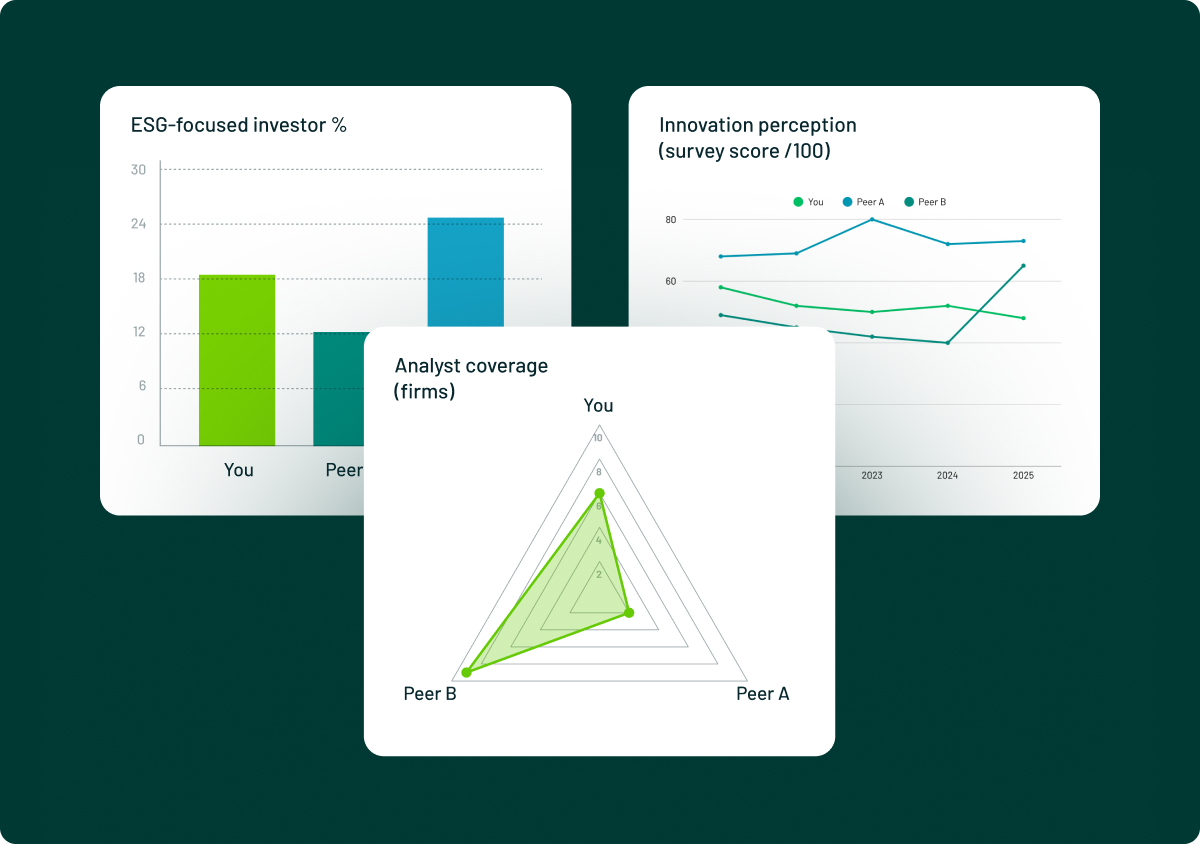
AI enables comprehensive perception analysis at a scale manual review cannot reach. Understanding how the capital markets perceive you requires processing large volumes of qualitative data: investor meeting notes, sell-side analyst commentary, perception survey responses and Q&A transcripts. Modern generative model can ingest all of it simultaneously and surface patterns that a human reviewer might take days for.
Sharper prompts produce sharper insights. Instead of asking "what are investors thinking?", try:
- What are the top three concerns appearing across these meeting notes?
- Where is our capital-allocation strategy being misunderstood by long-only institutions?
- Which strategic issues matter most to retail investors versus hedge funds?
This structured prompting turns scattered qualitative feedback into a directional read on sentiment and a defensible list of messaging adjustments for the coming quarter.
5. How does AI improve management preparation for investor meetings?
AI helps you brief executives on the right details, in a format they will genuinely use. Most IR teams prepare CEOs, CFOs and divisional heads under significant deadline pressure, and the solution is rarely additional information. It is the correct information, distilled into a single page.
Microsoft Copilot, Claude and ChatGPT convert lengthy investor profiles, prior meeting notes, and recent earnings transcripts into:
- Executive briefing notes
- Likely Q&A themes
- Mock interview questions and rehearsal scripts
- One-page event summaries
- Year-on-year messaging comparisons
- Concise profiles of priority investors
|
Try this prompt: Using the attached investor profile, the latest meeting notes from this fund and our most recent results presentation, generate: (1) a one-page briefing on the investor, (2) five likely questions they will ask the CFO, and (3) suggested talking points addressing each question. |
6. How does AI personalise shareholder communications?
AI rewrites the same core message for distinct audiences without compromising the underlying equity story. The introduction of the EU Retail Investment Strategy is widening the retail shareholder base substantially, and retail investors expect a different register from the technical depth used with institutional funds.
|
Audience |
What AI adjusts |
|
Institutional investors |
Technical depth, capital-allocation framing |
|
Retail shareholders |
Plain-language explanation, accessibility of the equity story |
|
ESG-focused audiences |
Emphasis on sustainability metrics and governance disclosure |
|
International investors |
Tone, idiom, full translation |
|
Internal executive stakeholders |
Strategic implications, internal narrative |
The core equity story remains constant. What changes is the angle, the depth and the language. AI absorbs the manual rewrite burden of producing five versions of a single update while preserving brand voice and disclosure consistency.
7. How does AI generate better insights from IR events?
AI tells you who attended your IR events, how they engaged and what that engagement reveals about your equity story. Sign-up numbers are a vanity metric. Knowing that a major fund manager spent thirty-eight minutes on the capital-allocation slide and submitted two follow-up questions is the kind of intelligence that genuinely shapes the next investor call.
|
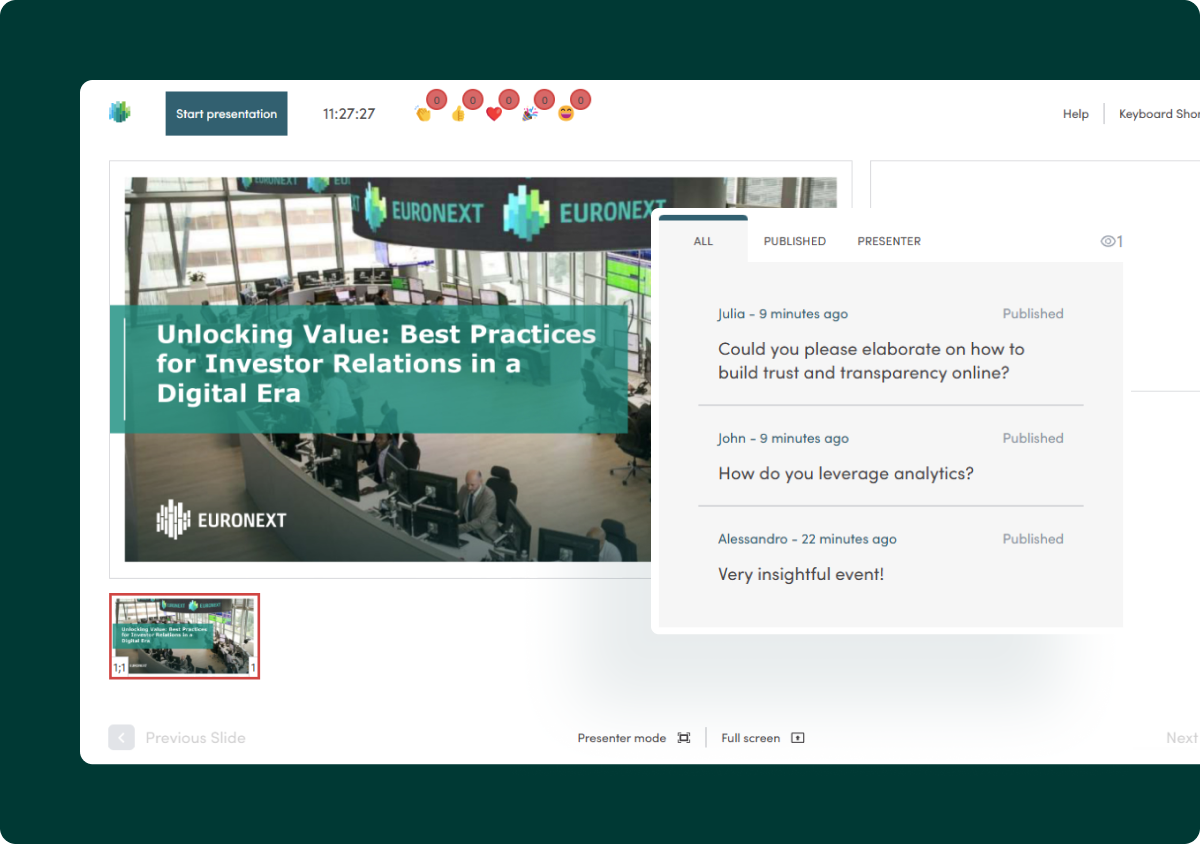
Make the most of your IR events with EngageStream EngageStream is a secure webinar platform built specifically for high-stakes IR events. Its AI-powered audience insights and profiling reveal how investors and analysts behave during your outreach, allowing you to act on the patterns rather than estimate at them.
|
8. How does AI turn IR events into ongoing content?
AI extracts continuing value from a single event by generating multiple downstream assets from one master transcript. A webcast or capital markets day does not need to remain a one-off communication. Through AI, one hour of recorded content becomes an entire quarter of follow-up assets.
|
Source event |
AI-generated follow-up |
|
Webinar transcript |
Summary of key takeaways for the IR website |
|
Capital markets day session |
FAQ article based on investor and analyst questions |
|
Investor Q&A |
Internal management note preparing for future questioning |
|
Earnings webcast |
Social-media snippet driving on-demand video views |
|
ESG event |
Long-form sustainability article for the corporate website |
9. How does AI support message control and compliance risk?
AI flags inconsistencies, vague language and tone drift across multiple drafts before any message reaches formal legal review. When the same announcement leaves the building in the different formats of press release, results presentation, IR website update, social copy, and internal briefing, small wording differences can create genuine compliance risk and undermine investor confidence.
Use Claude for cross-version comparison, Grammarly for tone calibration, ChatGPT for plain-language compliance scanning and mix their capabilities to:
- Compare press-release wording with presentation wording
- Check consistency across regional translations
- Surface vague or overly optimistic language
- Confirm tone stays measured and credible
- Review draft scripts before legal sign-off
This is a pre-check, not a replacement for the formal compliance review. It identifies the obvious problems before they reach the lawyers, which keeps the official review focused on the genuine interpretive grey areas.
10. How does AI improve peer benchmarking in IR?
AI makes peer benchmarking faster, more structured and substantially more useful. Instead of manually working through five separate peer earnings decks, capital markets day presentations and regulatory disclosures, you can ask a model to compare recurring themes, highlight differences in guidance language, and pinpoint where competitors frame shared issues more clearly than you currently do.
|
Try this prompt: Compare the guidance language across the five attached peer earnings transcripts. Highlight: (1) tone differences between cautious and confident framing, (2) specific phrases competitors use that we currently do not, and (3) any KPIs they emphasise that we do not presently disclose. |
The output reveals precisely where your own messaging reads as vague or under-confident relative to the peer set, which makes future investor communications considerably easier to sharpen.
Frequently asked questions about AI in investor relations
What are the best AI tools for investor relations teams?
For general-purpose research, drafting and analysis, Claude, ChatGPT and Microsoft Copilot cover the majority of IR use cases. For event-specific analytics such as audience engagement, AI-generated transcripts, and multi-format follow-up content, purpose-built platforms such as EngageStream provide capabilities that general-purpose tools do not.
Can AI replace an investor relations officer?
No. AI accelerates research, drafting and pattern recognition, but it cannot make strategic disclosure judgements, navigate sensitive shareholder relationships, or assume regulatory accountability. Treat AI as the IRO's most capable assistant rather than a substitute for the role itself.
Is it safe to upload investor meeting notes to ChatGPT or Claude?
It depends on the contractual terms. Enterprise versions of Claude, ChatGPT and Copilot offer data-use protections that consumer versions do not provide. Always verify your tool's data-retention policy and training-opt-out terms before uploading non-public or market-sensitive material.
How can AI improve perception analysis?
By processing large volumes of qualitative data in investor meeting notes, analyst commentary, survey responses, and Q&A transcripts, AI surfaces recurring themes, persistent concerns and points of strategic confusion at a scale human reviewers cannot match within useful timeframes.
What is the compliance risk of using AI in IR communications?
The principal risks are confidentiality, where non-public data is uploaded to a model with broad training rights, and accuracy, where the AI produces confident but incorrect output. Mitigate both by using enterprise-grade deployments, keeping a human reviewer on every external communication, and never allowing AI output to bypass formal legal review.
Does AI work for benchmarking peer IR communications?
Yes, and it is one of the highest-return use cases for IR teams. Models can compare multiple peer transcripts, presentations and disclosures simultaneously, surfacing tone differences, KPI choices and framing variations that a manual review would predictably miss under realistic time constraints.
The bottom line
AI does not replace the IRO; it changes how an IRO spends the working day. Research, drafting, comparison and audience analysis, or the manual, time-intensive back-end of the role, become substantially compressed. That returns the hours required for the irreplaceable work: disclosure judgement, positioning strategy, and direct shareholder relationships.
The IR teams generating the clearest competitive advantage are those using AI as a force multiplier on tasks that machines genuinely perform better, while protecting the human judgement that machines still cannot replicate.
Level up your IR events with EngageStream
EngageStream powers high-stakes IR events with white-glove production, AI-generated transcripts and rich audience analytics telling you exactly which elements of your equity story landed and where to sharpen the messaging for next time. Learn more.
References and further reading
Related Articles
See all postsPre-close calls under MAR: how to announce, record and publish them
12-10-26
GEO for Investor Relations: what AI tells investors about your company
06-08-26
Organising IR Events that Drive Engagement
09-06-26
Investor Relations Portal & Software: What Listed Companies Need in 2026
09-06-26
IR Communication Best Practices for Listed Companies
09-06-26