









.png)




.svg)
.svg)
.svg)







.png)
.png)





.jpg)
%20F%20(1).jpeg)







.webp)






 Login
Login
Why IR events matter
Investor events are the operational moments at which the equity story is converted from documentation into a live demonstration of management credibility. The annual general meeting evidences governance discipline under the Shareholder Rights Directive II. The capital markets day articulates strategic positioning and the medium-term financial framework. The results presentation subjects management commentary to real-time scrutiny by sell-side analysts and institutional holders. Each format has a distinct regulatory context, audience composition and production discipline. With the latter being the variable that determines whether the event re-rates the multiple or compresses it.
The economics of institutional investor engagement have shifted structurally over the past five years. The hybrid and virtual delivery formats accelerated by pandemic-era restrictions are now embedded in institutional investor expectations rather than treated as a temporary substitute for in-person delivery. Aggregate audience reach has expanded materially, cost-per-investor-touch has compressed, and the engagement data captured during delivery (registration profiles, attendance duration, Q&A submission patterns, asynchronous replay consumption) feeds the targeting workflow.
This guide covers the discipline behind the modern investor events programme: what each format is for, how to produce it, and what to measure.
The IR events calendar
A typical mid-cap European listed issuer runs four kinds of investor event across the year, with the larger groups adding a fifth.
1. The Annual General Meeting
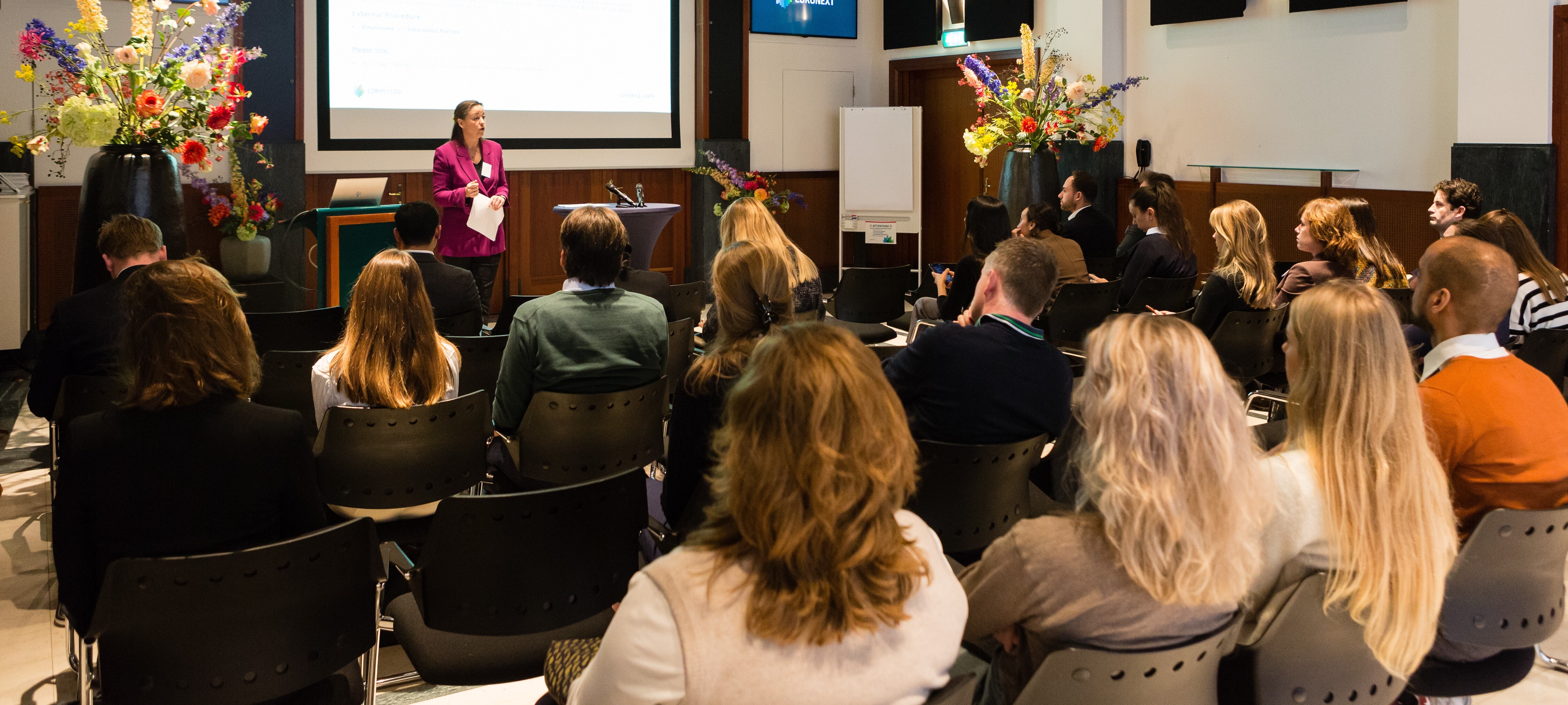
The Annual General Meeting is the constitutional event of the listed company year. It is where shareholders vote on the resolutions that govern the company including board appointments, remuneration policy, dividend approval, capital authorities, and where the management team faces direct questions from the holder base. The hybrid AGM is now the dominant format among European issuers: physical attendance for those who want it, secure remote voting and Q&A for those who do not.
The production discipline for the AGM is regulatory rather than commercial. The shareholder identification process under SRD II must be accurate, the voting infrastructure must be auditable, and the meeting itself must be conducted in a way that holds up to legal scrutiny. The IR function typically partners with the company secretary on the AGM rather than owning it outright.
2. The Investor Day
The Investor Day, or capital markets day, is the strategic showcase of the IR year. It is the format through which the management team presents the medium-term strategy, the financial framework that supports it, and the operational evidence that makes the framework credible. A well-produced CMD can re-rate a stock; a poorly produced one can compress the multiple for several quarters.
The production discipline is the most demanding of any IR event. The narrative arc has to hold across a four-to-six-hour programme. The financial framework has to be defensible under tight Q&A. The operational segment leaders have to be coached to a shared communication standard. And the production itself with the venue, AV, webcasting, and materials has to match the strategic ambition the day is supposed to demonstrate.
3. Results presentations
The full-year and half-year results presentations are the load-bearing communication events of the IR calendar. The discipline is covered in detail in the IR Communication guide: the framing of the headlines, the management commentary, the Q&A preparation. From an events perspective, the requirements are production reliability (the webcast must work, every time), recording quality (the replay is now consumed as much as the live event), and the integration of attendance and engagement data back into the IR CRM.
4. Roadshows and conferences
The roadshow programme - both post-results and standalone targeting roadshows - is the bilateral counterpart to the broadcast events. Production discipline here is logistical rather than theatrical: scheduling, briefing, post-meeting capture, and the analytical work that turns each roadshow into evidence for the next one. Sector conferences add a third format with their own conventions.
5. Smaller targeted formats
The fifth category, increasingly visible in the larger issuers, is the programme of smaller targeted events: investor lunches, ESG-specific sessions, retail investor webinars, sell-side analyst days. These formats have lower individual reach but higher per-touch engagement, and they fill the gaps in the contact base that the broadcast events do not address.
The production discipline behind a great investor event
Five elements separate the investor events that work from the ones that do not.
-
Narrative architecture. The event articulates a single defensible thesis. Each constituent segment of the strategic, operational, and financial, substantiates that thesis with corroborating evidence. The audience departs able to articulate the central argument in a single sentence.
-
Rehearsed Q&A. The most demanding analyst questions have been anticipated, documented, articulated aloud and refined through iterative rehearsal. The management team operates from internalised familiarity rather than scripted recitation.
-
Production reliability. The technical infrastructure performs to specification. Webcasting connectivity remains uninterrupted. Audio delivery achieves broadcast standard. Presentation materials advance correctly. Embedded video assets play without latency. These represent baseline operational requirements, and they are the requirements most consistently underdelivered by IR functions that under-invest in the production layer.
-
Engagement instrumentation. The event delivery platform captures registration metadata, attendance duration, Q&A submissions and asynchronous replay activity as structured behavioural data that feeds directly into the IR CRM. The event becomes a structured input to subsequent targeting and outreach rather than an isolated promotional exercise.
-
Post-event debrief. The IR function conducts a structured debrief immediately following each significant event. Which messages landed effectively. Which segments encountered analytical resistance. Which questions emerged from unanticipated angles. What the engagement instrumentation reveals about audience attention patterns. The debrief is documented in writing and operationalised into the preparation discipline for the subsequent event.
Continue reading
Investor Day Template
A practical template for planning and producing an investor day, covering the narrative architecture, the production timeline, the pre-event communication, the on-the-day execution and the post-event follow-up. Used by IR teams across European mid-caps.
→ Read the investor day template
Investor Day Guide
In this guide, we walk you through the essential steps to organise a successful Investor Day - from setting clear objectives and preparing your speakers to running the event in a format that works best for your audience, whether in-person, hybrid or fully online.
IR Webcasting Best Practice Cases
A collection of case studies from European listed issuers like Wolters Kluwer, Rabobank and others showing how IR webcasting has been used to extend reach, improve engagement and capture structured data on the investor base.
Frequently asked questions
How do you plan an investor day?
A successful investor day is built backwards from a single thesis. The planning sequence is: agree the thesis, design the narrative architecture, draft each segment against the architecture, build the financial framework, prepare the Q&A, rehearse end-to-end at least twice, finalise the production setup, and run the day with a structured post-event debrief booked in advance.
What are the most common mistakes IROs make on investor days?
The five most damaging mistakes are narrative drift (the segments do not connect to the central thesis), financial framework over-reach (commitments that cannot be defended under Q&A), operational segment inconsistency (each business head telling a different story), Q&A defensiveness (the management team appears uncomfortable with the harder questions), and production under-investment (the technical execution does not match the strategic ambition).
Should you webcast your capital markets day?
Yes, and the question is no longer whether but how. Webcasting extends reach to investors who cannot travel, captures replay activity from those who consume the content asynchronously, and produces the engagement data that feeds the next round of targeting. The discipline is producing a webcast that matches the production quality of the in-person event rather than a passive recording of it.
What is the best webcasting platform for investor relations?
The right platform depends on the format mix (results calls, AGMs, capital markets days, smaller webinars), the production quality required, the regulatory environment and the integration depth with the rest of the IR stack. The leading platforms used by European listed issuers offer secure delivery, multi-language audio, integrated Q&A and structured engagement data feeding back into the IR CRM.
How do you run an interactive webinar for investors?
The shift from broadcast webinar to interactive webinar requires three changes: format design that builds in genuine interaction (polls, structured Q&A, breakout segments), technical setup that supports it without friction, and audience segmentation so that the interaction is meaningful rather than performative.
How do hybrid AGMs work?
A hybrid AGM combines physical attendance with secure remote participation. The remote attendees can vote, submit questions and view the proceedings in real time, with the technical infrastructure providing the audit trail required for the regulatory standard. Hybrid is now the dominant AGM format among European listed issuers.
How Euronext Corporate Solutions supports IR events
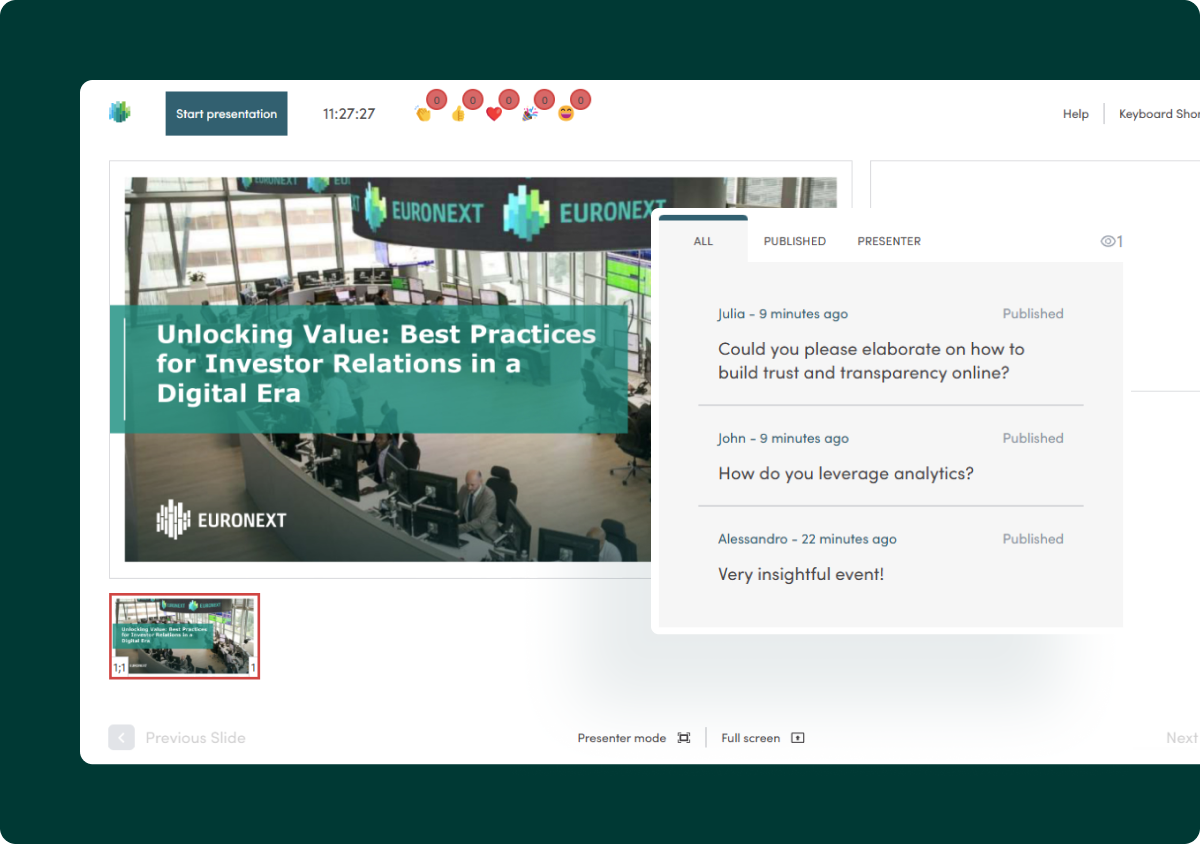
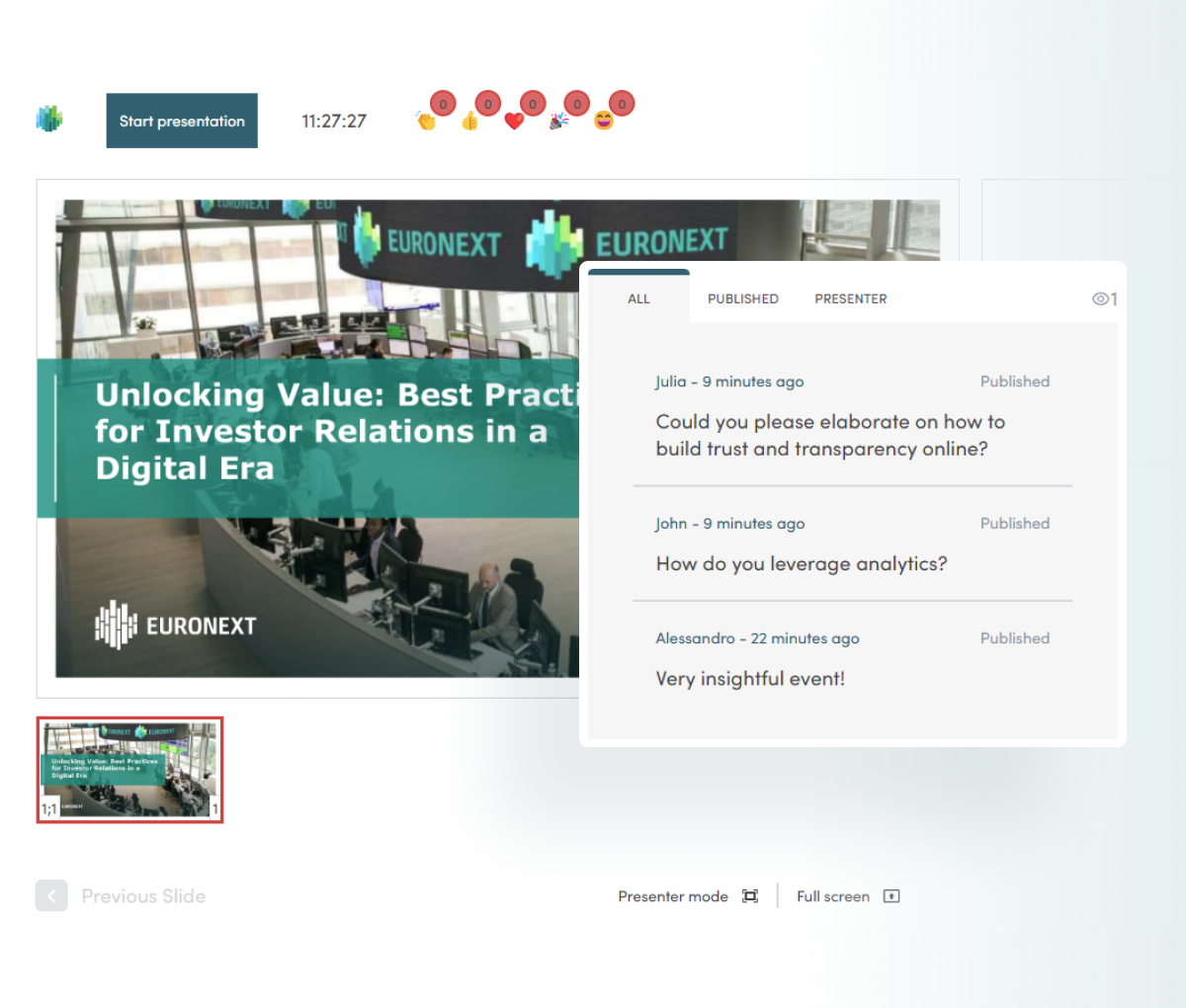
Euronext Corporate Solutions delivers the events layer of the IR stack through EngageStream, the secure event and webcasting platform used for results presentations, capital markets days, AGMs and smaller investor formats. EngageStream integrates with the IR.Manager CRM so that registration, attendance and engagement data flow directly into the targeting workflow, and connects to the Post-Listing Advisory team that supports the strategic preparation of major events such as capital markets days.
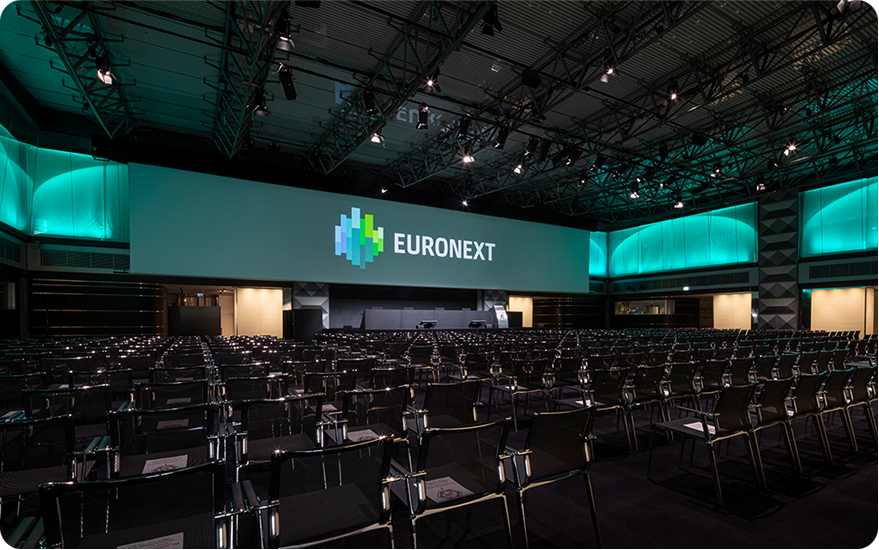
For issuers needing a physical venue with the production infrastructure to match, the Palazzo Mezzanotte in Milan delivers world-class capital markets days, results presentations and AGMs from one of Europe's most iconic exchange venues.
Continue reading
→ Investor Relations: The Complete Guide
→ IR Portal & Software: the technology stack behind the IR function.
→ IR Communication Best Practices: the disciplines that shape investor perception.