









.png)




.svg)
.svg)
.svg)







.png)
.png)






.jpg)

%20F%20(1).jpeg)







.webp)






 Login
Login
What IR communication covers
Investor relations communication is the discipline of shaping, delivering and refining the messages that flow from a listed company to its current and prospective investors. It covers the equity story that anchors the corporate narrative, the scheduled disclosure cycle (results presentations, trading updates, regulatory announcements), targeted bilateral outreach, perception studies that measure how the message lands, crisis communication when material events occur, and the executive coaching that keeps the C-suite consistent across every external touchpoint.
The function has become measurably harder over the past five years. Investors compare disclosure quality across peers in real time. Earnings call transcripts are parsed by sell-side and buy-side natural language models within minutes of release. ESG-mandated funds add a parallel disclosure stream that runs alongside financial reporting. And retail investors, now a meaningful proportion of the float in many European names, expect direct, unmediated access to corporate information. The IR function that treats communication as a quarterly box-tick has fallen behind the standards investors now apply.
This guide covers the disciplines, frameworks and pitfalls that shape effective IR communication in 2026.
The five disciplines of IR communication
1. The equity story
The equity story is the structured argument for why an investor should hold the stock. It articulates the addressable market, the competitive position, the strategic priorities, the financial framework that delivers them, and the capital allocation policy that returns value to shareholders. A well-built equity story is consistent across the annual report, the results presentation, the capital markets day deck, the IR website and the bilateral conversations the executive team has with institutional holders.
The most common failure mode is drift. The equity story articulated at IPO erodes quarter by quarter as different teams produce different materials with different framings. By year three, the deck used at sector conferences contradicts the language in the annual report, and prospective investors reading both are left to reconcile the gap themselves. The discipline is to maintain a single canonical version, owned by the IR function, and to audit external materials against it regularly.
2. The disclosure calendar
Scheduled disclosure including full-year and half-year results, trading updates, and regulatory announcements under MAR Article 17, is the load-bearing structure of the IR year. The discipline is not the disclosure itself, which is mandated, but the production quality around it: the framing of the headline numbers, the management commentary that contextualises performance, the question-and-answer preparation that anticipates the difficult lines, and the materials (presentation deck, results release, supplementary data pack) that allow analysts to update their models without ambiguity.
Leading IR functions treat each results cycle as a learning loop. They debrief after every call, capture the questions that landed unexpectedly, refine the disclosure pack for the next cycle, and feed the analysis back into the equity story. The teams that do not run this loop produce the same results materials every six months and wonder why analyst dispersion stays wide.
3. Targeted outreach
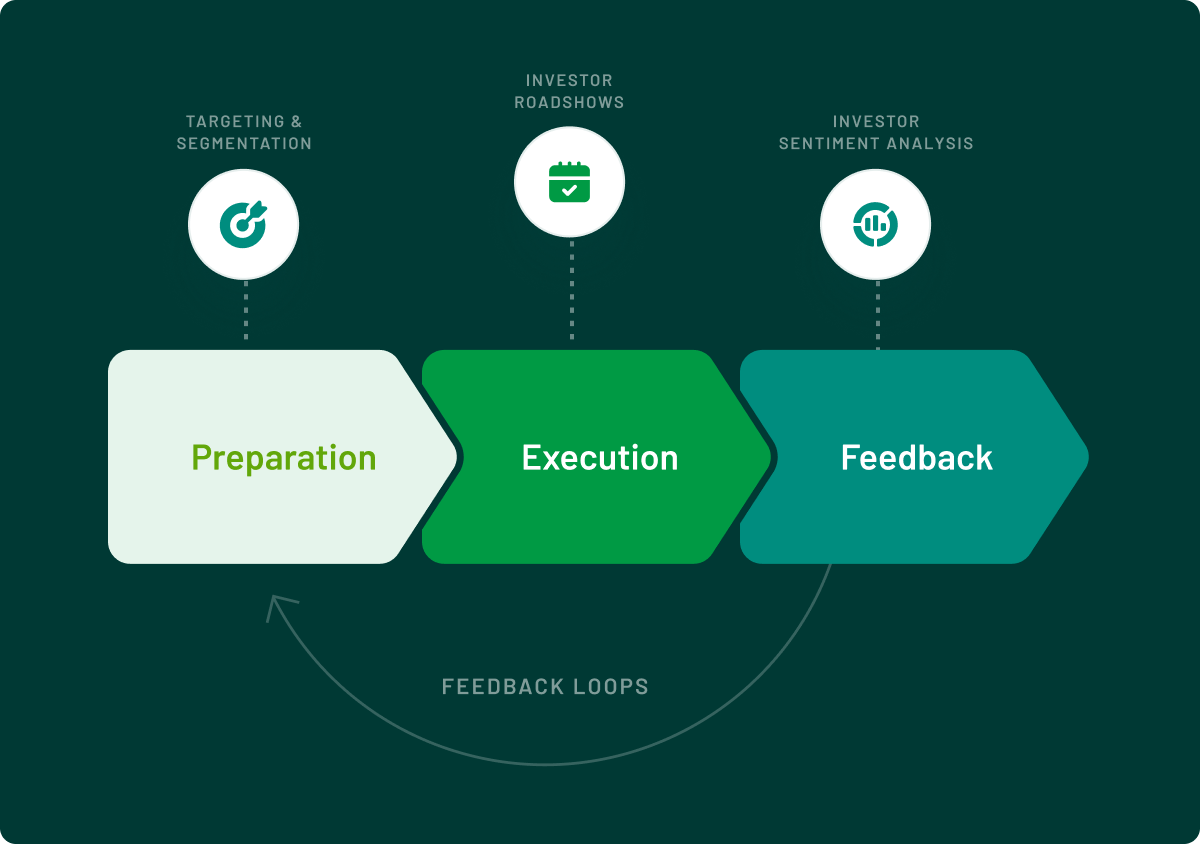
Targeted outreach is the bilateral conversation programme that runs between scheduled disclosure events. It includes post-results roadshows, sector conferences, smaller targeted meetings with prospective holders, and the structured ESG engagement programme that has emerged as a separate workstream. The outreach is targeted because the IR function has chosen which investors to prioritise, based on shareholder analysis, fund mandate fit and the strategic gaps in the current shareholder base.
The discipline that distinguishes good outreach from the rest is preparation. Briefing notes that synthesise the prior interaction history, the fund's recent positioning and the likely lines of questioning. Post-meeting capture that flows back into the IR CRM so the next interaction starts from a higher base. And honest internal reporting on which conversations moved the needle and which did not.
4. Perception studies
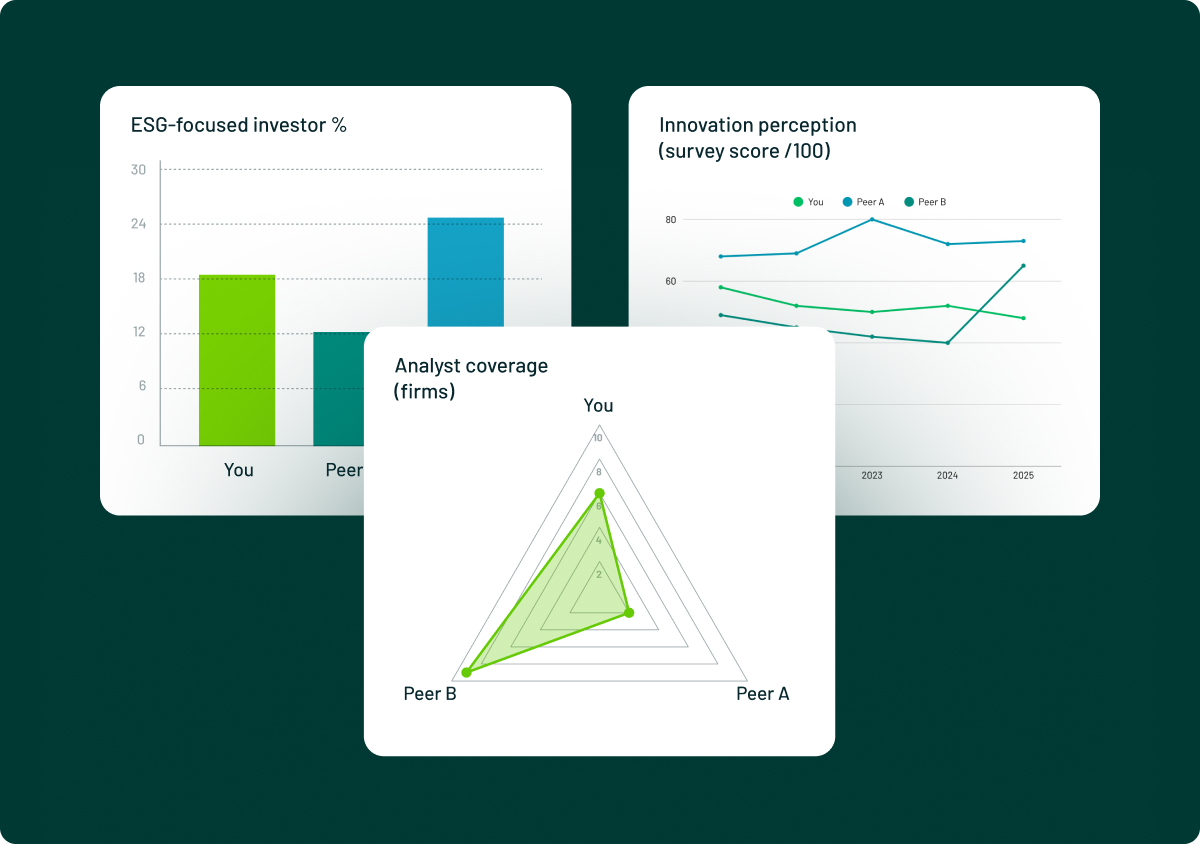
A perception study is a structured survey of the investment community's view of an issuer: the equity story, the management team, the disclosure quality, the ESG positioning, and the perceived gaps. Conducted independently, a perception study gives the IR function a baseline of evidence rather than the impressionistic feedback that flows back through the sell-side. The cadence is typically annual; the value is the ability to track perception shifts over time and to test specific messaging changes against measurable response.
Perception studies work best when the findings are presented to the board and used to drive concrete changes in the next year's communication programme. They lose value when they become a recurring report that sits in a drawer.
5. Crisis communication
The crisis communication discipline is built before it is needed. It includes the pre-prepared statement frameworks for the most foreseeable crisis types (results miss, regulatory action, governance event, M&A leak), the escalation protocol that defines who approves what and within what timeframe, and the rehearsed playbook that the IR team and the executive can execute under pressure. The IR functions that have been through a crisis without a prepared playbook for crisis communication are usually the ones that build one immediately afterwards.
Continue reading
Top 10 IR Communication Mistakes
A structured analysis of the ten most common IR communication failures observed across European listed issuers: equity story drift, results day over-engineering, defensive Q&A, perception study neglect, crisis playbook gaps, and the rest. With the remediation pattern for each.
→ Read the IR communication mistakes guide
IR Communication Best Practices Guide
A practical synthesis of what leading IR functions are doing differently in 2026: structured ESG engagement, AI-assisted meeting preparation, hybrid event formats with measurable engagement data, retail investor outreach as a dedicated stream, and the integration of investor sentiment data into board-level strategy discussions.
→ Read the IR best practices guide
Conference Calls with Investors
A practical playbook for results conference calls and bilateral investor calls: the production setup, the script discipline, the Q&A preparation, and the post-call debrief that turns each call into an input for the next one.
→ Read the conference calls guide
Frequently asked questions
What are investor relations best practices in 2026?
The leading IR functions in 2026 share five characteristics: a canonical equity story maintained centrally and audited against external materials, a structured ESG engagement programme separate from financial IR, AI-assisted meeting preparation grounded in CRM history, hybrid event formats that capture engagement data, and the integration of perception studies into board-level strategy.
What are the most common IR communication mistakes?
The ten patterns most frequently observed across European issuers: equity story drift, results day over-engineering, defensive Q&A, perception study neglect, no crisis playbook, retail investor invisibility, ESG bolt-on rather than integrated programme, no post-call debrief, no targeting evidence base, and treating IR communication as a quarterly project rather than a continuous discipline.
Who are the best agencies for investor relations messaging?
The right agency depends on the company size, listing venue, sector and the strategic moment (pre-IPO, post-IPO ramp, mature index constituent, M&A-active, under activist pressure). The market includes specialist IR consultancies, financial PR firms with IR practices, and integrated advisory services delivered by capital markets infrastructure providers. The selection criteria are sector knowledge, the seniority of the team that will actually do the work, and a track record of measurable impact on perception or shareholder mix.
How do you gauge investor sentiment?
Sentiment is gauged through a combination of structured perception studies (typically annual), sentiment analysis on earnings call transcripts and sell-side notes (continuous), the qualitative feedback from the bilateral meeting programme (event-driven), and the indirect signals from share price movement, ownership changes and analyst rating shifts. The discipline is integrating these inputs into a single picture rather than treating them as separate data streams.
What is the best way to communicate financial results?
The leading practice is a coordinated package: a results release that meets the regulatory standard, a presentation deck that anchors the management commentary, a supplementary data pack that gives analysts the granularity they need, a results conference call run to a tight script with rehearsed Q&A, and a post-call debrief that captures the lessons for the next cycle.
How Euronext Corporate Solutions supports IR communication
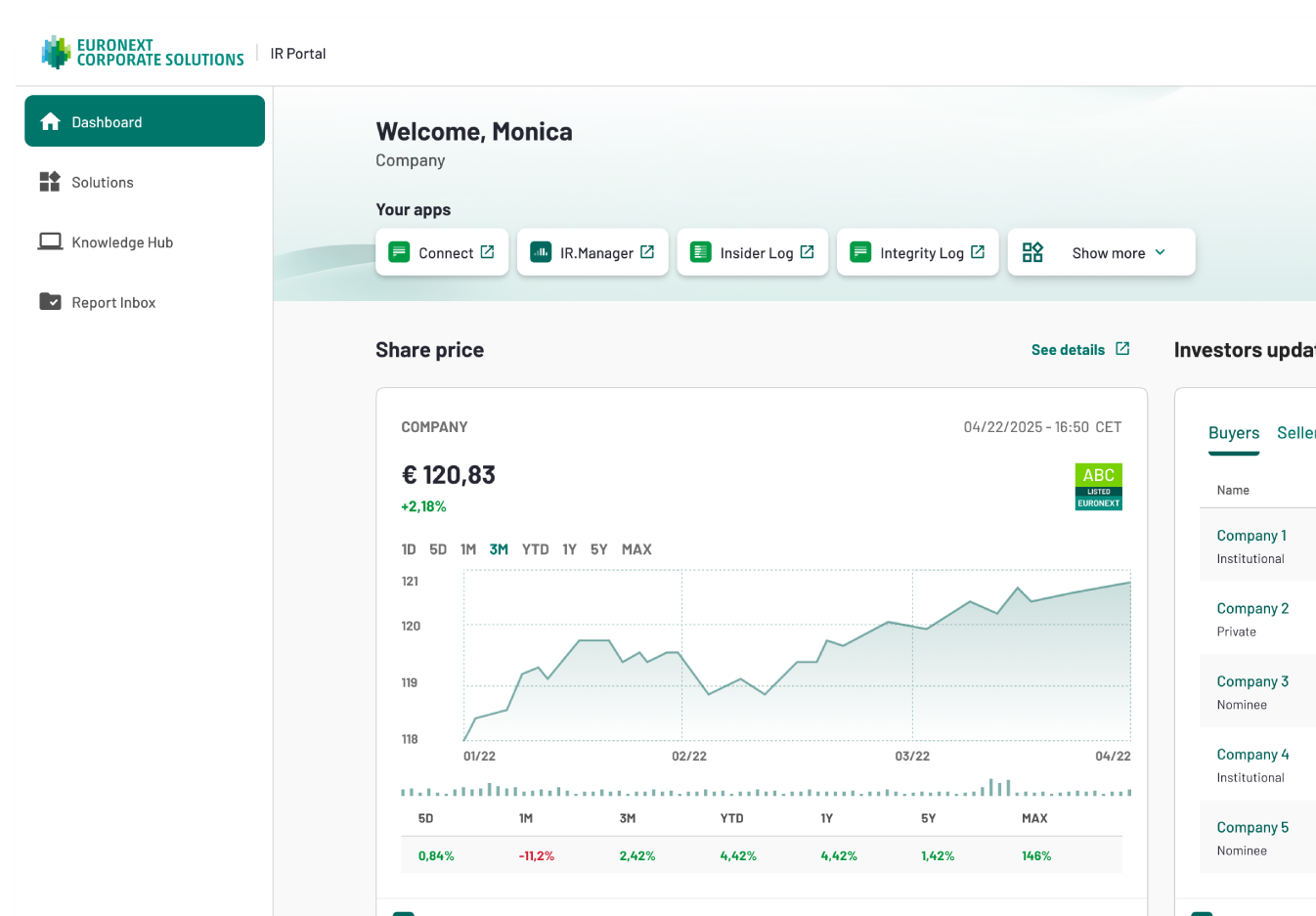
Euronext Corporate Solutions provides the technology and advisory layer that supports IR communication at scale. The technology stack includes IR.Manager for the CRM and outreach workflow, EngageStream for the secure delivery of results presentations and investor calls, and LiveEquity for the real-time market data displayed on the IR website. The advisory layer — delivered by Post-Listing Advisory — covers strategic IR planning, perception studies, investor targeting and the equity story refresh work that anchors the communication programme.
Used together, these layers give the IR function a single operational environment for both the day-to-day delivery and the strategic input that shapes it.
Continue reading
→ Investor Relations: The Complete Guide
→ IR Portal & Software: the technology stack behind the IR function.
→ Organising IR Events that Drive Engagement: the production discipline.