









.png)





.svg)
.svg)
.svg)







.png)
.png)






.jpg)

%20F%20(1).jpeg)







.webp)






 Login
Login
With Julien Tessier, CEO, Euronext Corporate Solutions (moderator) · Béatrice Richez-Baum, Director General, ecoDa · Caroline Ruellan, President, le Cercle des Administrateurs · Møyfrid Øygard, CEO, Admincontrol · Florence Priouret, President, SFAF
Recorded for Euronext Corporate Solutions, this webinar brings together five governance voices to examine why board evaluation has become central to board performance. Moderated by Julien Tessier, CEO of Euronext Corporate Solutions, the panel features Béatrice Richez-Baum of ecoDa, Caroline Ruellan of le Cercle des Administrateurs, Møyfrid Øygard, CEO of Admincontrol, and Florence Priouret of the SFAF.
Across three parts, the discussion moves from why evaluation practices must evolve, through what makes an evaluation actually work, to how findings translate into better boardroom decisions. The speakers weigh external, internal and hybrid evaluation models, the role of the chair, confidentiality and honest feedback, benchmarking and the action plans that turn a report into measurable change, practical territory for board members, chairs, company secretaries and the executives who support them.
- ecoDa recommends starting with an external evaluation, conducted roughly every three years to set an objective benchmark, with lighter internal reviews in between and a hybrid model (internal evaluation guided by an external facilitator) as a valued middle path.
- Every evaluation should end with a follow-up action plan that has milestones and clear ownership; without systematic follow-up, boards repeat the same patterns year after year.
- Rising transparency, accountability and shareholder activism have turned board evaluation into a way to detect vulnerabilities and weaknesses before activists do.
- Confidentiality is what produces honest feedback, especially when the findings concern the chair; an external consultant or hybrid process adds objectivity and shields the exercise from internal politics.
- Board dynamics and soft skills are the hardest and most important things to assess, and no database or technology can replace having the right people around the table.
- Board evaluation is relevant well beyond listed companies, including SMEs, family businesses, state-owned enterprises and non-profit organisations.
Video transcript
Click a speaker, timecode or passage to jump the video to that moment.
Why board evaluation is evolving: ecoDa's recommendations
Hi, everyone, and welcome to today's webinar. My name is Julien Tessier. I'm the CEO of Euronext Corporate Solutions, and I will moderate today's session.
We are pleased to bring together a high-quality panel of leading voices in corporate governance and board effectiveness.
We will discuss why board evaluation is evolving, what makes it effective, and how insights can translate into better decisions.
Let me first introduce you to our speakers. We are delighted to welcome Béatrice Richez-Baum, Director General of ecoDa, Caroline Ruella, President of Le Cercle des Administrateurs,
Møyfrid Øygard, CEO of Admincontrol, a Euronext company, and Florence Priouret, Chair at SFAF, French Society of Financial Analysts.
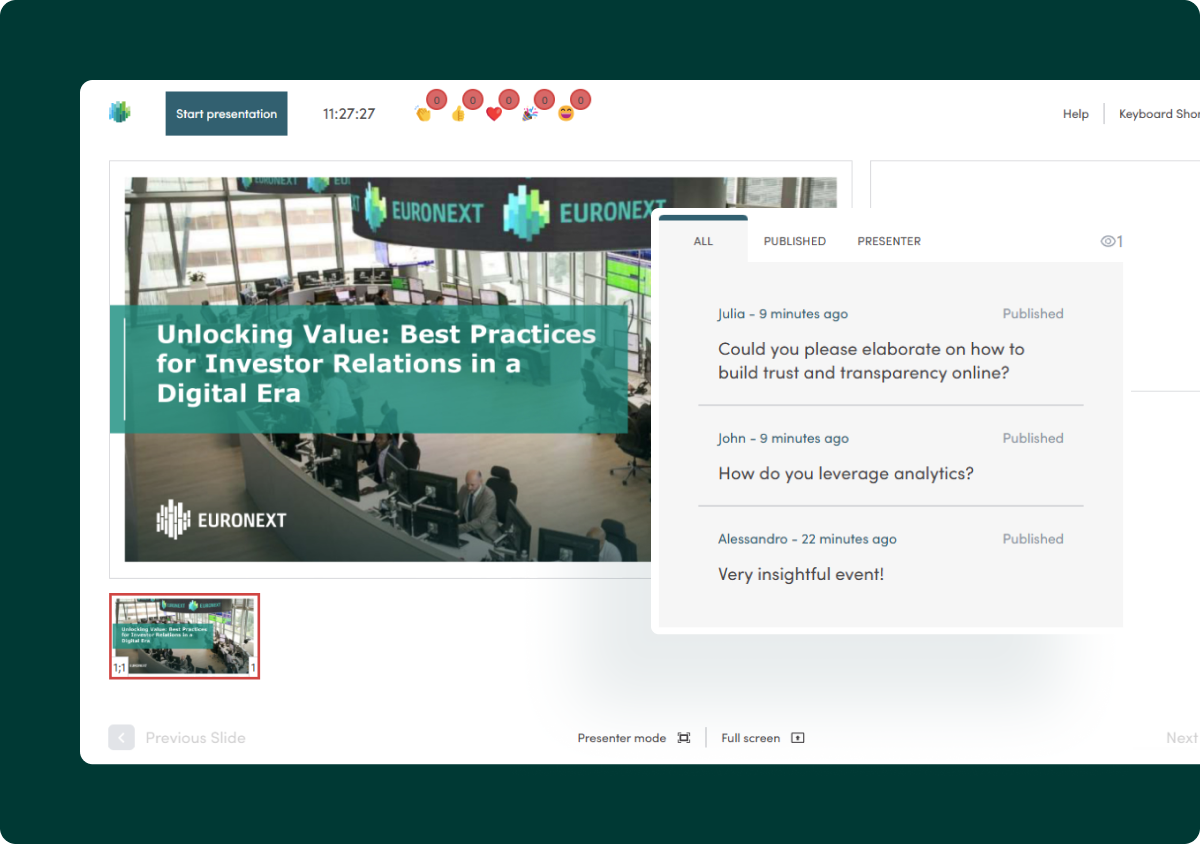
Thank you all for being here. I see we have over 500 attendees. Before we start, a practical note. On your screen, you'll find a field to submit questions at any time. We'll have a live Q&A at the end of the webinar. You'll also see polls appear on your screen. We encourage you to participate to help enrich the discussion.
Let's start by looking at the new demands boards are facing and why evaluation practices must evolve. Béatrice, ecoDa has recently published a report with board evaluation recommendation.
Can you share with us the key findings?
Yeah, I'm really delighted to join you for this webinar. Unfortunately, I'm not with you in person in your studio because I was a bit worried be stuck in the traffic, because I know that there are some strikes going on in Paris. So, for those who would not know ecoDa, just for you to know that we are an advocacy body. We represent 22 National Institutes of Directors in Europe and we are based in Brussels. So in fact, you are right, ecoDa issued a publication on board evaluation earlier this year, because we believe and we strongly believe that evaluation is a cornerstone in top-up governance. It impacts board dynamics, the quality of decision-making, and even the composition of the board itself.
So for us, well, in fact, board evaluation can be conducted in different ways and we will dig into that, but we strongly recommend always to starting with an external evaluation.
An external evaluation should be there to set a benchmark for the board's performance.
And in fact, external evaluation, what does it mean? So, basically, it's quite simple. It's just that it will involve an independent third party that will conduct the full exercise. So, external evaluation usually takes place every three years. That's at least what the main corporate governance codes recommend in Europe, allowing enough time
for the external consultants to gain real insight into the board functioning and also to better understand the governance practices at board level.
So those consultations, those evaluations provide at the end a very detailed and granular feedback. also thanks to one-to-one interviews that are often organized. And above all, you should take in mind that they offer the most objective assessment.
But ecoDa has really expressed one specific recommendation when it comes to external evaluation, because it's important that the organization, the company, ensure that the consultant does not face any conflict of interest. And that's really a point of attention for us, because we would not like companies to be in a situation where they would turn, for instance, to a headhunter, a search firm, who would be responsible to select board members and then would be involved in the assessment process.
What do we mean by internal evaluation? That's pretty clear. In fact, internal evaluation, first of all, can happen between two external evaluations.
Of course, they take less time. Usually, they can be conducted every year. They are usually also less expensive, but they tend to be lighter in analysis.
And then there is an hybrid model. So, in fact, it's an internal evaluation supported by an external facilitator. So, to a certain extent, you can consider this hybrid model as an halfway approach. And ecoDa sees a lot of value in this approach.
So why? Because in fact, the facilitator designs the evaluation framework, gaffers feedback from the board members, and then guides the board through the whole process.
So that helps also to uncover blind spots.
But in any case, to be really effective, and that's really a point of attention for us, internal evaluation with or without a facilitator must meet the same baseline standards as an external evaluation.
What do we mean by that? So in fact, to be efficient internal evaluation, you should, the board should be clear on what they want to achieve.
Is it a review needed only for compliance purposes?
Or are there any specific issues that the board would like to address? So that's something to be clearly set at the beginning of the process.
Also, what is important is within the board to allocate time to discuss the scope, the setup,
but also the methodology that will be used during the full process.
We recommend also to clarify the roles of the... key players, should it be the chair, the board members, but also the senior management, as well as, for instance, the lead independent directors, if it happens that there is one, as well as the secretariat of the board. So it's important to know who is going to do what and how much they will be involved in the process.
Also, to really offer and allow open feedback. feedback from the board members, confidentiality. is a key matter, so you really have to create an environment for trust where all board members will have a chance to express themselves in an open manner.
So that's another recommendation that we made in our publication.
I think board members and companies should really try to look at benchmarks from peer organizations. So should it be a benchmark in your sector of activity? Should you look at other companies within the same size? And don't forget, of course, but that's nothing that I will learn to you, but there are data providers in the market. So please also feel free to come back to them to get some data to support the exercise.
Also, at ecoDa, we believe that any kind of evaluation should focus strongly on board dynamics.
This is, and I'm sure all the other speakers will agree with me, that it is the most important part in the evaluation process. So, it's really our decisions are made, how everyone is embarked in the decision-making. So that's really a critical point, and I'm sure all our speakers will come back on that.
And also, and that's certainly also another important point, because what also matters is that all evaluation should really conclude with an action plan, an action plan for improvement.
Otherwise, the risk is that the board will get lost in what I would call introspection.
And we all believe that impact depends largely on the follow-up of what happened during the full process.
So to conclude, and I try to be brief, but board evaluation should not be an end in itself. It should not be a box ticking exercise. On the contrary, you have to really to consider it as a way to improve and to enhance professionalism of board members.
"Board evaluation should not be an end in itself. It should not be a box ticking exercise."
One point, and I will maybe finish with that one, is that we feel the need at ecoDa to really encourage shareholders to be more engaged when it comes to board evaluation. And also there should be more demanding. So they should have a discussion with the boards regarding the process, questioning the process, questioning also the outcome. And that's certainly something where we would like to see also improvement.
But I will stop here. But Julien, I remain ready to answer to any questions on that.
The board's new environment: transparency, accountability and activism
Thank you, Béatrice. And I saw Florence and Caroline nod quite a bit during your recommendations, so I feel they're quite shared. Now, before we dive into the board evaluation process, let's take a look at the current environment of boards and why evaluation is becoming a key level for performance. So, Caroline, over to you on the current environment of boards.
Thank you so much, Julien, and I'm very happy to be on this panel on this very important question for me.
Just as a prerequisite, I would like to mention that I am myself a board member, so I did take the exercise of being interviewed and being assessed as a board member. And also, I'm also on the other side, since at SONJ Conseil we have a core practice on this board assessment, so I do know the exercise and how important it is on both sides. So this is a first comment. I would also add, after Béatrice's introduction, that this exercise is definitely not a compliance exercise, and as a whole, the governance is not a compliance tool. It is about the ability and the capacity of the company to engage into the best decision-making process and in the best interest of the company. So before sharing more information about this board assessment, I would like just to share with you and to give you some, I would say, some peace of mind. some element of context of listed companies. I think they are now facing a very new paradigm, which is fueling with new expectations and new risks for companies and board members. Let me be very fast. The first one is, for long, the company has been acting out of the city. And now the company's companies are at the heart of the city, which means that they are concentrating many expectations and demands from shareholders, but not only for all stakeholders, and we will see how it may impact at some point the board assessment and board functioning.
Second pillar, second trend is we tend to continue to observe an intense rise of
hyper-transparency, which means from a board perspective that they definitely left the shadow to be in the full light, and we'll see how much the pressure is now getting more and more intense. And which we may come up with the third trend, which is very much important. This is probably the most important in that it will impact very heavily the board functioning and the board assessment process, which is the rise of accountability, which means that now investors, shareholders, but also stakeholders, tend to question the strategy. They want the company to engage into dialogue into, I would say, they need to have more information and to justify the strategy, the decision, and the core decision of the company. One core indicator of this powerful accountability trend is the rise of shareholder activism, which is at the crossroads of transparency and accountability.
In other words, shareholders, but not only shareholders, consider they may have a direct or indirect interest to challenge the company directors, executives. In other words, on the shareholder side, they do consider that they are not happy with a purely capitalistic treatment of the stake. They intend to influence the company strategy, the company future, when they consider that it is in their best interest. So from the board perspective, it means that they will be more ready, more willing to challenge board directors, and even sometimes to trigger their liability, at least their reputation.
So you see how much this new environment is putting intense pressure on boards. And in that respect, the board assessment exercise is getting more and more important, and also more and more scrutinized. So sorry, because I don't have my glasses myself, but I don't know whether we are on the right slide. Nevertheless, what does it mean from the board assessment perspective? First, as I told, boards have indeed shifted from the shadow to light this in a few years,
which means that they are very much under pressure, and they are also very much challenged by investors, activists as well, that will discipline in some respect the decision-making
process and whether the company is well functioning and the governance is well functioning or not. So, as a result, I would say the board evaluation is first a unique opportunity for the company and for the executive and non-executive to detect very much ahead vulnerabilities and weaknesses before the others do, and mostly activists.
So, second thing, it's of course a very good exercise to improve the board performance and each board director performance, but I think we'll have a chance to talk about this question later on. Thank you so much.
Scope, priorities and the role of the chair
Thank you, Caroline, for sharing those insights, and actually, a question for you or maybe for those who are less familiar with the process, what's the scope of a board evaluation? And we actually got already a question live on that from Eric. How about like the different committees associated to the board, like nomination committees and others?
and others. is normally targeting the functioning of the Board itself and also in its relationship with the management, which is very much important, because just praising the Board as a separate body doesn't make any sense, which is very much important, is the interaction between the Board and the management. So this is on the one hand. In case of an external exercise with a consultant, external and independent exercise, as Béatrice mentioned before, it's very much important. The thing is, the consultant will carry out the exercise, but in connection, in relation with the nomination committee that is supposed to organize and also to provide the consultant with information. But the main actor of this exercise, when it is external, be the external, will be the consultant.
And when you launch a board evaluation process, are there items you prioritize?
I mean, you have different body of items, actually, whether the collective body function well as a whole, for instance, whether board members are provided with all the information they're supposed to get, because one of the core problem for board members is to get the Let me just mention one thing about information, which is very much important, and I'm really talking of experience, is, as a board member, you tend to consider that you got the full information, non-biased, and complete information. The fact is that the information is biased and incomplete, which we call, technically, the information asymmetry. So the first things you need to, I would say, to address, to question, is how much this asymmetry information is mastered and how, in which respect, the chairman of the board is very active in making sure that all board members got the right information on time in order to take the right decision in the best interest of the company. So one of the core items is really focus on the information of this information asymmetry and how it is treated and how it is overcome.
Okay. And speaking of the role of the chair, what's in your view the role of the chair in this process?
The role of the chair as a whole, regardless of the process, the board assessment process
is absolutely, absolutely very, very core. Why? Because if you want a body like the collective body as the board is, you need someone who is making sure that is really making this body working very efficiently. So it's like a conductor, you know, in orchestra, and he will provide the information, he will set up the agenda, he will make sure that all the board member have a chance to express, to say what they really think, to instill, I would say, kind of honesty in the feedback during the board. So that's something you need to check out when you're doing the exercise of board assessment. So as a result, of course, the chairman, the chairwoman is a very core position to the board functioning. So one of the core exercises when you're doing the board evaluation is, of course, to check out whether the chairman, the chairwoman, is doing the job properly, which is really one of the core questions you need to ask, to challenge with each board member.
And when you put this question at the table, of course, you tend to think that it's not that easy, because it's not so comfortable for board members to say, well, I've been
proposed by the chairman, but at the end of the day, I don't think he's doing the job that well. So one of the core, I would say, expectation of the board evaluation is to foster confidentiality so you get true, honest feedback. This is one of the core difficulties. And you will get true, honest feedback, first, because you are able to build up trust with board members, and second, because you will ensure board members that whatever they say, it will never be disclosed. It will remain anonymous. So this is one of the key, I would say, expectations to make this exercise not a compliance exercise.
Balancing internal support and external review
So maybe a question for Béatrice.
In terms of the blind spots, you mentioned blind spots earlier. It's not easy for a board to be self-aware of its own performance. So how should the board balance the support between internal support and external support?
First of all, I would like to say that in general, board members often overestimate themselves. I would not like to appear a bit unpolitical here, but I have a feeling that female board
have maybe more of a capacity to question themselves.
But this taken into consideration, I have a feeling that this is why, in fact, external evaluation are so valuable,
because they will bring, again, independent views, because they will include one-to-one interviews with the board members, but also the senior management.
But that being said, I would not recommend to wait for the external review. That will happen, as we said, every three years. So I think there is different ways, different tips to really assess the board on a long run. And that will make the big difference. So if you allow me, I would like to present some ideas, some suggestions. First of all, in fact, that's a good practice that we see happening,
is that at the end of each board meeting, boards should really take the time to discuss what worked well during the meeting, what didn't, and what could be improved.
With those small adjustments along the way, you can really prevent bigger issues from coming up.
Also, that's another opinion that I have, but the chair has a point. crucial role in giving feedbacks so sharing both bravos and clear expectation with individual
board members is for me a powerful way to keep everyone motivated and to really know what is expected from them at board level.
So I think that the board should regularly review how much time is allocated to priority matters. So that can be a task for the secretariat, the secretary of the board, just to analyze from time to time if the board spent enough time on the priorities. I think that's really a key information for improvement.
Also, but I'm sure you will agree on that,
it's important from time to time, and that should be the role of a chair to check the strategic alignment. So, do all board members share a clear vision on where they want to take the company? So, from time to time, I think it would be good just to repeat what are the company's major targets and the key performance indicators to make sure that the board is working in the right direction.
Also, it might be seen as paperwork,
But don't forget that quite a few boards have developed a board charter, and it's important to keep this board charter alive. So it's not just a piece of paper, and it should be a living remember on how boards would work and commit together. So I would recommend board members to look from time to time at this board charter and to challenge themselves. Do they feel that they really meet the expectations that the group?
Before we continue, we'd like to hear from the audience. So you'll see a poll appear now on your screen. Let us know if you've ever participated in a board evaluation process. Thank you.
What makes a board evaluation actually work
Let's now move to our second part on what makes evaluation actually work. For this, I'm pleased to hand over to my colleague, Møyfrid Øygard, CEO of Admincontrol.
Thank you, Julien.
The board's main purpose is to ensure that the organization fulfills its mission responsibly, sustainably, and also in the best interest of its stakeholders.
And a key challenge for our board is that they often assume they are effective, which
Béatrice has mentioned already, but blind spots in governance, strategy, or dynamics can hold the organization back.
A good board evaluation helps solve this key challenge, obviously combined with having
the right people on the board.
No evaluation or technology can ever replace the human capital that is so crucial.
In reality, most board evaluations fall short of their potential. The main reason to evaluate a board is to make sure it drives real changes to the organization
rather than just existing as a formality, which has also been mentioned here already.
And we consistently see three critical issues with board evaluations.
The first one is lack of follow-up.
Too many evaluations end with a report that sits in a drawer.
"Too many evaluations end with a report that sits in a drawer."
Without systematic follow-up, insights remain unused,
and boards repeat the same patterns year after year.
The second one is unclear purpose.
Many boards conduct evaluations because it is required or expected, not because they are genuinely committed to improvement.
This compliance mindset produces superficial exercises rather than meaningful assessments.
And the third one is superficial feedback.
Generic questionnaires asking, how well does a board function?
Those provide little actionable insight.
They fail to address the nuanced dynamics that actually drive effective governance.
Modern board evaluations can drive meaningful improvements, and they definitely support effective board work and good governance when they are done in the right way.
We strongly recommend board evaluations to be conducted annually.
This will evaluate and enhance board capabilities. It will foster a culture of feedback and openness. It gives valuable insights into responsibilities and effectiveness.
And it advances transparency and accountability.
And, of course, it also gives very valuable input to the nomination committee.
In Admincontrol, we offer a board evaluation that consists of five categories.
The first one is looking forward. It evaluates how well the board contributes to strategy development, priority setting and financial target definition.
The next three are about board effectiveness.
They focus on how efficiently the board works. They assess meeting structures, preparation, the leadership of the chair
and the contribution of individual members.
And the fifth one is looking back. It reviews the quality of financial reporting, business follow-up and the board's compliance and control responsibilities.
The evaluation addresses the critical gaps and provides you with a roadmap for implementing actions
that truly enhance board effectiveness as well as ESG performance.
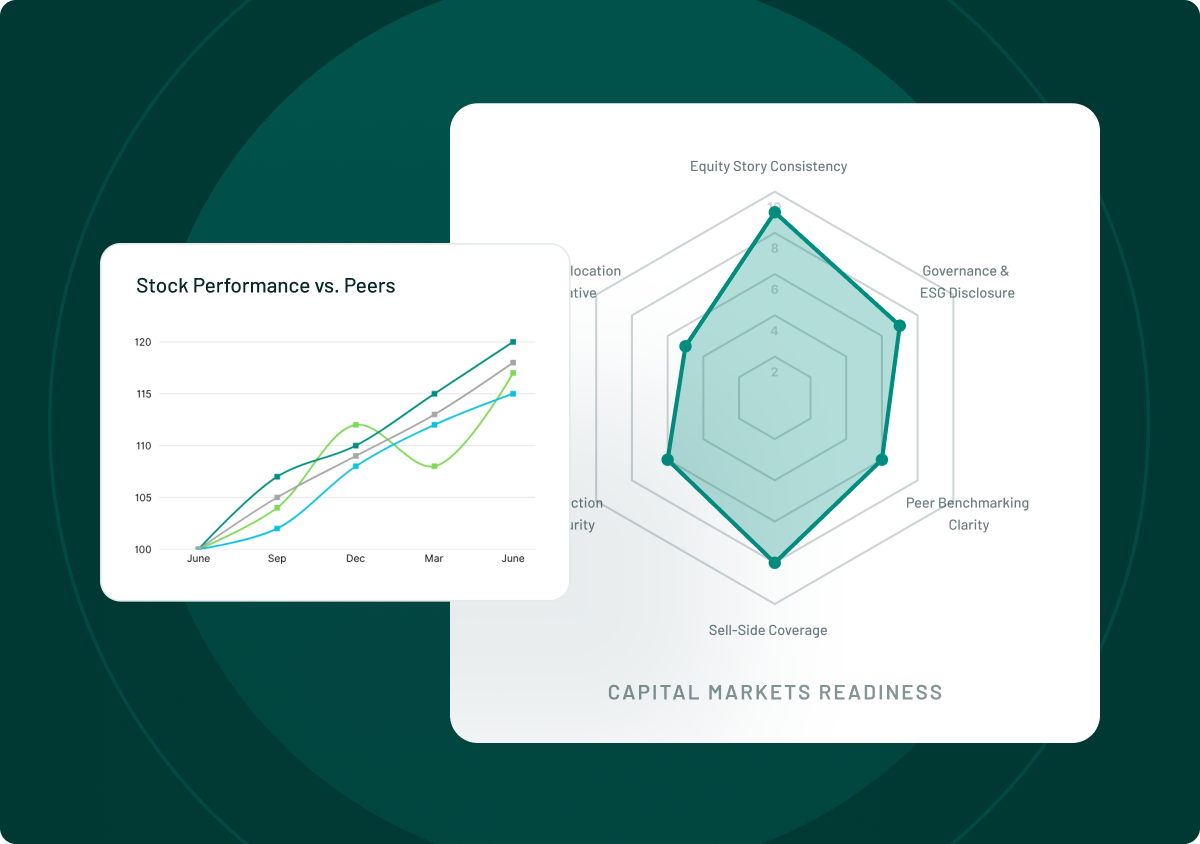
The main results from our board evaluation are shown in a spider chart with these five categories, but of course also much more detail for each category.
And you might see here at the bottom of this slide that both the board and the management have been given the opportunity to be part of the evaluation,
which we also think is very, very important
invite the management in to evaluate the board as well.
Then I would like to show you two specific examples from customers who have conducted our board evaluations. Let's have a look.
The first example is where the board considered they had a very good balance in time spent on long-term strategy versus compliance and operational details.
However, the evaluation results revealed imbalance between these. areas.
The action they took was to adapt a new agenda structure where they had 70% strategy, 20% risk and 10% compliance.
Decision making as a result of this improved as directors were
more aligned on growth priorities and leadership set clearer long-term goals with milestones.
The second example is from a customer where the board meant they worked very well with
cyber and regulatory risks. But the evaluation showed gaps in risk expertise and risk committee effectiveness. So the board decided to recruit a director with cyber security expertise,
and they established quarterly deep dives into this area.
And the impact was that the leadership was better prepared for emerging threats, resulting in proactive risk management and faster responses to incidents.
It has also been mentioned today to have benchmarking and many boards are very interested in benchmarking with other boards,
but I would emphasize that it's the year-over-year benchmarking that adds the most significant value to a board
and actually drives change for that board and the organization and the stakeholders that this board represents. And this data, the year-over-year benchmarking, that turns insights into a story of progress. It ensures continuity. It highlights emerging issues. It provides evidence of accountability.
And it strengthens the leadership credibility by showing a consistent trajectory of improvement, not one of fixes.
So at the end, I would like, I hope that I can give you three key takeaways.
And it's about using modern technology combined with having the right competence on the board.
Supporting culture and building trust are crucial ingredients. Technology and evaluations can never replace this.
The second one is that board evaluations provide consistency and clarity through conducting
a structured board evaluation with year-over-year comparisons.
And then finally, they enable action and accountability through clear reporting
that turns feedback into measurable improvement.
Turning findings into a lasting action plan
Thank you, Møyfrid Øygard. Very clear and practical overview and clear example on how to deliver measurable impact. And I would like to hear again from our audience. You've just seen how a structured evaluation process can strengthen board effectiveness. So if you'd like to explore this in practice, let us know in this poll. Thank you.
We'll now move to the third part of our discussion, with our panel discussion, turning insight into better boardroom decisions. And for this conversation, I'm joined here by Caroline, by Møyfrid Øygard, and welcome, Florence Priourett. So we will explore how board evaluation can strengthen corporate governance and decision making. Florence, perhaps I can start with you. So after the evaluation process, there are findings. What's the key to transform the evaluation findings into lasting improvements in the boardroom?
Thank you, Julien. First to say, I'm quite happy to be here today with you and to be part of this panel. So what's key to transform the board evaluation to lasting improvement? I would say just as Møyfrid Øygard said, an annual evaluation is key because otherwise, even
if you have an action plan, you may only take short-term actions and just forget the other
ones later, but, well, in a more structural way, I would say for me there are four keys
to go to an improvement, the fact that the evaluation is adequate, which means that there is first an in-depth analysis of the context of the board, of its priorities and challenges.
There's no one-size-fits-all for board evaluation, and this point is quite important because
it's a unique board evaluation, it's a unique opportunity to take a step back and to align
members on priorities of the board work.
The second one is to examine the relevant scope during the process, because it's important
of course to examine collective functioning. hard and soft skills, interactions between board and board committees, between board
and C-suite, but also to look what are the expectations of shareholders and stakeholders,
which is an important point, as you mentioned, in external evaluation. So I mean, it's an important point to make it efficient, the evaluation for the improvement
of the board. Because if you do not, if you just look at the board functioning while forgetting expectations
from stakeholders, you might not gather all the improvements you could have.
The third point is the quality of the restitution of findings to each board member, which is
a quite important point as well, because board members have to feel comfortable with the
findings and just to share them, otherwise they will not change their way of acting on
the board.
And of course, the last step, but I think you will have a question on this later, is The action plan, it's a real implementation and the follow-up of the action plan.
Maybe we can actually talk about the action plan, Florence.
In your view, what makes a strong action plan and how do you ensure it actually gets implemented?
action plan, as it has already been said, is an action plan with milestones, and it's
important also to dedicate the right means to do this action plan, to make it effective,
to have a follow-up and correction in some cases.
Well, with the follow-up,
correction on the original action,
and also persons responsible for each item of an action plan, because otherwise some things may be not treated.
I don't know if...
No, I agree with you. We spoke about this earlier today, that it's very important with the milestones to follow up the clear ownerships and you should also integrate that action plan with board work.
Make sure that you link actions to strategy, planning, risk oversight, embed it into agendas and so forth and make sure
that you actually evaluate from time to time. Let's not wait for a whole year and then bring it off and see how we did.
Can I ask something about this thing, the action plan, because I think this is a core
question, really key, because you're doing a very great job, but it's useless, and at
the end of the day, you spend a lot of money and a lot of time, and the exercise is useless. One thing is you have to make sure, but this is also true for the board work as a whole.
The thing is, from one session to another board session, what is one of the core exercise each board member should
have in mind is to make sure there is a continuity between each session. And the board assessment is part of this exercise. So how you make sure that from session number one, session number two, board three, four, and four, and so on, there is a kind of something going on, and you don't forget what's been told the board before, the board before before, and the board last year. And, of course, we're mentioning this about the board assessment, but it's very true for any topic on the table of the board. So, and it's not that easy because the agenda is so extensive. Now, you tend to forget about it. So, about the action plan, I wanted to add, you need to have someone or a committee charge of the feedback and the follow-up.
So, actually, who's in charge? Is it the corporate secretary? Is it the chairman? And if someone realizes live that we're not improving versus the last board?
That's something you can decide in the board. It makes sense that it will be the chair of the nomination committee or the lead director.
Whoever the person is, you need to nominate someone who is— really much in charge and is supposed to get back to the board with a roadmap and with the quick fix, actually. But this is the same for any topics dealing with the board, you know. I just want to mention that because I think it's very much important, you know.
And maybe related to leadership. Yeah, absolutely. So someone will be in charge of making sure we, you know, the board doesn't fall into the, let's say, shortcomings that we've seen in the past. But what happens if some of the the evaluation findings actually concern the chair?
Good question.
I'm not supposed to answer.
First, and as I said before, one core question
that will be asked to each board member is whether the chair is doing the job and whether it's got the good leadership, whether is really doing a good job regarding this information asymmetry. If it's not the case, that's a problem that should be addressed. Of course, normally, by the nomination committee,
ideally and normally, the chairman or chairwoman is not supposed to be into this committee that provide the committee with a big independence. That's the reason we don't want the chairman or chairwoman to be on this committee. So it will be the job of the committee. And of course, when you have this kind of issue, it's much more comfortable when you have an external consultant because in some respect it will provide the objectivity and the process, which is much more difficult when the assessment is purely internal because you can imagine that people are conflicted at some point, you know.
Benchmarks, soft skills and who owns the follow-up
Which actually leads me to some, we have like something like 200 questions, so I'm not sure we'll be able to address all of them, but there was actually a question related to what you just said around, so it's a question from Mihaly, I hope I pronounced it correctly, when there is an internal evaluation process, how do you ensure it's not influenced by corporate politic matters?
I don't know, Florence or Caroline, who would like to answer that? You cannot ensure it, to be honest, it's impossible.
And that's the interest of what Béatrice mentioned of sort of hybrid processes.
I do perform some as a consultant where the consultant can assist and support an internal process to give some independence to the process and to involve more if necessary, in particular
when there's a concern with the chair.
So a consultant, a tool, external support.
Yes, and yes, and as you say, and as Béatrice said as well, benchmarks are quite important to address
concerns with the juror.
And also in the action plan, it's
easier to give some targets to a juror based
on benchmark than just to say there is that expectation from your board members.
It's more, it's always easier when there's an objective number of. It gives some comfort to the board, actually, you know.
For sure.
Béatrice, I see you have your hand raised.
Yes, if you allow me, I would like to add a couple of points. You mentioned the role of the chair, so I do believe that good leadership from the chair starts with championing the exercise. I think he has to show the board that the evaluation truly matters, and he has to sell
it as a positive exercise, not to judge individuals, but really to see how they can improve together.
And for me, the chair has to guide the process without dominating it, so making sure of course
that each board member has a say, he has to keep in mind that he is a primus inter pares,
so it's only one voice among many, and he should not try to influence the outcome of
Additionally, I think it's an important point, maybe that can respond also to the question. I believe that good leadership means making sure the evaluation leads to action, but also not to focus. only on a review of the past, so it has to be sold as a dynamic tool to reset priorities,
to strengthen the way the board works together.
So I think all the board members around the the table should not feel uncomfortable with the exercise. They have to see it at the end as a collective exercise. And I think it's also a way to analyze gaps in terms of skills and maybe to recommend extra trainings. Should it be for the board as such, or should it be for specific individuals? So I think really bringing this positive mindset is really important. And I would question also the importance and the need for board members to get a specific budget. So they should have enough budget to conduct all of that, including training programs for board members.
Maybe going back to what you alluded to before, and we actually have a question from Rashbir, again, I hope I pronounced correctly. In terms of benchmark, the question is what benchmarks currently exist, and are they robust, and are they by verticals, by sectors?
Yeah, there are some databases that may help a lot the board's assessment process can name two, but I don't know whether I'm supposed to do that for these companies. But I think there's OFG Research, which is a very good one, research providing really a very highly scrutinized databases on the trains
and what the company peers are doing and what are the best practices. On the one hand, there's also Ethics & Boards. So you have some tools, but I think having said so, I think the good exercise, I mean, board evaluation process
that is a success is a combination of a lot of things because what is very much difficult to appraise and which is key for me, it's our soft skills. And no databases will give you a chance to appraise soft skills Because at the end of the day, you can have the most sophisticated board with great expertise in finance, cyber, risk, whatever. But if you don't have people around the table being, for instance, courageous, being able to say, we have an issue, we need to reset everything, or we need to challenge the chairman, whatever, I mean, the board is not functioning.
So which is very difficult about this exercise is being able to assess hard skills, but this
is very easy, to be honest, which is much more difficult, is to assess soft skills. And second, to assess soft skills of the board as a collective body, whether the board as a collective body really function well or not. And this is very much difficult. I think this is one of the key difficulty of the assessment.
And actually, going back to the people and the skill set, but before that, I see, Béatrice, you have your hand raised.
No, I would like to build on what was just said. I think it's important that board members don't take decision only on opinions, but really make the effort to collect real facts, and that's not so easy. You always, and maybe a human being, tend to turn to your opinions without checking the truth of this opinion.
So opinion means people, so question on people. We have actually a few questions on the different roles. One question from Vaida about the role of the company CEO when it comes to the action plan from the board. Is he totally out of this topic or is he involved? And then there is another question on the corporate secretary to know if the process, the evaluation process This includes the evaluation of the corporate secretary himself or herself.
For the second question, I would say that the process includes the evaluation of the
corporate secretary, not the whole evaluation, but its contribution to the functioning of
the board is included in the evaluation.
And how about the role of the CEO?
In the action plan, that was your first question.
In the action plan you mean?
Yes. Of course, as Béatrice said, it's also a leading role to show it's important, and just also
to follow it.
I would add, what you really try to assess when you do the board evaluation process is
how well these two bodies, this is very theoretical, but it's not that theoretical, those two bodies
which are on the one hand the board members, on the other hand the manager, are working well together.
Because if you just set the board itself like a kind of body in the sky without any connection, without any ground relationship with the management, it's totally useless. What is really the weakness or the strength of a company is the ability to make those bodies working together well and sharing the right information in the best interest of the company. That's what you really need to check out when you do the exercise of the board evaluation. So it's a way to answer yes to your question, you know.
Board evaluation beyond listed companies
And so we will take one last question and we'll answer offline for the over 100 left. But being mindful of time, maybe one question that is slightly different, it's on the type of companies that can be concerned by board evaluation, and maybe, Møyfrid Øygard, for you. We've talked a lot about listed companies, but how about board evaluation for non-listed companies and also for NGOs, non-profit, voluntary organizations? Is it relevant for those kind of organizations?
Yes, I would definitely say a big, big yes.
It helps those organizations as well to professionalize their boards.
For private companies and SMEs, it will be smart to have done those evaluations when seeking more investors, for instance. For state-owned enterprises, public bodies, it helps building trust, transparency, reliance, accountability, and family businesses helps professionalizing as well.
So yes, this is definitely for so much more than the listed companies.
So it's for everyone.
It's definitely for everyone, yes.
Yes, in NGOs for example, associations, the role of the board is more operational as well,
so the well-functioning of the board is quite important for the body.
It's important everywhere, but it's not.
And the thing is, maybe to add information, the way listed companies are structured, discipline
will all these processes, which are not definitely implemented in non-listed companies, tend to overlap and to go into this, I mean, this bench of companies, because I think there is a positive influence in that respect, and that we need to encourage it, of course, you
know. It's not because you're not listed that you have your board functioning well, you know it's obviously it's not connected. So board evaluation for all.
That will be the concluding word. A big thank you to our to our speakers Béatrice. C'est la fin de l'émission. Merci. Au revoir. Au revoir. Au revoir. sharing your expertise and thank you all in the audience for the very active engagement and for all the questions asked, we will make sure to follow up. So we hope this session has given you practical insights on how board evaluation can strengthen decision making and improve corporate governance. And on behalf of Admincontrol and Euronext Corporate Solutions, thank you again for your time, your engagement and we look forward to further connecting. Thank you.
Show transcriptHide transcript
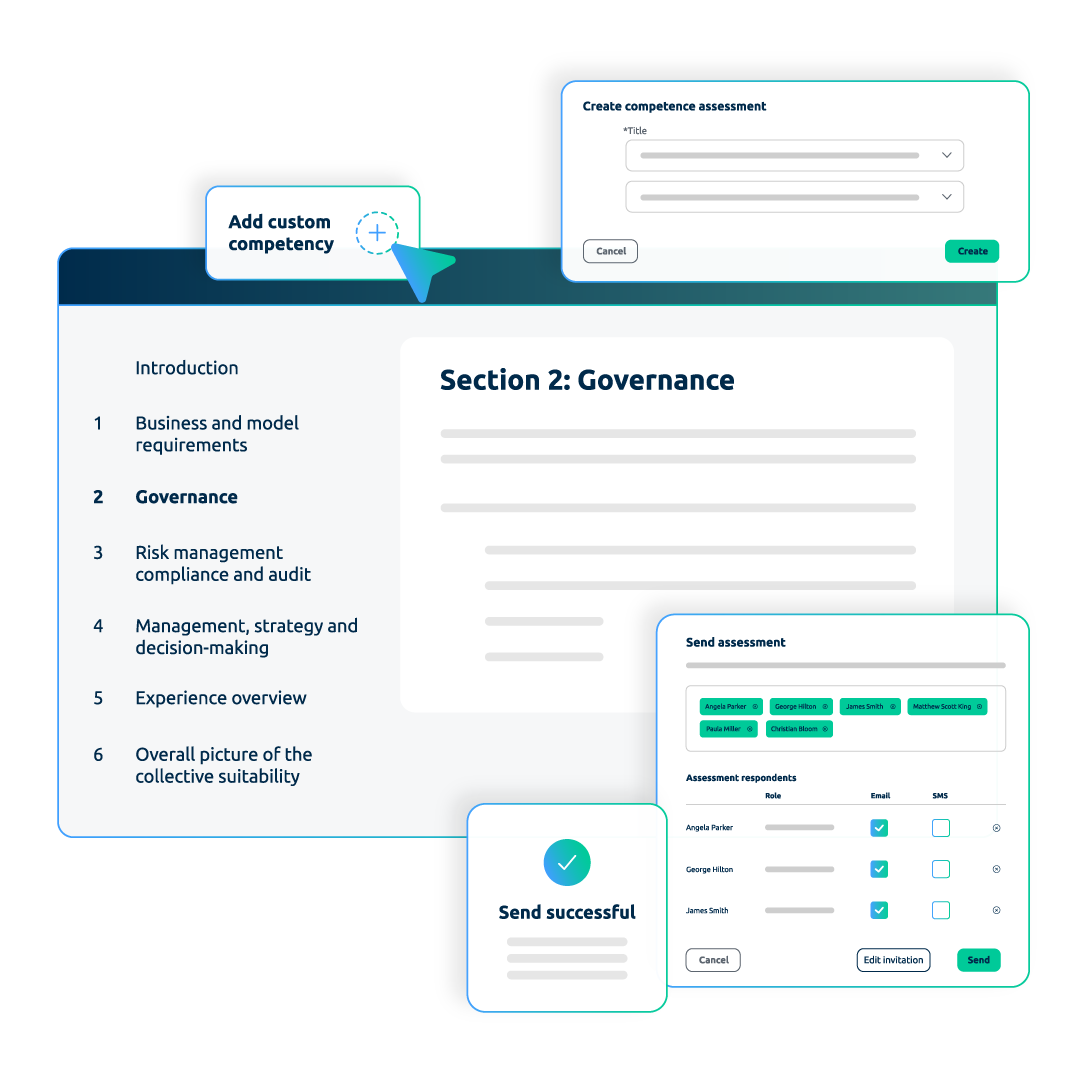
The panel is clear on one point: an evaluation only earns its place when it ends in action, with year-over-year comparison and clear ownership of follow-up. Admincontrol Board Evaluation is a structured self-assessment module, integrated into Admincontrol Board Portal, that captures forward and backward-looking feedback, compares board and management views, tracks year-over-year trends and turns the results into presentation-ready reports, drawing on a methodology built from more than 1,000 evaluations across Europe.
Explore Admincontrol Board Evaluation