









.png)





.svg)
.svg)
.svg)







.png)
.png)






.jpg)

%20F%20(1).jpeg)







.webp)






 Login
Login
International Financial Reporting Standards (IFRS) are a globally recognised set of accounting standards that provide a consistent framework for issuers when preparing financial statements. A core element of this is IAS 24, which requires you to identify and disclose relationships and transactions that could influence how investors interpret your financial statements.
Without being aware of the nature of a company’s dealings with related parties, it can be difficult for shareholders, regulators and other stakeholders to gain a true understanding of its financial position. Following the framework of IAS 24 ensures you are open and transparent about these relationships and provides context to your reporting.
Although the majority of organisations make their IAS 24 disclosures with good intentions, some still fall short in their governance efforts. They often have trouble identifying the right people and relationships to report, as well as failing to maintain comprehensive evidence that their related party database is up to date and complete.
This article explains where related party disclosure governance breaks down and what a good IAS 24 process looks like.
Key takeaways
-
IAS 24 is about transparency, not just accounting. It helps investors understand when relationships with related parties could influence a company’s financial position or decision-making.
- Most reporting failures stem from weak processes, not misunderstanding the standard. Identifying all related parties, keeping records current and coordinating information across teams are the biggest challenges.
- Clear ownership and structured workflows reduce risk. Centralised registers, standardised data collection and regular reviews help ensure disclosures are complete and accurate.
- Audit-ready records are essential. Maintaining a clear audit trail of declarations, updates and approvals allows organisations to demonstrate adherence to the standard and respond confidently to auditor or regulatory enquiries.
- Technology can simplify IAS 24 processes. Purpose-built tools reduce manual administration, improve data quality and help organisations maintain accurate, up-to-date related party information throughout the year.
The issue of identification
Most businesses understand the need to be precise in documenting related party transactions, but the process is not always straightforward. Before you can disclose accurately, you need to know:
Who qualifies as a related party
How they are connected to your entity
Whether the relationship has changed materially
Whether the parties have confirmed the information provided for your records recently.
For a small business, it might be adequate to track your dealings with related parties on spreadsheets or through annual questionnaires. But, as you scale, it can become more difficult to ensure accuracy, especially when your organisational structure changes and directors hold more external positions that create conflicts of interest, for example.
As the number of related parties grows, the administrative workload of engaging them regularly throughout the year to validate the information can also put pressure on your resources. This can lead to you rushing to collect missing data before the deadline for publishing your financial report.
The seven related party categories
In practice, most related parties that you need to identify in your organisation fall into the following categories, derived from the IAS definitions:
| Related party category | What it means | Common challenge |
|---|---|---|
| Parent companies | Any entity that controls the reporting entity, directly or indirectly. These relationships must be disclosed even if no transactions occur. | Changes in ownership or group structure are not reflected in reporting promptly. |
| Subsidiaries | Companies controlled by the reporting entity. Transactions and balances between them may require disclosure under IAS 24. | Maintaining accurate and up-to-date information across large or international groups. |
| Fellow subsidiaries | Companies controlled by the same parent company. These entities are related even if they operate independently. | Cross-group transactions are often overlooked because teams operate in silos. |
| Associates and joint ventures | Businesses over which the entity has significant influence or joint control, but not full control. | Determining whether a relationship qualifies as an associate or joint venture and identifying transactions consistently. |
| Key management personnel (KMP) |
Directors and senior executives responsible for planning, directing and controlling the organisation. This includes their compensation packages or loans provided by them to the organisation, for example. | Appointments, resignations and changes in responsibilities are not always communicated promptly, meaning it can be unclear whether it constitutes a deal with a related party or not. |
| Close family members of KMP |
Family members whose relationship could influence, or be influenced by, the KMP in their dealings with the company, such as spouses, partners and dependent children. |
Information quickly becomes outdated unless individuals regularly confirm their details. |
| Entities controlled or influenced by individuals
|
Companies, trusts or other organisations controlled, jointly controlled or significantly influenced by KMPs or their close family members. |
These indirect relationships are often the most difficult to identify and are frequently discovered late in the reporting process. |
Who owns the responsibility?
One of the issues with creating comprehensive related party disclosures is that adherence to IAS 24 does not just belong to one department. In a typical business, these functions all play a role in maintaining compliance:
| Function |
Typical responsibilities |
|---|---|
| Compliance
|
Maintain policies, monitor declarations and oversee governance |
| Legal
|
Interpret IAS 24 requirements and assess complex relationships |
| Company Secretary
|
|
| Finance / CFO
|
Ensure complete financial statement disclosures and coordinate reporting.
|
Without a clear, centralised process to manage your disclosures, details can go missing or be miscommunicated between teams, with no one to maintain overall oversight and ensure you identify the right parties, collect the correct information, ensure it is current and record it accurately.
What good IAS 24 governance looks like
Strong IAS 24 governance requires a consistent process to ensure you do not miss vital information. Leading organisations maintain their related party records throughout the year, reducing the need for last-minute panic and keeping their records up to date.
By putting an effective process in place, you can achieve this without placing an administrative burden on your teams. Here is the breakdown of what an effective process for IAS 24 governance looks like:
A centralised register
Maintain a single, up-to-date register of all related parties and their relationships, which all internal teams can access and update. A central source of truth reduces duplicated effort and makes it easier to identify changes before you add them to your financial report.
Structured data collection
Collect related party information using a dedicated form that contains standardised fields and templates rather than free-text responses or multiple spreadsheets. Implementing a consistent approach improves the quality of the data and makes the information easier to review. You also reduce the risk of missing key details.
Clear ownership and accountability
Define who is responsible for collecting, reviewing and approving related party information. While finance, compliance, legal and the company secretary all have a role to play, clear oversight reduces the chances of missing updates. Without one overall owner, responsibilities can fall between departments and be forgotten about.
Regular review and refresh cycles
Related party relationships can change throughout the year as directors join or leave, ownership structures evolve or personal circumstances change. Sending out regular reminders to keep information up to date prevents a significant task ahead of financial reporting to identify and fill information gaps.
A complete audit trail
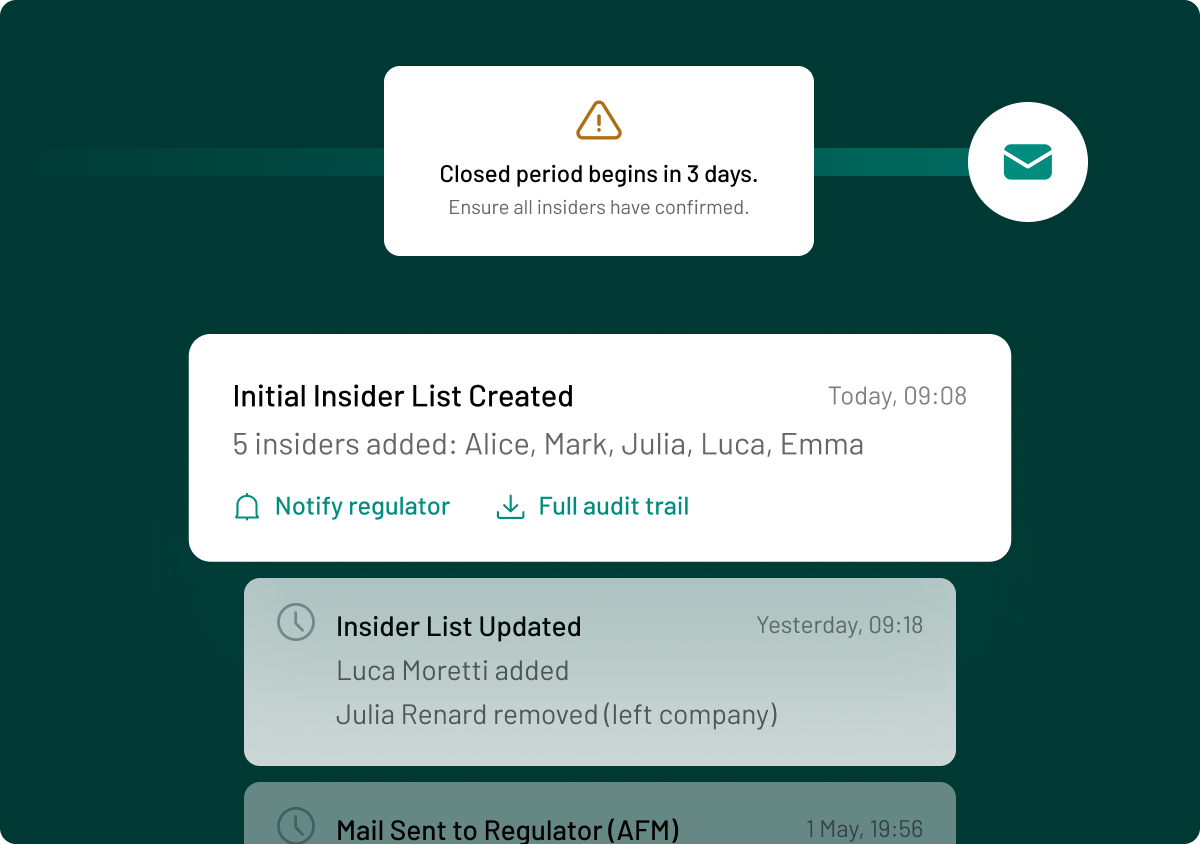
Maintain a record of every disclosure, update and approval, including when changes were made and by whom. A robust audit trail helps demonstrate adherence to IAS 24 to auditors and regulators, while making it easier to explain how you prepared your related party disclosures if challenged later.
How technology can simplify the process
Many of the practical challenges associated with IAS 24 stem from relying on manual administration processes rather than understanding the technical accounting requirements. Purpose-built digital tools can help organisations:
- Maintain a structured register of individuals and related parties
- Standardise the information collected
- Send scheduled reminders to keep disclosures up to date
- Maintain a full audit trail of changes over time.
InsiderLog features an IAS 24 module that allows you to create a consistent and comprehensive data collection process that administrators can update or complete to ensure you have all the information you need for your disclosures
The platform automates notifications and provides email templates that take the manual work out of chasing the latest information. It also stores the data securely and provides a recorded audit trail of activity so you can show regulators you have met your obligations. Book a free consultation with an IAS 24 expert to find out how you can speed up the process and reduce errors.
FAQ
Is IAS 24 audited separately?
No. IAS 24 forms part of the audit of an organisation’s financial statements. Auditors assess whether related party relationships and transactions have been identified and disclosed appropriately.
What happens if related party disclosures are incomplete?
Incomplete disclosures can lead to negative audit findings, regulatory questions, requests for additional evidence or financial restatements, which can be damaging for a company’s reputation.
Who should own IAS 24 governance?
Responsibility is usually shared between teams such as finance, compliance, legal and the company secretariat. Clear ownership of the overall process and coordination between teams are essential.
How often should related party information be reviewed?
Many organisations refresh information annually, but good practice is to review it whenever appointments, ownership structures or personal circumstances change. Reviewing more often can reduce the burden of work towards the publication of financial statements.
Why do organisations struggle with IAS 24?
The standard itself is relatively clear. Most challenges arise from identifying all related parties, keeping their information current and coordinating updates across multiple departments.
Conclusion
As organisations grow and become more complex, it is more difficult to identify and keep track of all related parties. Manual processes and generic tools like spreadsheets are no longer fit for purpose when it comes to meeting your IAS 24 obligations. Centralise your information and use a dedicated digital platform, such as InsiderLog, to structure your process and reduce the administrative effort, whilst speeding up the process and reducing errors. Book in a conversation with an expert today to find out how to put in place an effective related party disclosure process.
7. References and further reading
Related Articles
See all postsIs Your IAS 24 Related Party Register a Compliance Risk?
03-07-26
2026 changes to the Market Abuse Regulation: What issuers need to know
19-06-26
How to Look Up a Company's LEI in the GLEIF Database
15-04-26
What Is the Global Legal Entity Identifier (LEI) System?
15-04-26
How the Global LEI System Works: A Complete Guide
15-04-26