









.png)






.svg)
.svg)
.svg)







.png)
.png)







.jpg)

%20F%20(1).jpeg)







.webp)






 Login
Login
The seven related party categories
In practice, most related parties that you need to identify in your organisation fall into the following categories, derived from the IAS definitions:
The use of spreadsheets to carry out important corporate functions is prevalent across the business world, but carries significant risks. This led to the formation of the European Spreadsheet Productivity & Risks Interest Group (EuSPRIG), which states that “an alarming proportion of corporate spreadsheet models are not tested or controlled to the extent necessary to meet [companies’] obligations.”It is understandable that companies often look to office tools like spreadsheets when designing processes. They are already accessible and the majority of users already have experience with them. However, whilst spreadsheets are suitable for making quick calculations, they do not possess the capabilities to maintain strong audit trails needed for workflows such as maintaining an accurate IAS 24 related party register.
This article explores the different processes issuers currently have in place to help them disclose related party relationships under the accounting standard IAS 24. It explains why these workflows may pose a risk, what auditors look for and how to build a structured register that is robust under scrutiny.
Key takeaways
-
IAS 24 compliance depends on more than accurate disclosures. You also need a robust process for identifying related parties and demonstrating how information was collected and verified.
- Manual tools become a risk as organisations grow. Spreadsheets, emails and annual declaration exercises can make it difficult to keep related party registers complete and consistent.
- Auditors expect evidence, not assumptions. A defensible register should provide traceability, regular updates, clear approvals and a complete audit trail from identification through to financial statement disclosure.
- Weak register management can lead to audit findings. Missing declarations, outdated information and fragmented ownership increase the risk of incomplete disclosures and additional regulatory scrutiny.
- A structured register strengthens governance and reduces administrative effort. Centralised data, automated workflows and standardised processes help improve data quality while making IAS 24 compliance easier to manage throughout the year.
How most listed companies manage this today
Many issuers have developed IAS 24 related party disclosure processes over time using tools that are familiar and readily available. While these approaches can work for smaller organisations, it becomes increasingly difficult to create and maintain a complete and up-to-date register as the business grows and the nature of its relationships becomes more complex.
Here are some common approaches to IAS 24 register management and why they are not necessarily fit for purpose:
| Common approach | Why companies use it | Where it falls short |
|---|---|---|
| Spreadsheets | Easy to create, low cost and familiar to everyone. | Multiple versions can be in circulation at the same time, making it difficult to generate a definitive register. Manual updates and a lack of built-in validation or audit trail functionality increase the risk of errors. |
| Email questionnaires | Simple way to collect declarations from directors and key management personnel. | Difficult to track responses and prove who received or completed them. |
| Manual chasing | Keeps the process flexible and allows personal follow-up. | Time-consuming, inconsistent and heavily dependent on individual administrators remembering whom to contact. |
| Shared document folders like Google Drive | Provides a central place to store forms and supporting documents. | Not built specifically to accept and store IAS 24 register information in a structured and secure manner. Documents can become outdated, duplicated or difficult to search, with little visibility of the latest version. |
| Annual declaration exercise |
Aligns with the financial reporting timetable and reduces the number of requests sent to employees. | Relationships can change throughout the year, leaving registers out of date until the next reporting cycle. |
| Separate records held by different departments |
Allows finance, legal and the company secretary teams to manage their own information, using their existing relationship with the related party. |
Creates silos, duplicate records and uncertainty over which version is accurate and complete. |
What auditors actually look for
When auditing your financial reporting, auditors use ISA 550 as a framework to identify risks of material misstatement associated with related party relationships and transactions. It helps them understand how well you have applied the accounting standard IAS 24 to your related party transaction reporting.
This is what they expect to see during their audit of your financial statements:
- Traceability from identification to disclosure.
Auditors should be able to follow each related party from its initial identification through to the final financial statement disclosure, with clear evidence showing how you assessed and reported the relationship.
- Evidence that information is kept up to date.
You should be able to demonstrate that related party information is reviewed and refreshed regularly, particularly after changes to the board of directors, ownership structures or other relevant relationships.
- Complete identification of related parties.
Auditors will assess whether your company has a robust process for identifying all relevant related parties rather than relying only on individual declarations.
Clear approval and sign-off process.There should be evidence of who reviewed, approved and validated related party information before it was used in the financial statements. This is to demonstrate that you have an appropriate governance and accountability framework in place.- A reliable audit trail.
You should be able to show when you created, updated and approved records on your register, together with providing previous versions where necessary. This helps demonstrate the completeness and integrity of the disclosure process, something that can be difficult to prove using spreadsheets and email alone.
The specific failure modes
Without robust controls or a clear IAS 24 reporting process, an audit might conclude that your disclosures do not meet the required standard and could require a financial restatement. This can alert the market to significant errors in your financial reporting, which might be damaging to your reputation and to investor confidence.
| Failure mode |
Why it matters |
|---|---|
| No record of who was asked to declare related parties |
If you cannot show who received a declaration request and when, it becomes difficult to demonstrate that your process was complete. Missing declarations may only come to light during the audit. |
| No version history |
Related party information changes over time. Without previous versions, you cannot explain what changed, when it changed or why a disclosure differed from an earlier record. |
| No validation of information |
Information submitted by directors or executives may be incomplete, inconsistent or entered in different formats. Without validation, these errors can be transposed directly into your financial reporting. |
| Out-of-date information |
Directors take on new appointments, ownership structures evolve and personal relationships change. If records are only updated annually, your register may no longer reflect the reality of the situation by the time you begin reporting. |
| No central oversight |
When every department maintains its own records, there is no single owner responsible for ensuring your disclosures are complete. This increases the risk of duplicate records and conflicting information, as well as missing some related parties entirely. |
What a structured register requires
Your register of related party transactions needs to be accurate and current. It should provide evidence that you have been thorough in highlighting existing relationships that could affect the perception of your financial results. To meet the requirements of IAS 24, a structured register should contain the following.
Centralised data
Store all related party information in one place rather than across multiple spreadsheets, emails and document folders.
A central register gives compliance, finance, legal and the company secretary access to the same information, streamlining your manual processes and workload, as well as making it easier to identify changes before reporting begins.
Structured data collection
Collect declarations using standardised forms with predefined fields. This ensures everyone provides information in a consistent format, improving the quality of your data and making your records easier to review.

Automated collection workflows
Keeping your register accurate requires regular updates, rather than just an annual declaration exercise. With automated notifications and recurring reminders to related parties, you can encourage directors and key management personnel to review and confirm their information throughout the year.
This reduces the risk of your register being out of date. It also prevents you from having to chase relevant parties in the run-up to compiling your disclosures and reporting.
Administrative control
Your team should be able to oversee the entire process rather than relying solely on individuals to complete their own records. Use a solution that allows administrators to create, edit and complete disclosures on behalf of related parties, if requested.
This helps ensure you can keep your register complete even when you get no response or a delayed response from related parties.
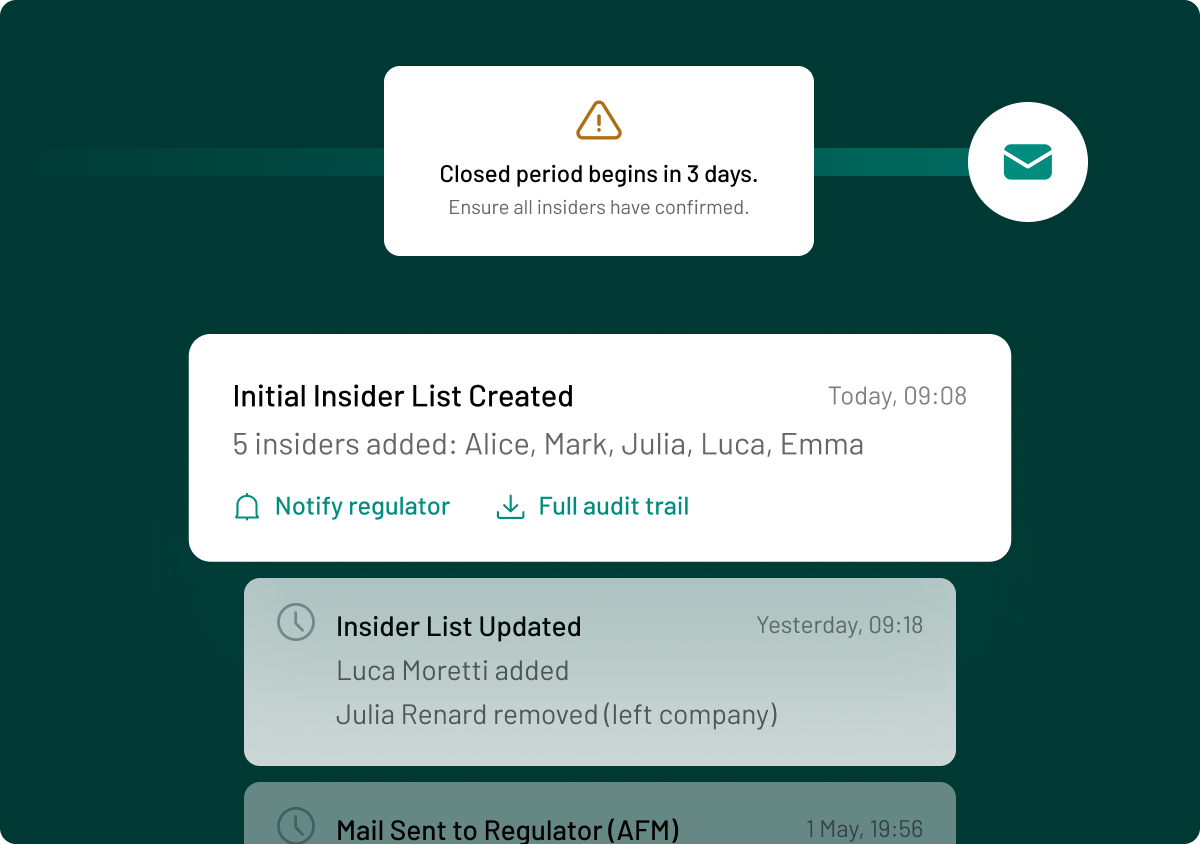
A complete audit trail
Every declaration, update and approval should be recorded automatically.
Maintaining a clear history of who submitted information, when it changed and how your records evolved over time provides valuable evidence during audits. This builds confidence that your IAS 24 disclosures are complete and representative of the current position.
FAQ
How often should a related party register be updated?
A related party register should be updated whenever there is a relevant change, such as a new director appointment, a change in ownership or a new related party relationship. Regular reminders throughout the year help ensure the information remains accurate rather than relying on a single annual update.
Who should be responsible for maintaining the related party register?
While finance, compliance, legal and the company secretary all contribute to IAS 24 compliance, one function should have overall responsibility for maintaining the register and ensuring information is complete, current and ready for financial reporting.
Why isn’t a spreadsheet enough for managing a related party register?
Spreadsheets can record related party information, but they do not easily demonstrate who submitted or approved information, when records were updated or whether everyone has responded. As organisations grow, these gaps make it harder to maintain an accurate register and provide the evidence auditors expect.
Conclusion
Your IAS 24 related party register is key to giving auditors everything they need to ensure you have met your obligations for transparency over related party transactions. Holding this information on a spreadsheet is not necessarily the problem. The issue is being able to present a defensible process aimed at collecting complete and accurate information and protecting its integrity, whilst being able to show how and when it was updated and verified. This is where the spreadsheet falls down on functionality.
InsiderLog gives you confidence in your IAS 24 reporting
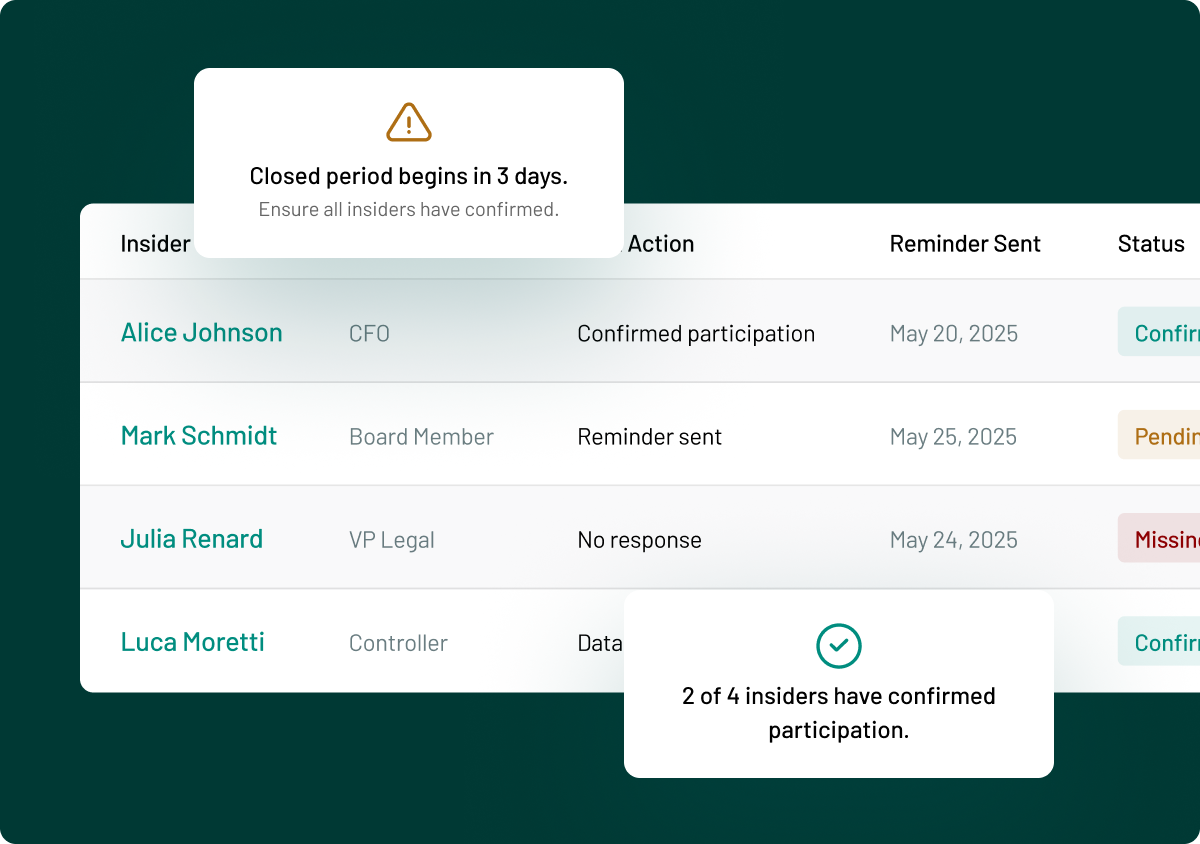
InsiderLog's IAS 24 module is built to make your related party register defensible and easy to maintain. It provides:
-
Standardised data collection. A predefined setup ensures you capture all required information consistently
-
Automated reminders. Related parties are prompted to review and refresh their data after each reporting cycle.
-
Admin controls. Administrators can create, edit and complete disclosures at the request of related parties to help keep the workflow streamlined.
-
Full audit trail. Every update is recorded, so you are ready for scrutiny when it comes.
Request a free consultation with a compliance specialist to learn more about IAS 24 reporting with InsiderLog.
7. References and further reading