









.png)




.svg)
.svg)
.svg)







.png)
.png)





.jpg)
%20F%20(1).jpeg)







.webp)






 Login
Login
International investors now represent a substantial and growing proportion of the shareholder base of major European listed companies, which makes the question of how to reach them effectively a structural concern for investor relations rather than a secondary one. The Banque de France recorded that 51 per cent of the shares of French listed companies were held by non-resident investors at the end of 2016, a level of cross-border ownership that materially shapes the calculus of every results announcement, capital markets day and AGM. Virtual and hybrid IR events have become the principal mechanism by which issuers reach this geographically distributed shareholder base at scale, and the discipline involved in running them well is increasingly a differentiator in the eyes of the international investor community.
The shift is no longer experimental. Euronext Corporate Solutions research established that 85 per cent of companies recorded their investor days for online viewing. In Italy and the Netherlands the figure reached 100 per cent. The implication is straightforward. On-demand viewing and broad remote access are now expected rather than exceptional. The issuers that fail to provide them place themselves at a structural disadvantage relative to peers who do.
Why international investors require a different approach
The factors that bear on international participation are not the same as those that govern domestic attendance, and conflating them produces an event that serves neither audience well. Cross-border shareholders typically face time-zone constraints that exclude live attendance during European working hours. They also incur disproportionate friction from any expectation of physical travel. They place a higher premium on translation and accessibility provision. And they are particularly attentive to the equity story consistency that emerges across multiple touchpoints, rather than from a single live moment. Each of these considerations shapes how a virtual or hybrid IR event should be designed.
The substantive consequence is that the international shareholder base is best served not by a single live event but by a sequence of accessible interactions: a live broadcast for those who can attend, a high-fidelity on-demand recording for those who cannot, supporting written material distributed alongside, and follow-up outreach calibrated to time-zone reality. Issuers who treat a virtual IR event as merely a tech swap for a physical room tend to underperform. The better approach is to treat it as a multi-format communication discipline in its own right.
The format choice: virtual or hybrid
The first practical decision is the format itself. A fully virtual event removes venue, travel and accommodation costs and makes attendance simple for shareholders anywhere in the world, which suits thought-leadership content, strategy updates and certain results presentations particularly well. A hybrid event combines an in-person element for shareholders and analysts who value the proximity, with a high-quality remote stream that delivers an equivalent experience to those joining from elsewhere. For AGMs in particular, where institutional shareholders frequently expect and value a physical option, a hybrid approach is generally preferable to a fully virtual one.
The platform decision follows from the format decision. A general-purpose conferencing tool will technically support either, but the production quality, the interactive depth, the security profile and the reliability under load that high-stakes IR events demand are unlikely to be present in a tool designed for internal collaboration. A purpose-built webcasting platform such as EngageStream addresses these requirements directly. It draws on a network of broadcast-standard studios across Europe and holds ISO 27001 certification. Its peer-to-peer streaming technology cuts the bandwidth needed for remote attendees, supporting the stable delivery that international participants rely on.
Engagement features that translate across borders
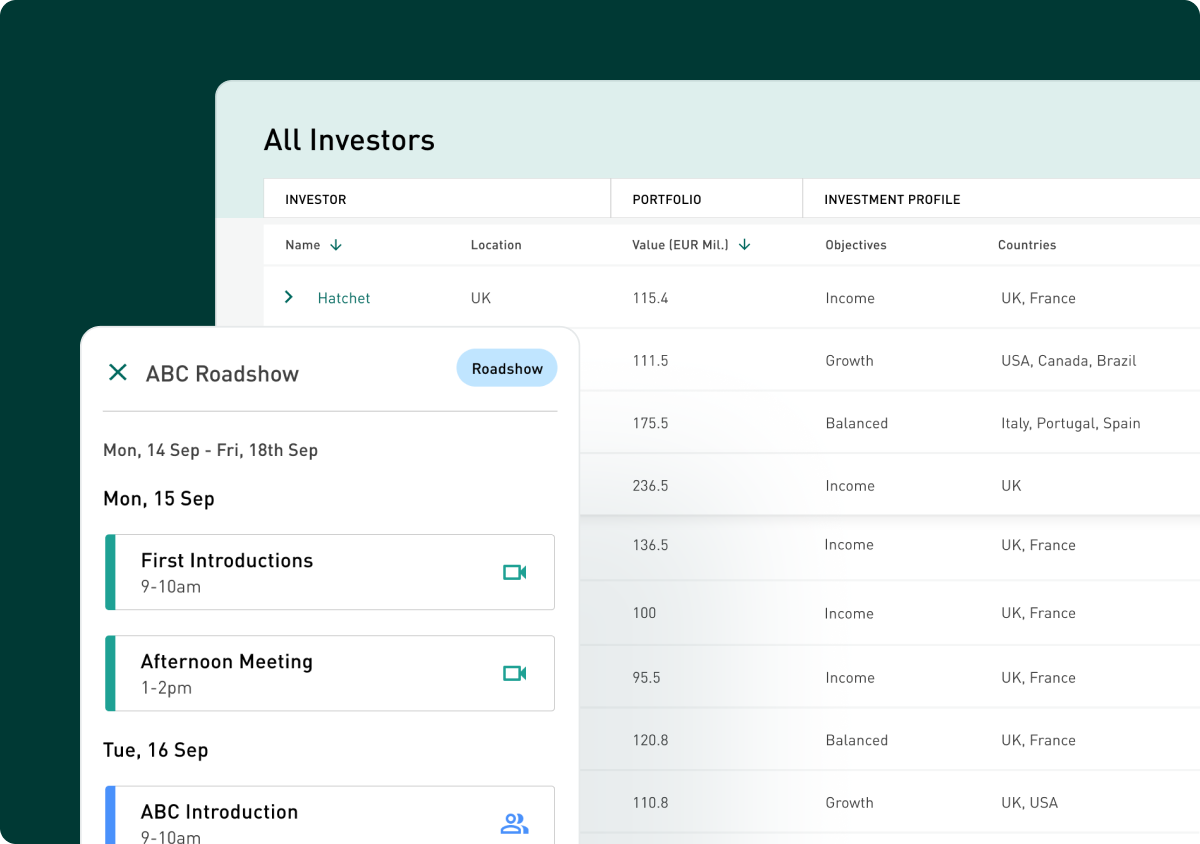
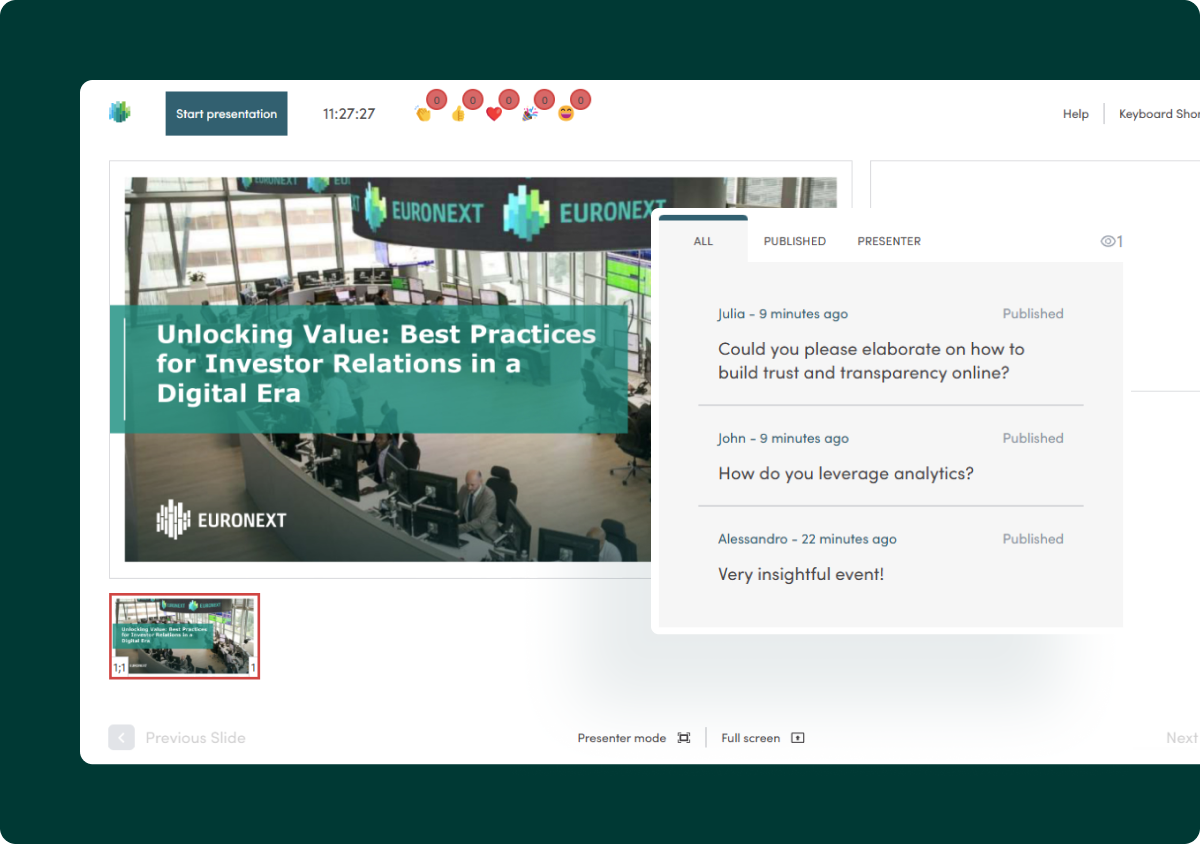
The interactive features that distinguish a professional webcast from a passive broadcast carry particular weight when the audience is international. Live polling allows the issuer to gauge sentiment in real time across the entire shareholder base, surfacing reactions from investors in multiple jurisdictions that a domestic event would never capture. Moderated question-and-answer accommodates the inherent reticence of remote participants while ensuring the substance of their questions reaches the executive team. Chat-based interaction permits a parallel conversation an in-person room could not sustain. Breakout rooms enable focused discussions with specific investor segments without the venue overhead an equivalent in-person arrangement would impose. Simultaneous translation, where required, removes one of the more material accessibility barriers to genuine cross-border engagement.
These features are not cosmetic. Each of them addresses a specific obstacle that an international audience encounters in a traditional event, and each contributes to the perception of an issuer that takes its broader shareholder base seriously rather than serving it as an afterthought.
On-demand reuse as the second event
The on-demand recording continues to work long after the live broadcast concludes. The Euronext figures above quantify how widely the practice is now adopted, but the substantive reason is that a single IR event reaches a meaningfully wider audience when made permanently available than when restricted to its live window. Time-zone-displaced shareholders view it at their convenience; sell-side analysts revisit specific sections when revising their models; potential new investors review the strategic narrative before initiating a position. A professional recording made searchable by agenda item, speaker and slide is materially more useful in this regard than an audio-only archive, because it allows viewers to locate the substantive passages they need without searching linearly.
A few practical points apply. The on-demand version should be published promptly after the live event. Supporting material — the slide deck, supplemental documents and, where appropriate, the transcript — should be distributed alongside. Follow-up outreach to international shareholders should reference the recording explicitly, both as a service and as evidence the company is meeting them on their terms.
Measurement and the international dimension
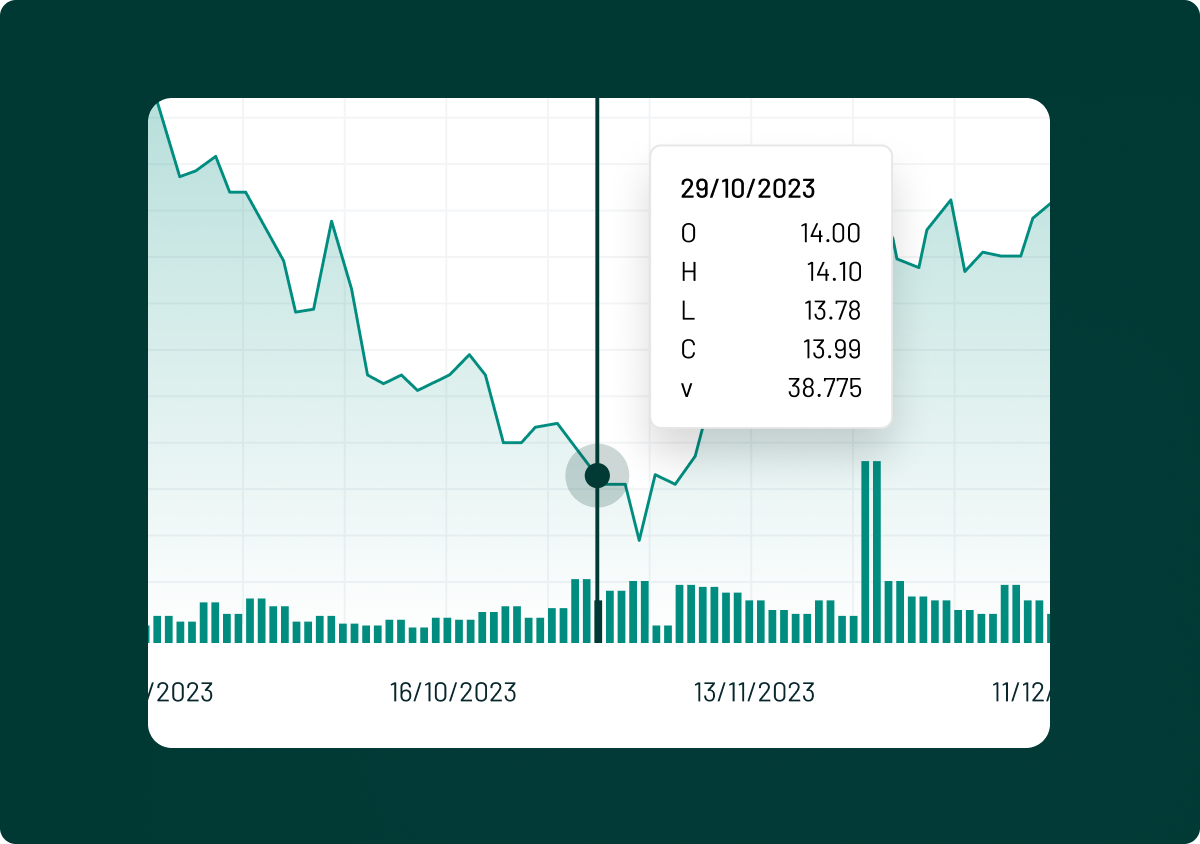
The analytics from a virtual or hybrid IR event are particularly useful for international engagement, because they reveal patterns that physical events conceal. Engagement data by geography indicates which markets are receiving the equity story most effectively; duration of viewing identifies the topics that hold international attention and those that do not; questions submitted by region surface the specific concerns of particular shareholder segments. Used in the planning of subsequent events, this data enables targeted refinement that is impossible to achieve from a physical event whose attendance simply records who was present rather than how they engaged.
The effect on the international shareholder relationship mirrors the broader market effect. Better-prepared, more open and more consistent communication reduces the implicit cost of holding the stock. It also supports the breadth of institutional participation on which a strong free float ultimately depends.
Key takeaways
-
International ownership is structurally significant: the Banque de France recorded 51% non-resident ownership of French listed company shares at end-2016.
-
Cross-border shareholders face different constraints than domestic ones — time zones, travel friction, translation, multi-touchpoint consistency.
-
The format choice (fully virtual vs hybrid) follows from the event type; AGMs typically suit hybrid, strategy updates often suit fully virtual.
-
On-demand recordings function as a ’second event’: 85% of companies make them available (100% in IT and NL).
- Engagement analytics by geography reveal which markets receive the equity story most effectively — invisible at physical events.
FAQs
Why do international investors need a different approach?
Cross-border shareholders face time-zone constraints, higher travel friction and translation requirements that domestic attendees do not. They also place a higher premium on equity story consistency across multiple touchpoints.
Should we run a fully virtual or hybrid IR event?
It depends on the event type. Strategy updates and certain results presentations suit a fully virtual format. AGMs and capital markets days, where institutional shareholders often value the proximity, generally suit a hybrid approach.
What platform features matter most for international IR events?
Broadcast-grade reliability under load, security (ISO 27001), interactive features that translate across borders (polling, moderated Q&A, chat, breakout rooms), simultaneous translation, and bandwidth-efficient streaming to support remote viewers.
How do we measure international IR engagement?
Use engagement data by geography to see which markets are receiving the equity story most effectively, track viewing duration by region, and analyse the substance of questions submitted from each jurisdiction.
References and further reading
- IR Events
- Investor Relations
How IR webcasting drives market performance- How to use data to engage investors in earnings calls
- What shareholders want from an investor day
- IR webcasting best practices
- The benefits of webcasting your AGM
- IR Communication guide
- The ultimate guide to hybrid event planning
- EngageStream webcasting platform
- Engaging webinars & webcasts
Related Articles
See all postsCorporate Communications in 2026: A Strategic Guide for Listed Companies
08-07-26
What Shareholders Want from an Investor Day
26-06-26
Webinar Statistics 2026: Key B2B Benchmarks
25-06-26
How to Repurpose Webinar Content and Measure Success
25-06-26
How to Use Data to Engage Investors in Earnings Calls
17-06-26