














































 Login
A good board of directors is judged by its collective intelligence, not by the sum of its members' expertise: that is the conviction of Maïlys Ferrère, former head of the Bpifrance Large Venture fund. In the first episode of Hors Séance, the interview series from Euronext Corporate Solutions, she explains why the ego belongs to the chief executive, why what matters most is often left unsaid, and why an IPO has to be prepared 18 to 24 months ahead.
Interview in French. The quotes in this article are translated.
- For Maïlys Ferrère, a board's quality lies in its collective intelligence, carried by members with governance experience and the will to think together, rather than in a collection of specialists.
- The boardroom is the place for the chief executive's ego; directors are there to bring out the best decision for the company.
- The hardest part of a director's job is to understand what is neither written nor said, beyond the documents presented.
- A director who represents an investor decides in the company's interest, while keeping two funding rounds ahead in mind.
- IPO governance is prepared 18 to 24 months before the listing: predictable results, internal control, formal decision-making and more independent directors.
- Outside technology companies, artificial intelligence still has little presence on boards, although the subject is critical and tied to cybersecurity.
Who is Maïlys Ferrère?
Maïlys Ferrère knows boards from both sides of the table: first from capital markets, then as an investor. She sums up her career in two stages.
- Some twenty years in capital markets. Working for several banks, she advised company leaders on capital increases, IPOs and other financial transactions until 2009.
- Equity investor from 2009. She joined the Fonds stratégique d'investissement, which later became Bpifrance.
- Bpifrance and the Large Venture fund. At Bpifrance she set up, in her words, a fund with €2.5 billion under management. She is the former head of the Large Venture fund.
This dual perspective, that of the banker preparing a listing and that of the investor sitting on the board, runs through every answer.
What sets governance apart in high-growth companies
High-growth companies have a governance of their own, Maïlys Ferrère explains, because they are usually backed by investment funds. Three features follow.
- A board made up of fund representatives. The board of directors brings together the investors who have financed, and still finance, the company.
- Few independent directors. There are some at times, but it is relatively rare: the collective intelligence can be similar to that of any other board, but the dynamics differ.
- An indispensable pace of acceleration. It is exciting and carries everyone along, and at the same time it can create certain risks.
The board therefore has to support the momentum without losing sight of the risks.
Collective intelligence over a collection of specialists
Asked what makes a board work well, Maïlys Ferrère cites neither technical expertise nor a composition rule. She contrasts two models: a collection of specialists, each in their own field and struggling to pass on what they know, and a group that reasons together. What makes the difference, in her view:
- Governance experience and common sense. Members who have already been through this kind of situation on a board, and who approach it with common sense.
- The will to drive collective intelligence. Bringing out shared thinking rather than defending one's own specialism.
- A balance between experience and new blood. Directors seasoned in governance alongside people for whom it is sometimes their first board.
That balance starts with recruitment and later shows in the board's culture. Maïlys Ferrère draws a rule of conduct from it for every director.
"A board cannot be the sum of individual personalities. The board is the place for ego, essentially the chief executive's, and it should not be the place for the ego of directors, who are there instead to try to bring out the best decision for the company."
Making the board an actor in strategy
Board members usually react to a strategy developed by the chief executive. The debate that struck Maïlys Ferrère most reversed that pattern: a chief executive challenged the board on the medium-term strategic vision, in three steps.
- Questions sent in advance. The chief executive sent the board about ten precise questions on medium-term strategy.
- Time to prepare. Directors could work on their answers before the meeting.
- A position asked of each member. Members had to take a stand and answer precisely, instead of commenting on a strategy that was already written.
The result, in her words: a "particularly rich" debate, because members took ownership of the subject and became actors in the thinking, which is rarely the case. To organise this kind of meeting, our guide to board meetings covers how to prepare the agenda and the board pack.
Reading what is neither written nor said
For Maïlys Ferrère, the hardest part of a director's job lies not in the documents but in what they leave out.
"The most important thing, and it is one of the great difficulties for a board member, is to sense and understand what is not written and what is not said."
It means developing enough "sensors" to grasp a situation beyond what the documents present. She insists there is no recipe and no template: every company has its own dynamics and DNA, and every board its own circumstances. In practice, several sensors help a director look beyond the board pack:
- Conversations outside meetings. Exchanges with the chair, committee chairs and management between meetings shed light on what the board pack does not say.
- Comparison over time. An indicator that changes presentation, or disappears from one board pack to the next, deserves a question.
- The gap between written and spoken. A tension between what is written and what is said in the meeting often points to the real issue.
This ties into the wider question of information asymmetry on the board.
Investor director, independent director: two perspectives
In a fund-backed company, the director who represents an investor pays particular attention to financing, a key issue for the company's future as well as for the investor. Maïlys Ferrère draws a twofold requirement from this, which sets that director apart from an independent director.
| Director representing an investor | Independent director | |
|---|---|---|
| What they must do on the board | Set aside their fund's own interest as far as possible and decide in the company's interest | Decide in the company's interest, without representing any particular shareholder |
| What they bring | Constant attention to funding capacity, with "two funding rounds ahead" in mind | A view that sometimes differs from that of directors who represent a shareholder |
In her view, this medium-term thinking on financing, essential in a very high-growth company, is something an independent director does not necessarily have in the same way.
IPO: prepare governance 18 to 24 months ahead
An IPO requires a degree of structuring very different from the maturity of a young company. Maïlys Ferrère places the start of this work 18 to 24 months before the listing, across four workstreams.
- Broadly predictable results. The company structures itself so that its results become predictable.
- An internal control system. It defines the company's risks very precisely and makes it possible to manage them.
- More formal decision-making. The formalism of board decisions increases.
- More independent directors. Their number grows, bringing a view that sometimes differs from that of directors who represent a shareholder.
For companies that refer to it, France's Afep-Medef Code recommends that independent directors make up half of the board in widely held companies and at least a third in controlled companies. It is a comply-or-explain recommendation, not a legal requirement. The Middlenext Code, used by many small and mid-caps, covers independent members in its recommendation R3.
For the listing itself, see our page on preparing for an IPO.
AI and cybersecurity: the skills boards lack
Asked which skills are still rare on boards, Maïlys Ferrère sets aside technology companies, where she has often sat. Elsewhere, she observes, artificial intelligence still has little presence on boards, although the subject is critical and inseparable from cybersecurity.
France's financial markets regulator is looking at the same subject: in June 2026 the AMF announced (in French) that its 2026 corporate governance report will include a thematic study on how boards take account of risks linked to AI, cybersecurity and geopolitics. The stake, according to the AMF, is that the organisation and skills of governing bodies allow these risks to be fully factored into decisions and strategy.
For a board that wants to act on this, three workstreams stand out.
- Map the skills. Identify who on the board understands AI use cases and cyber risks, with a board skills map.
- Build the topic into the evaluation. Use the board evaluation to examine the board's ability to oversee these risks.
- Train or recruit. The Afep-Medef Code provides for director training; bringing in a new profile is the other lever.
Frequently Asked Questions
Its collective intelligence. Maïlys Ferrère puts it ahead of a juxtaposition of specialists and builds it on members with governance experience, common sense and the will to bring out shared thinking.
Because the board is first and foremost the place for the chief executive's ego. Directors, according to Maïlys Ferrère, are there to bring out the best decision for the company, which means the board cannot be a sum of individual personalities.
They decide in the company's interest, setting aside their fund's own interest as far as possible. They do, however, bring particular attention to financing, keeping two funding rounds ahead in mind.
18 to 24 months before the listing, according to Maïlys Ferrère. That lead time allows the company to build predictable results, internal control that defines and manages risks, formal decision-making processes and the arrival of independent directors.
Outside technology companies, artificial intelligence still has little presence on boards, Maïlys Ferrère observes. It is a critical subject, tied to cybersecurity, on which the AMF has announced a thematic study in its 2026 corporate governance report.
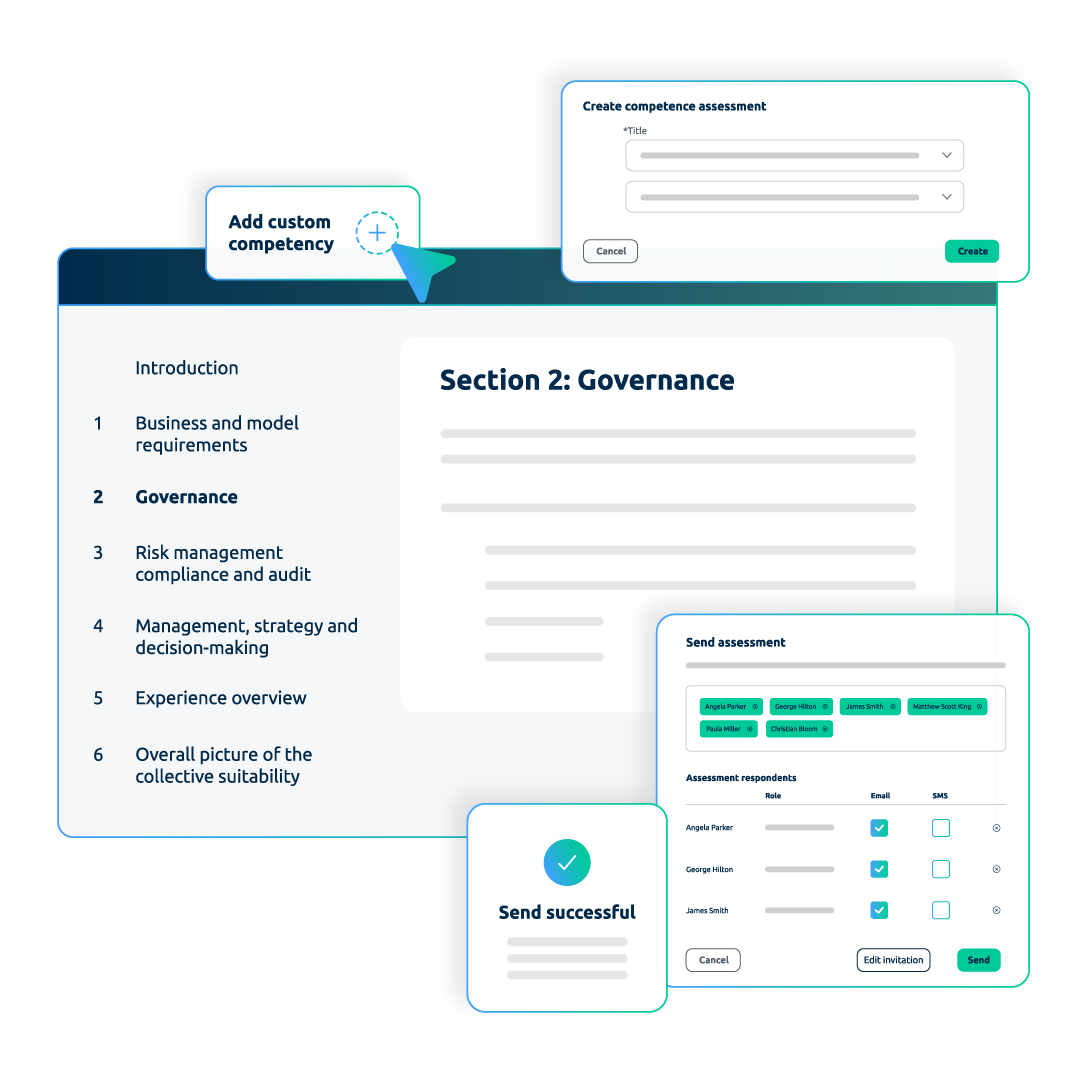
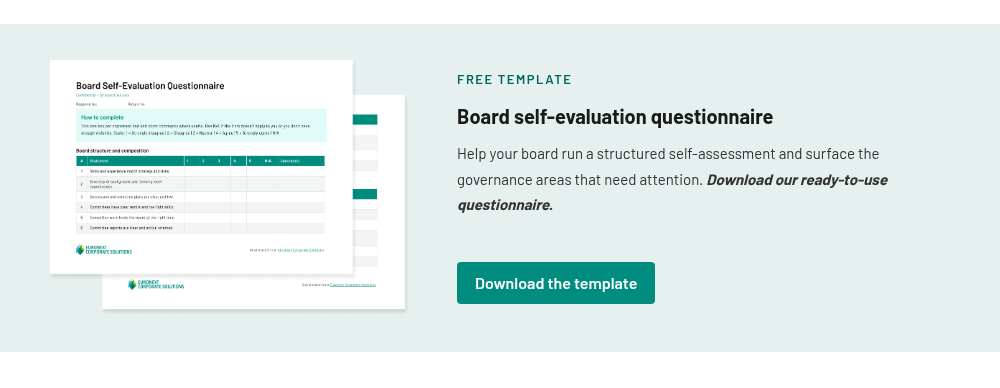
The points Maïlys Ferrère raises (collective dynamics, the balance of profiles, AI and cybersecurity skills) are easier to work on once they are evaluated. Admincontrol Board Evaluation is a structured self-assessment, integrated into Admincontrol Board Portal, that assesses board dynamics, decision-making and oversight, with anonymous responses and automatically generated reports to track progress year on year.
Explore Admincontrol Board Evaluation