









.png)




.svg)
.svg)
.svg)







.png)
.png)






.jpg)
%20F%20(1).jpeg)







.webp)






 Login
Login
A pre-close call is a private briefing between a listed company and the analysts who cover it, held just before the quiet period that precedes interim or annual results. Under the EU Market Abuse Regulation (MAR), a pre-close call may only cover non-inside information, and the European Securities and Markets Authority (ESMA) recommends that issuers announce these calls, publish the materials used and record what is said. On 29 June 2026, the French Autorité des marchés financiers (AMF) reminded listed companies that many still fall short.
- Pre-close calls are legal under MAR, but only non-inside information may be shared. Anything that slips out must be published promptly under Article 17(8) MAR.
- Almain's latest newsletter for listed companies sets out the five good practices drawn from ESMA's May 2024 statement: assess the content, announce the call, publish the materials, record the call and publish the record.
- In the first half of 2026, the AMF found that issuers do not always announce calls in advance, publish what was shared or record the sessions.
- The Dutch AFM measured 13% higher trading volume and 12% higher volatility on pre-close call days, across 104 calls held between 2023 and 2025.
- Running pre-close calls as registered webcasts gives the IR team one link to announce, a recording to keep and a replay to publish.
What is a pre-close call, and why are regulators watching?
Pre-close calls take place just before the quiet period, when the company stops talking to the financial community ahead of its results. That quiet period often overlaps with the 30-day closed period under MAR, which restricts dealings by managers. The stated purpose of the call is legitimate. Companies surveyed by the Dutch Authority for the Financial Markets (AFM) said they use it to stay in contact with the analysts who follow them and to check that recently disclosed information has been properly received.
The difficulty is the format. A pre-close call is typically held one-to-one or with a small group, often with no public announcement and no record of what was said. ESMA published its statement on pre-close calls on 29 May 2024, after it and national regulators observed several episodes of high share price volatility in the EU, some shortly after calls with selected analysts. Its conclusion was direct.
"Pre-close calls carry inherent risks of inadvertent unlawful disclosure of inside information."
Statement on good practices in relation to pre-close calls, 29 May 2024
The data supports the concern. In its Market Watch published in March 2026, the AFM analysed 104 pre-close calls held between 2023 and 2025. On call days, trading volume was on average 13% higher and volatility 12% higher than on comparable days. The AFM is careful to say this does not in itself indicate market abuse, but it shows that pre-close calls are not neutral events.
The definition of inside information can also reach further than it appears. In its Carnegie judgment of 19 March 2026 (Case C-363/24), the Court of Justice of the EU held that information later shown to be wrong can still be inside information, if it was plausible when disclosed and could give its holder an economic advantage. A hint about the quarter, or a confirmation of direction, can be enough.
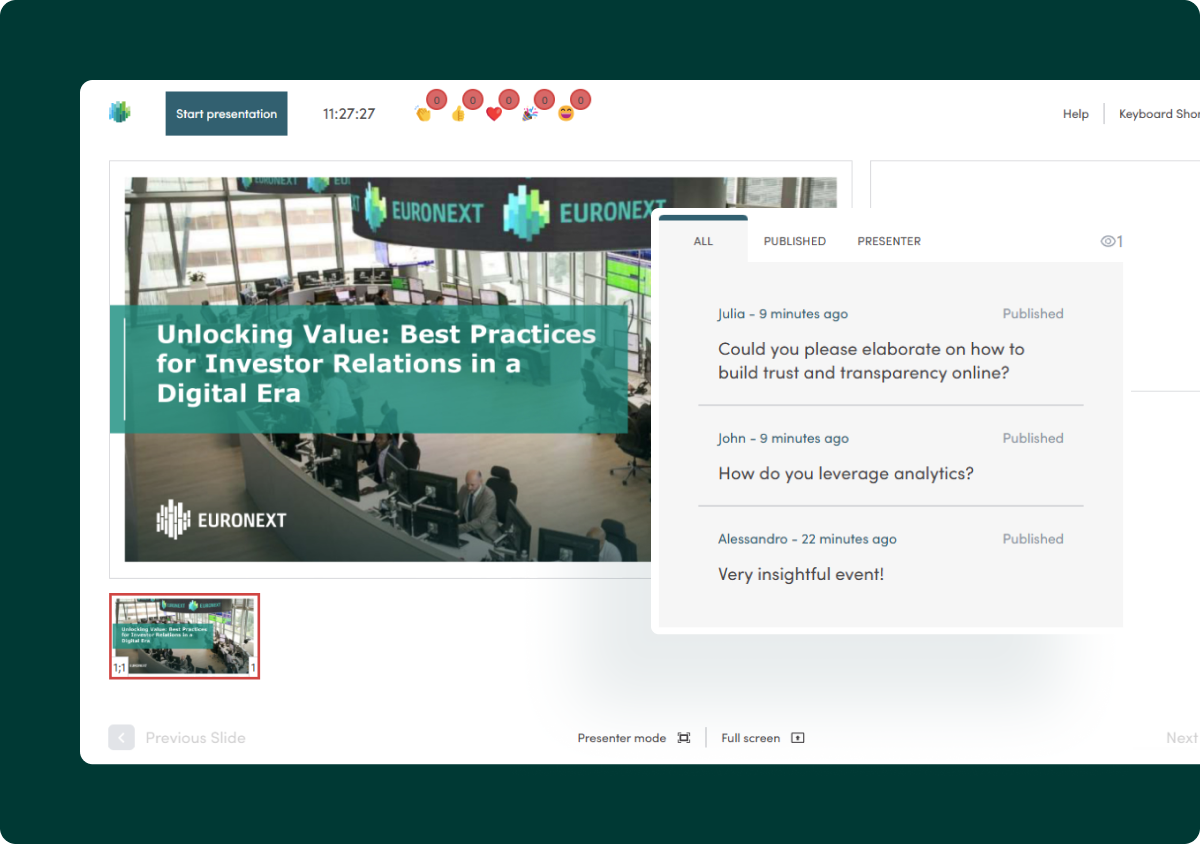
EngageStream turns a private analyst call into a controlled, documented webcast, with the same event link from registration to replay.
✓ Public, invite-only or whitelisted registration
✓ Every session recorded, with AI-generated transcripts
✓ Retention and attendee-data anonymisation set by you
See EngageStream for results and analyst callsESMA's five good practices, and what the AMF found in 2026
The Paris law firm Almain sets out the five good practices in La Veille Juridique des Sociétés Cotées No. 35, its review of regulatory developments for listed companies from January to August 2026. The practices come from ESMA's statement, which compiled them from approaches some European issuers had already adopted and reminds issuers that a pre-close call may only include non-inside information. The AMF restated them for French listed companies on 29 June 2026.
| # | Good practice (as set out by Almain) | What it means for the IR team |
|---|---|---|
| 1 | Assess the information beforehand | Review the script, slides and likely questions with legal and compliance, so that nothing shared qualifies as inside information. |
| 2 | Announce the call | Publish the date, place, topics and list of participants in advance, for example on the IR website. |
| 3 | Publish the materials simultaneously | Put presentation slides, notes and any macroeconomic data shared on the website at the same time as the call. |
| 4 | Record the call | Keep a recording that can be handed to the competent authority on request. |
| 5 | Keep and publish the record | Retain the record of what was disclosed and publish it on the website, so every investor has equal access. |
Source: Almain, La Veille Juridique des Sociétés Cotées No. 35 (January to August 2026), based on ESMA's statement of 29 May 2024 and the AMF's publication of 29 June 2026. The right-hand column is guidance from Euronext Corporate Solutions.
Two years on, application remains uneven. The AMF's June 2026 publication reports that, in the first half of the year, issuers did not always inform the market of the call date beforehand, and did not systematically publish or record the information shared. The AMF insists that source materials, including analyst and investor presentations, must go online without delay and at the latest when the meeting starts, under its General Regulation. It also says it observed practices during recent calls that could undermine equal access to information, and that it will examine signs of unlawful disclosure case by case.
The Dutch picture is similar: only 31% of respondents to the AFM's survey publish the call agenda in advance. Almain's newsletter places this warning alongside the 2026 changes to the Market Abuse Regulation introduced by the Listing Act. Stéphanie de Robert Hautequère, partner at Almain, sums up the regulator's position.
"The AMF notes that these good practices are not systematically followed, and says it will continue to monitor issuers closely on this point."
Partner, Almain · La Veille Juridique des Sociétés Cotées No. 35 (translated from French)
Why recording is the practice that protects the issuer
Recording is an ESMA good practice, not an explicit MAR obligation. It still does the most to protect the company, because ESMA links the risk of these calls partly to the absence of records of what was presented. Without a record, a private call with a handful of analysts is difficult to defend if questions arise later.
A recording also speeds up the response if something goes wrong. If inside information is disclosed unintentionally, Article 17(8) MAR requires the issuer to make it public promptly, and, as ESMA points out, anyone who received it is barred from trading on it or passing it on. With a recording, compliance can identify precisely what was said and prepare the regulatory announcement under Article 17 without having to reconstruct the conversation from memory.
The stakes are rising in France. Law No. 2026-534 of 25 June 2026, published in the Journal Officiel on 26 June 2026, allows the AMF Enforcement Committee to ban a person for up to ten years from holding a corporate office in a listed company or trading on their own account. These bans come on top of fines of up to €100 million or ten times the profit gained. ECS has previously covered how market abuse penalties under MAR play out in practice.
A recording is personal data, so it needs its own rules under the GDPR. Tell participants in the invitation and at the start of the call that the session is recorded. Set a retention period, and decide when attendee data is anonymised. The simplest place to capture these rules is your disclosure policy, kept alongside your other governance documents (see our guide to policy management).
A compliant pre-close call in five steps
The five good practices translate into a repeatable quarterly routine.
- Prepare and clear the content. Draft the talking points and slides from published information only, anticipate the questions analysts will ask, and obtain sign-off from legal and compliance.
- Announce the call on your IR website. Add it to the financial calendar with the date, time, format, topics and participants, and include the registration link. Our IR website best practices cover where this information should sit.
- Run it on a controlled channel. Use registered access and moderated Q&A rather than ad hoc phone calls. The choice of tool matters too: France's move away from Zoom and Teams shows why the security and jurisdiction of communications platforms now draw scrutiny.
- Record and transcribe. Capture the full session, including Q&A, and produce a transcript that compliance can search.
- Publish, then archive. Post the slides when the call starts at the latest, publish the replay or transcript afterwards, and retain the master recording in line with your policy.
How EngageStream supports compliant pre-close calls
EngageStream is the webcast and event platform of Euronext Corporate Solutions, trusted by more than 850 organisations to produce over 1,500 live events a year. The same capabilities IR teams use for earnings conference calls map directly onto the five good practices.
- One link from announcement to replay (practices 2 and 5). The same event URL serves registration, the live webcast and the on-demand replay. You announce one link on your IR website, and once the call ends the replay sits behind it.
- Controlled access. Choose public, invite-only or whitelisted registration, configure authentication, and see who registered and attended in the participation reports.
- Slides alongside the call (practice 3). Presentations run synchronised with the webcast, and the same deck can be posted on the IR website when the call starts.
- Recording and transcripts (practice 4). Every event is recorded. AI-generated live captions produce downloadable transcripts, and timed slide and chapter markers make replays easy to navigate.
- Retention on your terms. Organisers decide how long recordings are kept, and attendee data can be anonymised on a timeline they set, which supports your GDPR retention rules.
- Moderated Q&A and secure delivery. Questions arrive through a moderated channel, so the IR team can screen them before answering. The platform operates in line with ISO/IEC 27001 and the GDPR, with encrypted streaming.
The webcast format also keeps the call live, which investors value. IR Magazine research reported by IR Impact in 2022 found that more than seven in ten investors consider it important for prepared remarks on results calls to be delivered live rather than pre-recorded. With EngageStream, the call stays live for participants and becomes a documented, publishable record once it ends. For more on the format, see our IR webcasting best practice cases.
Technology does not replace the first good practice. The assessment of what may be said remains a human, legal judgement. If inside information does need to be published, EuroStockNews handles regulatory announcements in the markets it serves, including Ireland, Norway and Sweden, and InsiderLog supports wider MAR compliance.
Frequently Asked Questions
Yes. MAR does not prohibit pre-close calls, but they may only include non-inside information. ESMA's 2024 statement and the AMF's 2026 publication both encourage issuers to follow five good practices to reduce the risk of unlawful disclosure.
Recording is an ESMA good practice rather than an explicit legal obligation under MAR. The AMF has nonetheless drawn attention to it, and it separately insists, under its General Regulation, that presentations used with analysts and investors are published no later than the start of the meeting.
Under Article 17(8) MAR, the issuer must make the information public: at the same time if the disclosure was intentional, and promptly if it was not. Participants who received it may not trade on it or pass it on until it is public.
MAR also covers issuers whose shares trade on multilateral trading facilities, and Euronext Growth and Euronext Access are both MTFs. The risk of unlawful disclosure during a pre-close call, and the relevance of ESMA's good practices, is the same for these companies.
An earnings call follows the publication of results and is generally open to the market. A pre-close call takes place before the quiet period, usually with analysts only, which is why regulators ask for it to be announced, recorded and published.
ESMA's statement does not set a retention period. Define one in your disclosure policy that allows you to respond to requests from the competent authority while respecting GDPR limits on how long personal data is stored.
ESMA highlighted the good practices in 2024, and in 2026 the AMF called on listed companies to apply them. EngageStream gives IR teams one announced link, a controlled live session, a recording and transcript, and a replay they can publish, with retention and anonymisation set on their own terms.
Explore EngageStream Request a demoRelated Articles
See all postsGEO for Investor Relations: what AI tells investors about your company
06-08-26
10 Ways AI Is Transforming Investor Relations
11-06-26
Organising IR Events that Drive Engagement
09-06-26
Investor Relations Portal & Software: What Listed Companies Need in 2026
09-06-26
IR Communication Best Practices for Listed Companies
09-06-26